
What a Trade Show Invitation Actually Is
Six weeks before doors open, the invitation calendar fires on schedule. A well-designed email goes out to the full contact list: the logo, the dates, the hall, the booth number. On opening day the aisle in front of the booth stays quiet, and the team spends the first morning wondering what went wrong. The email was delivered, styled, and on time. It still did almost nothing.
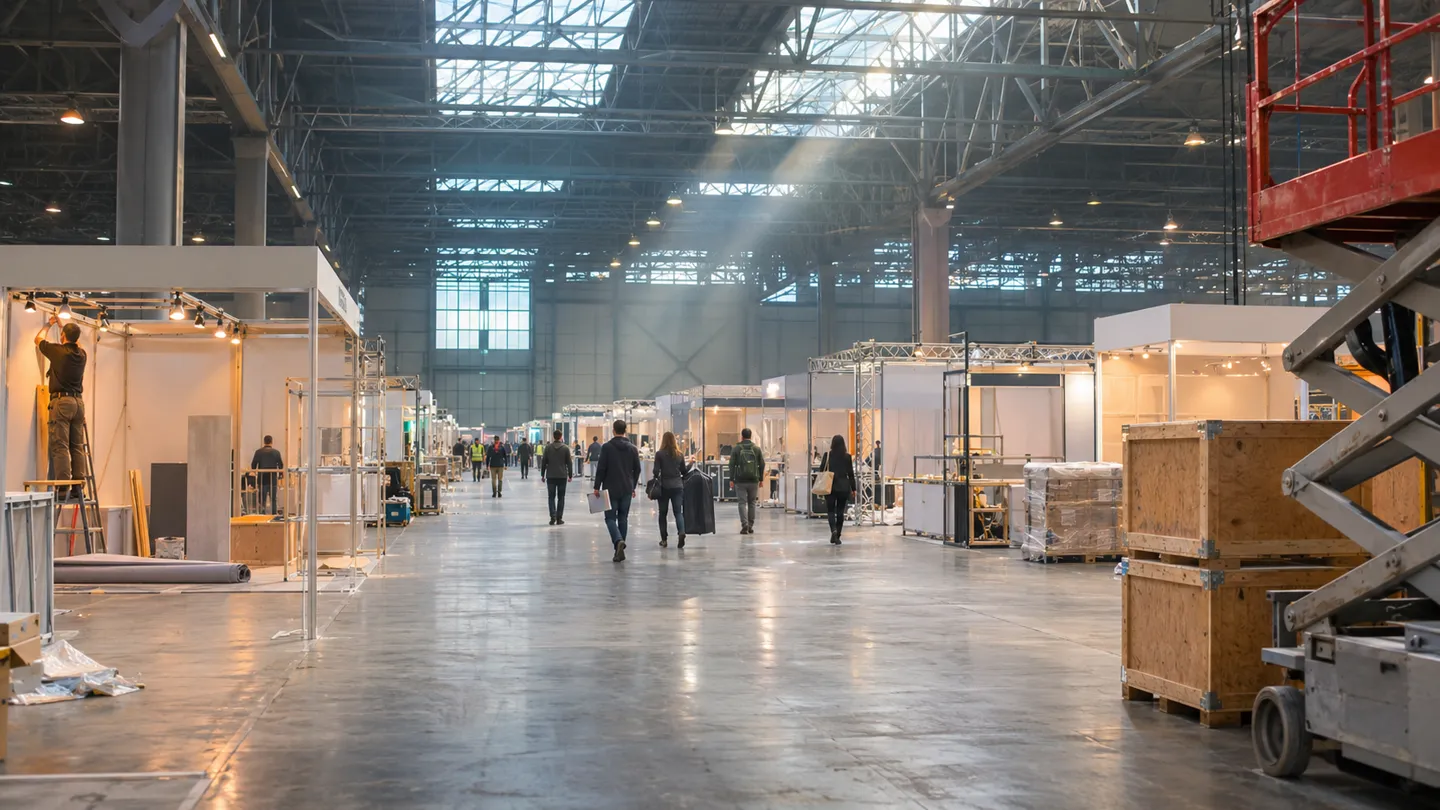
Most trade show invitations fail this way for one reason: they are announcements, not invitations. An announcement transfers information. An invitation trades a specific reason for a specific slice of the recipient’s time, and the recipient’s calendar is the judge. Read that way, the invitation is the first test your booth passes or fails, weeks before anyone lands in the hall.
One clarification before going further, because the same phrase covers three different documents. This article is about the exhibitor-to-attendee invitation: the message your company sends to customers, prospects, and registered attendees to bring them to your booth. It is not the organizer’s invitation to exhibit, which is the prospectus a show sends to recruit exhibitors. It is also not the visa invitation letter some international travelers need for business travel paperwork; for that, contact the show organizer directly. If either of those is what you came for, the rest of this page will still help you brief whoever handles it. The playbook below is written for the first case.
Everything that follows runs along one line: invitations have levels, defined by what they ask of the recipient. You will first see the three levels and why the market’s default template sits on the lowest one. Then you will match level to list, set the sending cadence, diagnose invitations that flopped, and finally run the invitation and the booth as a single budget instead of two separate line items.
The Three Levels of Invitation (and Why Most Stop at Level One)
The market’s default invitation sits at the lowest level, and the market’s default result follows from it. Search any invitation template roundup and the samples are overwhelmingly level one: announcements wearing an invitation’s subject line (Eventbrite, 2023). The level you pick decides the response you get, before wording, subject lines, or design enter the picture.
| Level | What it asks of the recipient | Typical content | What the recipient does |
|---|---|---|---|
| Announcement | Nothing, really | “Visit us at Booth 1234” plus logo and dates | Skims, closes, forgets |
| Appointment | A defined slot of time | Scheduled demo at 11:00, 15-minute meeting, registration code | Checks calendar, accepts or counters |
| Promise | Attention in exchange for a reason | New product first look, live demo series, reserved session | Plans the day around your booth |
Level 1: The Announcement (the market default)
The announcement says you will be present. Subject lines do the heavy lifting, and three patterns cover most of them. The direct notice: “Come see us at [Event] next month.” The question: “Will you be at [Event] on the 15th?” The preview: “View our live demo of [Product] at [Event].” Two sendable sentences: “Hi [Name], we will be exhibiting at [Event] on [dates]. You will find us at Booth [number] in [hall].”
The failure is structural, not cosmetic. The announcement asks the recipient to do all the work: remember the date, find the hall, invent a reason to walk over. Attendees plan shows around scheduled moments, not around booths they might drift past. A level one message gives their calendar nothing to grab, so the open rate is the only metric it reliably moves.
The one case where Level 1 works
A warm list that already knows your company, getting a logistics reminder close to the show date. That is a confirmation, not an acquisition tool. Sent cold with booth-traffic expectations, the disappointment starts.
Level 2: The Appointment (turning the invite into a booking)
The appointment attaches a time and an action. Instead of “stop by,” it books a slot: a ten-minute demo at a posted hour, a fifteen-minute meeting at the booth’s meeting table, a registration link carrying a discount code (Eventbrite, 2023). Two sendable sentences: “Hi [Name], we are running live demos of [Product] every hour at [Event]. Want me to hold a 15-minute slot for you on day one or day two?”
Two mechanics make appointments work. The first is specificity: a scheduled activity is something an attendee can add to a plan, which is exactly what a generic invitation lacks (ExpoFP, 2026). The second is the list: appointments go to people who can plausibly buy, which is why the next section pairs levels with list tiers.

Level 3: The Promise (a reason worth planning around)
The promise commits to something that exists only at your booth: the first public look at a new product, a working demonstration of something attendees have only read about, a reserved session with your specialists. The invitation sells the moment, and the moment has to be real. Sendable sentence: “We are opening [Product] to the public for the first time at [Event]. Day one at 2:00 PM, our team runs the full demo and answers questions; reply and we will reserve you a seat.”
The promise carries the highest upside and the hardest boundary: it is a debt. Promise a product reveal and the product must be there, running, staffed. A promise the booth cannot cash converts your most successful invitation into your most visible failure, which is why the last section of this article refuses to plan invitations separately from booths.
Whatever the level, every invitation carries the same seven pieces of cargo (EthixMerch, 2024). The cargo: who is inviting, what the show is, when it runs, where the venue and your booth number are, why the recipient should come, the registration link, and one clear call to action. Free editable templates from the usual design tools cover the visual layer in an afternoon. The level decision is the part no template makes for you. One rarer format belongs in the map even if most teams will never use it: the physical mailed invitation, a printed card or a small branded object sent to a handful of top accounts. It costs an order of magnitude more per contact and earns attention in proportion, which is why it only ever makes sense for a list you can count on one hand.
Once the level and the list are set, send Aplus Expo your show plan: a free 3D design and an itemized quote come back within 48 hours.
Get the 48-hour booth planMatching Invitation Level to Your List
The level you can afford is set by the list you send to. Warmth, not volume, decides it: the same invitation that delights a top account reads as noise to a cold list. The budget spent on appointments is wasted on people who cannot buy.
Sort the list into three tiers before writing anything. Tier one is customers and past inquiries, people with history and a reason to take a meeting. Tier two is registered attendees who match your target profile, the accounts you would call if you had their number. Tier three is everyone else, including purchased lists and the full show registration dump.
| List tier | Level to send | What success looks like | What to avoid |
|---|---|---|---|
| Customers and past inquiries | 2 or 3: book meetings, promise the reveal | Confirmed slots on the calendar before the show | Treating loyal buyers to a generic announcement |
| Profile-matched attendees | 2: scheduled demos, registration codes | A shortlist of ten to fifty booked conversations | Blasting the whole registration file |
| Cold list | 1 at most, or nothing | A few dozen aware contacts | Spending appointment-making effort on accounts that will never convert |
The matching logic has one more consequence worth stating plainly. The industry’s template culture trains marketers to invert this table: one polished announcement, sent to everyone, judged by opens. The failure reports behind this article’s diagnosis section mostly describe that inversion. Personalization effort flows to the accounts that can act on it; the cold list gets honesty, which at level one means admitting it is only a reminder.
The Working Cadence: Timing, Tracking, and Metrics
Once the level and the list are set, the invitation becomes a schedule. Working backward from opening day gives four anchors, and each anchor carries its own job.
The sending cadence, backward from opening day
T-6 weeks
First invitation goes out at the level your list earned, registration links live with tracking codes.
Every 7-10 days
One follow-up touch, each adding or restating the reason to come, never just resending.
T-2 weeks
The reminder shifts to specifics, demo times, meeting confirmations, the promise restated in one line.
T-3 days and show mornings
Pure logistics, booth number, hall, route, today’s demo schedule; no new reasons introduced this late.
Start the first invitation four to six weeks out and keep follow-ups seven to ten days apart (ProExhibits, 2025). The cadence compresses for small shows and warm lists; a local event with known customers can run on two or three weeks. The one rule inside the final 72 hours is absolute: confirm, never add. A new promise launched three days out reads as chaos, not excitement.
Tracking is what turns the cadence into evidence. Put a tagged registration link or a discount code in every invitation so each registration carries its source. Then read results as a four-stage funnel rather than a single open-rate number. The funnel shows where the chain breaks, and the next section is the repair manual for the two breaks that happen most.
The four-stage funnel
Registrations
attributed to invitations
Meetings booked
on the calendar
Booth arrivals
at the aisle
Follow-up
within 24-48 hours
Stages per ExpoFP, 2026.
When Invitations Fail: Diagnose Before You Blame the Booth
Invitation failure has a pattern, and it is rarely the one teams first suspect. One B2B software team described three years of trade shows returning essentially zero ROI against roughly $18k spent across three shows in a year (r/b2bmarketing on Reddit, 2026). A show-floor veteran went further and argued that a single £40k custom booth was actively destroying ROI rather than building it (r/tradeshows on Reddit, 2026). Both reports describe budgets that grew while the invitation stayed at level one.
Warning: the expensive part is rarely the broken part. When booth traffic disappoints, teams audit the booth: graphics, size, location. The invitation layer is cheaper to fix and fails more often, and it fails in four distinct ways. Diagnose in order, cheapest change first.
Diagnosis rule
Audit the invitation chain before the booth. List and promise are fixable before the next show; timing is fixable the show after; booth delivery is the hardest and last resort.
Nobody came: list and reason failed together
Zero traffic with a clean send usually means a cold list received a level one message. Two checks settle it: how many recipients had buying history or a profile match, and whether the message asked for anything beyond awareness. If both answers are weak, the fix is the level-list table above, not a redesign. Check the funnel stage too: registrations that never converted to meetings point at the invitation; registrations with no meetings that still visited point elsewhere.
The wrong people came: list selection was skipped
Traffic without quality means the list tier was ignored. Giveaway-driven invitations are the classic case: they move people, and the people they move are collecting prizes, not evaluating vendors. The repair is to separate traffic mechanics from meeting mechanics. Tie any raffle entry to badge capture so the prize crowd at least becomes a follow-up list rather than a dead end.
They came but did not stay: the promise outran the booth
This is the boundary case where the invitation worked and the booth did not. The invitation promised a demo, a reveal, a specialist; the visitor arrived into a generic space with a counter and brochures. The visitors you worked hardest to earn leave fastest, and they tell the account the experience did not match the promise. This failure is real and serious, but it is a delivery failure, and delivery is the subject of the final section.
Booked meetings no-showed: the confirmation chain broke
Appointments that evaporate on the day are usually a cadence failure, not a list failure. The booking happened three weeks out and nothing confirmed it since. The repair lives in the cadence: the T-3 day confirmation and the show-morning message exist precisely to defend the calendar you booked. Resending the booking link with a concrete time and the booth route recovers a meaningful share of shaky slots.
| Symptom | Broken layer | Verifiable action | When to change approach |
|---|---|---|---|
| Nobody came | List tier or level mismatch | Count buying-history recipients; check the message for a time-based ask | Fix list and level before the next show |
| Wrong people came | Selection skipped, giveaway traffic | Separate raffle entries from booked meetings in the funnel | Shift prize mechanics to badge-captured follow-up |
| Came but did not stay | Promise outran booth delivery | List each promised element and its physical counterpart in the booth | Downgrade the promise level until delivery matches |
| Bookings no-showed | Confirmation chain | Verify T-3 day and show-morning sends went out with slot and route | Add same-day resend with booking link |
$18K · 3 shows a year · 3 years running · ROI near zero
The first breakpoint was never the booth. It was an invitation stuck at level one.
Read those numbers as an order of operations: the invitation layer is the cheapest place to fail and the cheapest place to fix, which is exactly why it gets audited first.
Running Invitation and Booth as One Budget
The diagnosis above rewrites how the budget should be read. Teams traditionally split money into a booth line and a marketing line, then optimize each alone. The failure reports suggest the split itself is the error: the booth line buys space and structure, while the invitation line manufactures the reason that space gets used. When the second line stays at level one, the first line funds a stage with no audience.
Running them as one budget starts with sequence. Decide the promise first: the product reveal, the demo series, the meeting format that top accounts will accept. That promise is a specification for the booth, not a caption for it. A demo promise requires a working demo area with sightlines from the aisle; a meeting-led promise requires a real table and acoustic separation; a reveal requires a staging moment. Bookings and RSVPs become input targets the booth design must serve. Invitation planning and booth planning belong in the same conversation, in the same week, not in two departments a month apart.
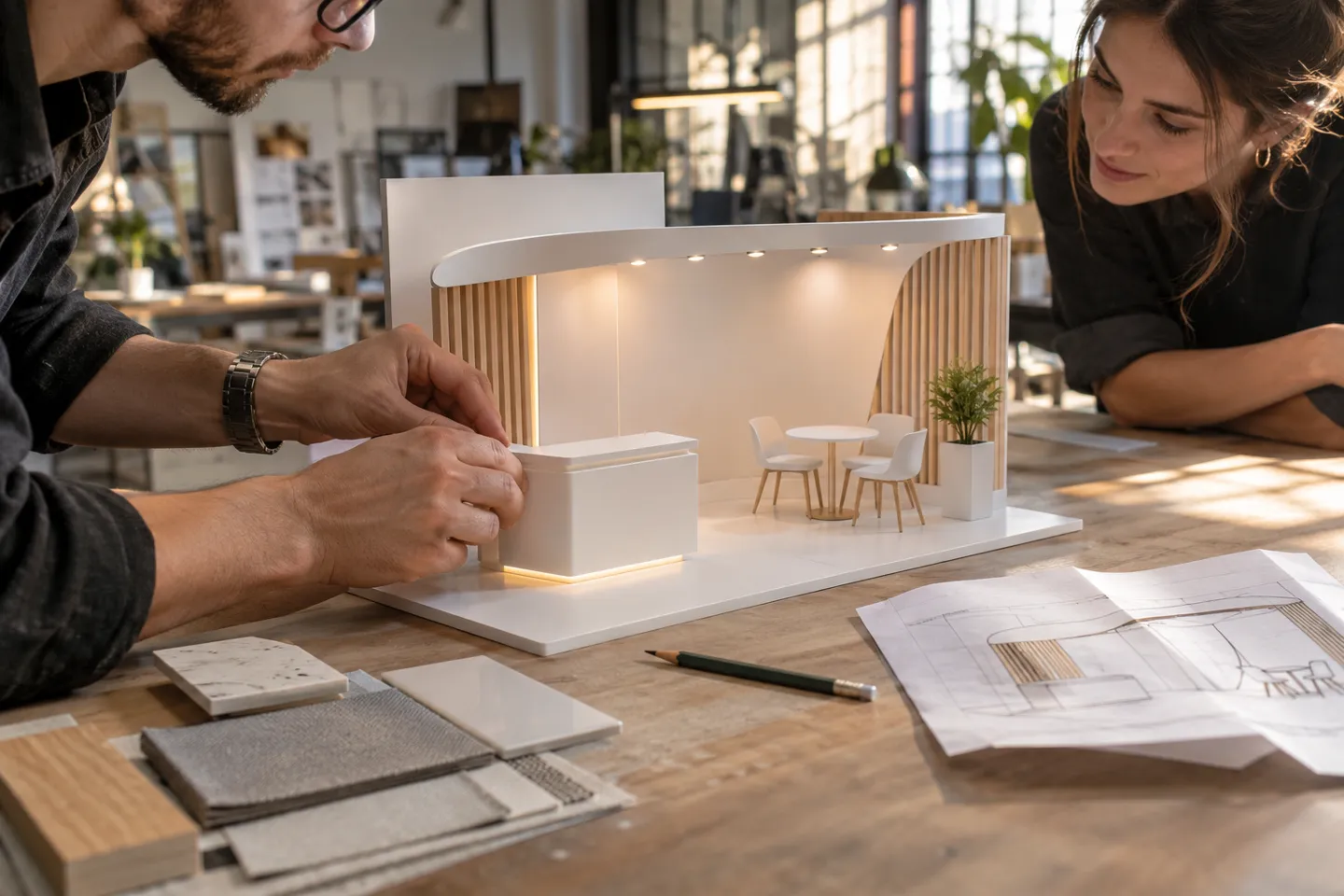
The promise then converts into delivery requirements you can verify before the show: build complete and checked the day before doors open, demo units with a backup on site, a crew that fixes problems in minutes rather than hours. Every conversation that mattered also gets a follow-up within 24 to 48 hours after the show (ExpoFP, 2026). Write these as requirements into the agreement with whoever builds the booth, because a promise without a delivery clause is just a louder disappointment.
Chain check before you commit the budget
Reason: we can name the specific thing worth planning around, and it exists.
List: invitation level matches list tier, appointments only where they can convert.
Cadence: first send at T-6 weeks, follow-ups spaced 7-10 days, confirmation at T-3 days.
Delivery: every promised element has a physical counterpart and a named owner.
Follow-up: every booked conversation leaves with a 24-48 hour contact window.
International exhibitors should start this sequence even earlier: cross-timezone invitations in a second language need more lead time and more concrete promises to close the same calendar. Visa-adjacent logistics only widen the gap between planning and doors.
The chain check above is the whole article in five lines, and it is also a fair vendor test. If the booth partner cannot commit to the delivery line, the promise you invite people with stays at risk no matter how well the invitations are written. That test is one we hold ourselves to as well. Our design team turns a brief into a free 3D design and an itemized quote within 48 hours (see the 3D rendering and concept development service). The promise you invite people with and the booth that has to cash it get drawn by the same hand at Aplus Expo, before the first invitation goes out. If that checklist reads like the way you already work, we should talk before your next show’s deadlines do.
Have a promise the booth has to cash?
Send the brief today and Aplus Expo returns a free 3D design with an itemized quote inside 48 hours.
Start your free 3D designReferences
- Eventbrite. “9 Must-Have Email Templates for Trade Shows.” 2023. https://www.eventbrite.com/blog/trade-show-email-templates-ds00/
- EthixMerch. “Guide: How to Write and Create a Trade Show Invitation.” 2024. https://ethixmerch.com/blog/create-trade-show-invitation/
- ExpoFP. “How to Attract Visitors to Your Trade Show Booth: 21 Ideas.” 2026. https://blog.expofp.com/how-to-attract-visitors-to-your-trade-show-booth-21-ideas/
- r/b2bmarketing. “Trade Show ROI Has Been Basically Zero for Us Three Years Running.” Reddit, 2026. https://www.reddit.com/r/b2bmarketing/comments/1rrx8b9/trade_show_roi_has_been_basically_zero_for_us/
- r/tradeshows. “Why Your £40k Custom Trade Show Booth Is Actually Killing Your ROI.” Reddit, 2026. https://www.reddit.com/r/tradeshows/comments/1st7cg0/why_your_40k_custom_trade_show_booth_is_actually/

 English
 Spanish
 German
 French
 Italian
 Korean
 Chinese