
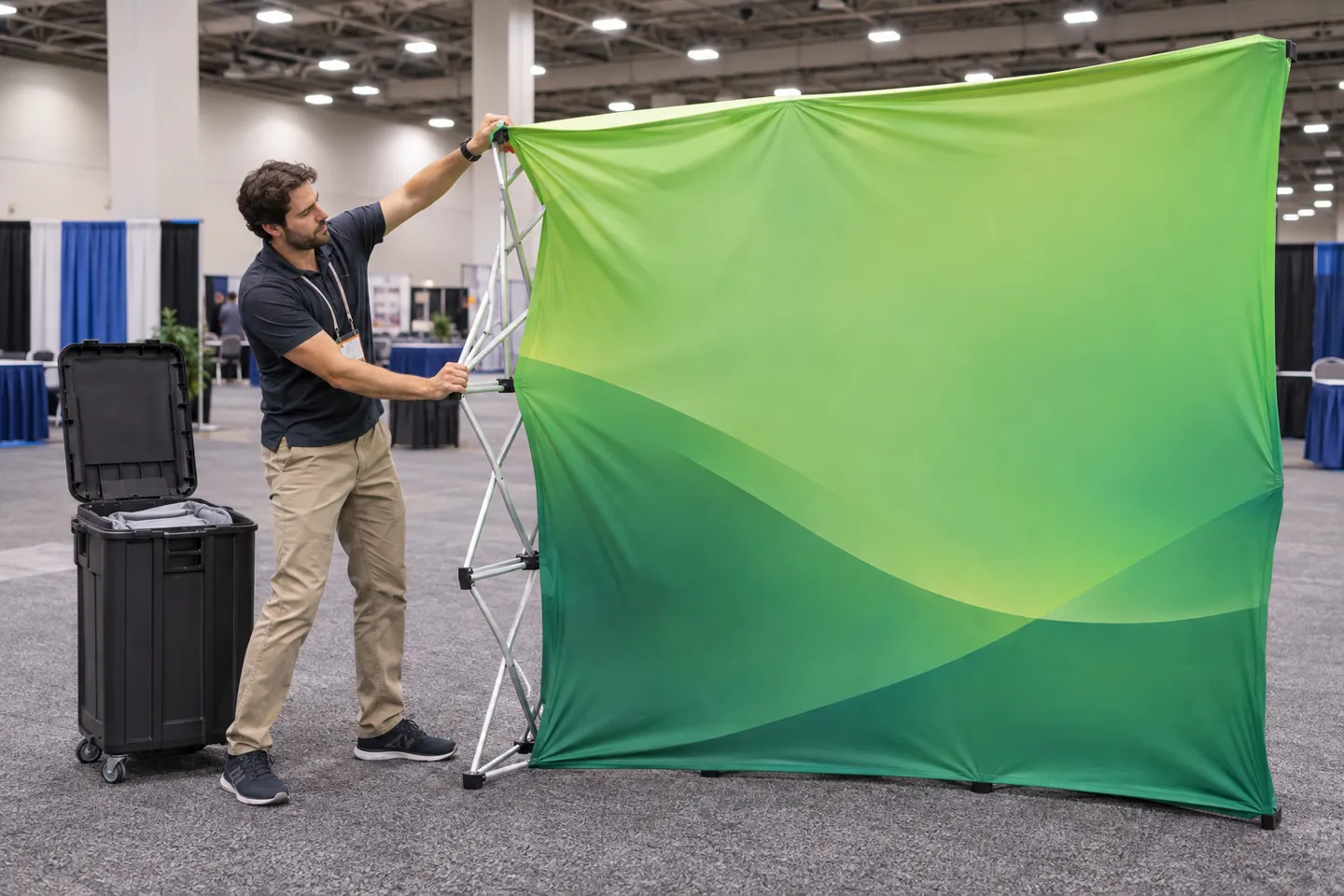
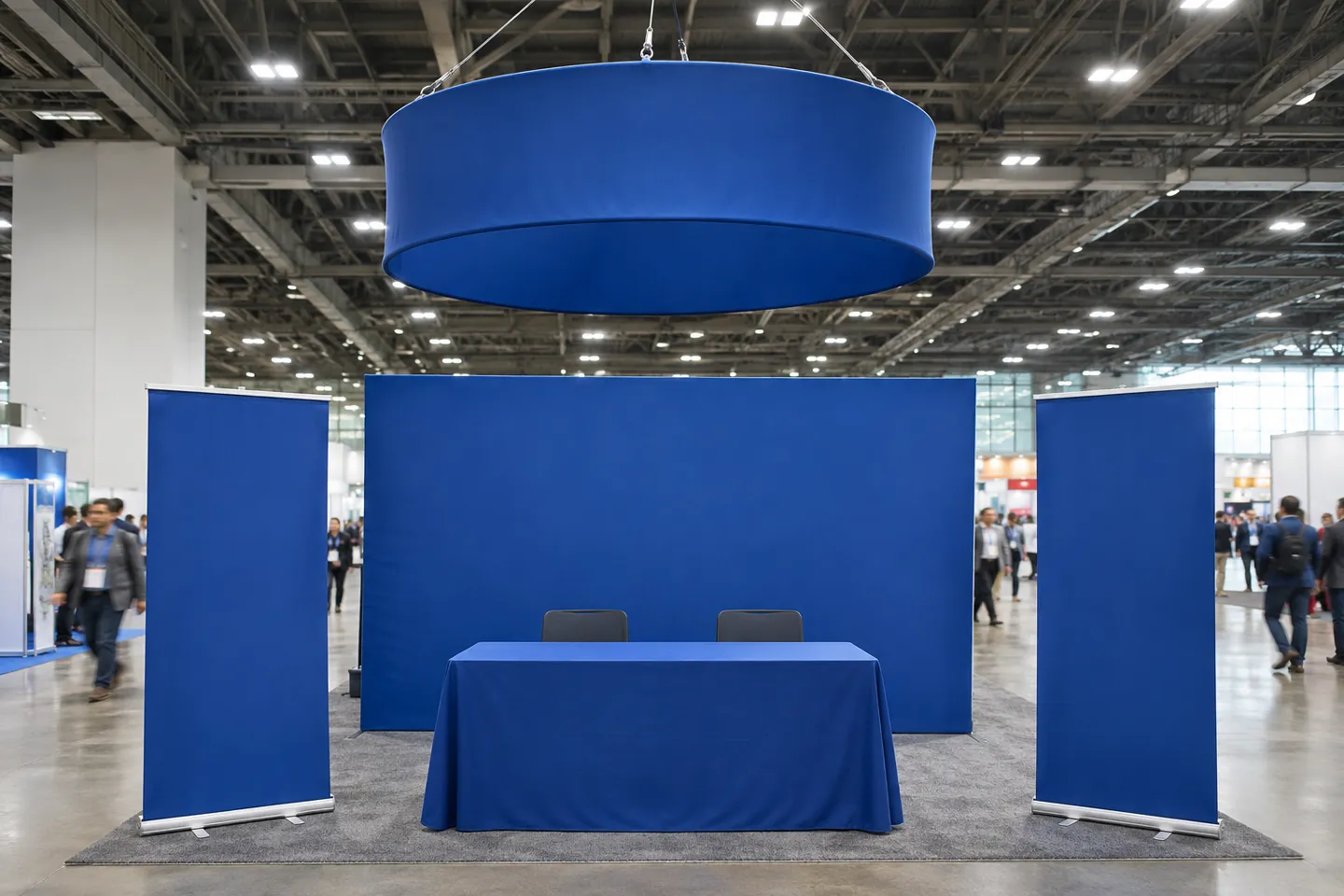
A pop up booth earns its name the first time you watch one go up. A scissor-lattice frame unfolds out of a wheeled case, and the printed graphic either rides on the frame or hooks on in minutes. One person walks away from a finished backwall before the aisle carpets are even down. That is the entire trick: an expanding frame plus a tensioned graphic. It is engineered so a single exhibitor can do in minutes what a build crew used to do in a day.
One clarification before anything else, because the word gets borrowed a lot. This article is about the trade show pop up: the portable backwall system sold to exhibitors in 10×10 and 10×20 footprints. A pop-up retail store that takes over a street-front lease for three weeks is a different product with a different design discipline. A folding table at a farmers market is a different thing again. If you are equipping a booth space at a convention center, everything below applies to you.
The frames themselves come in a handful of layouts: straight, curved, gull-wing, and serpentine S-shapes. On fabric versions the graphic is sewn or velcroed to the frame, so setup means pulling the frame open rather than hanging panels. Classic Exhibits, a manufacturer that has built these systems for over 30 years, notes that a typical fabric pop-up packs into a rolling case, and one of their 10 ft kits weighs 37 lbs with the case included (Classic Exhibits, 2026). You can check one as airline luggage. That single fact explains most of the category’s appeal: the booth travels as baggage, not as freight.
Portability is also what makes this category deceptive. Because anyone can stand one up, it is easy to assume the design decisions end at the graphic file. They do not. What you mount on the frame, whether you buy or rent it, and how it gets to the venue decide where the money actually goes. The same booth can cost $900 as a kit or read as part of a $25,000 show budget. The next four sections walk that ladder, one decision at a time.
Designing the Backwall: Graphics, Fabric and Light
Start with the rules that never change, because they are already everywhere: carry one message, keep the headline readable from ten feet, and let lighting do more work than decoration. Those basics are settled. What separates booths on a show floor now is the graphic treatment you choose, because that choice sets both the price and the presence of the backwall.
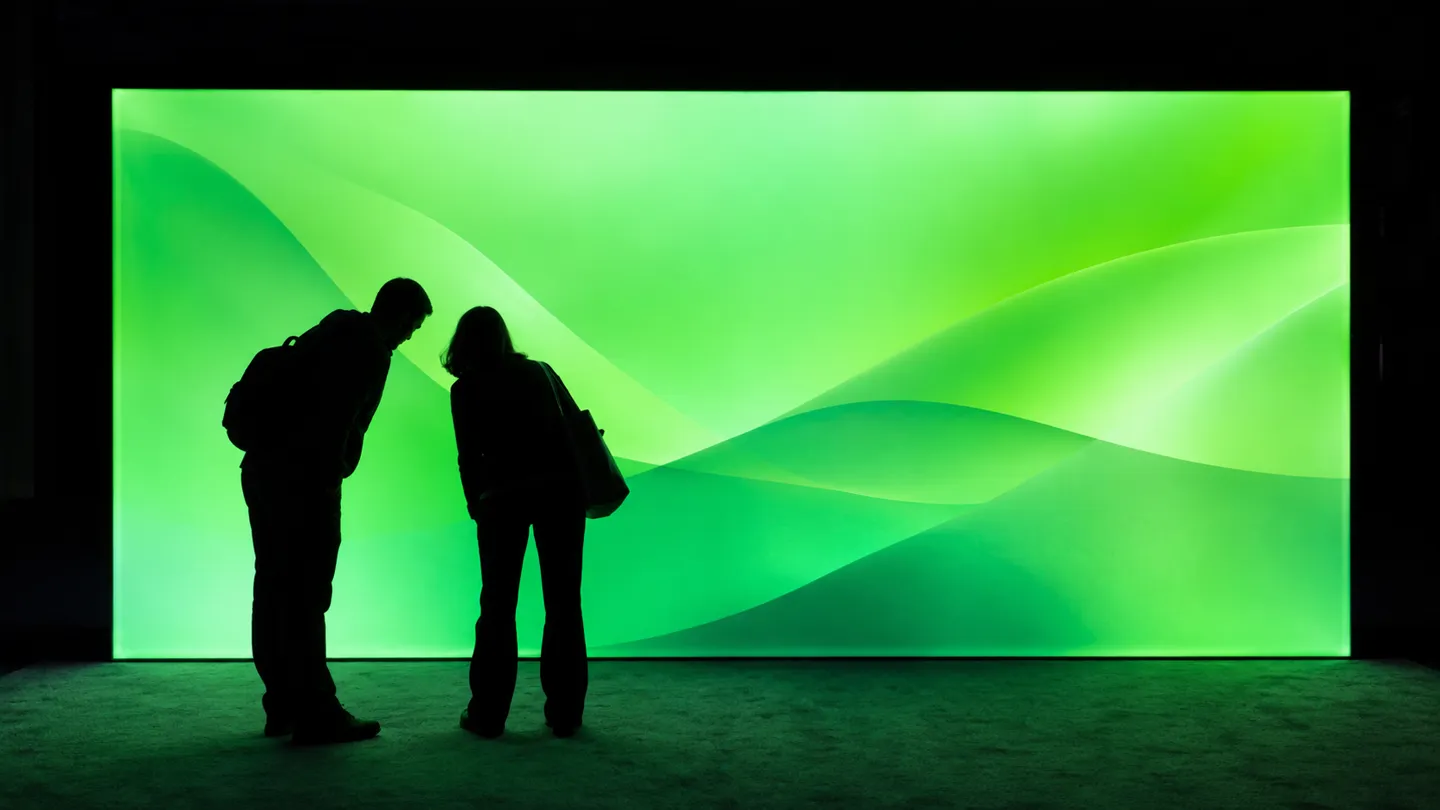
Think of graphic treatments as a ladder with four rungs. At the bottom sit mural panels, printed hard panels that hang on the frame. They give the sharpest image but they travel as separate pieces, and separate pieces have a way of going missing. One rung up is standard tension fabric, where the graphic stays attached to the frame so you never hang anything; the tradeoff is wrinkles after storage, which a travel steamer fixes in minutes (Classic Exhibits, 2026). The third rung is SEG fabric: a silicone-edged strip that pulls the graphic drum-tight into the frame for a seamless, hard-wall look. The top rung is backlit SEG, which puts LED light behind that seamless face. Exhibitors who have upgraded describe the difference bluntly: SEG costs more but looks much better, and backlit SEG delivers more impact than hanging lights ever will (Reddit: r/tradeshows, 2025).
Graphic Treatment Ladder for Pop Up Backwalls
| Treatment | What it looks like on the floor | What it asks of you |
|---|---|---|
| Mural panels | Sharpest print, hard-panel look | Travels as separate pieces that can be misplaced |
| Standard tension fabric | Graphic stays on frame, fastest setup | Wrinkles after storage, fixed with a steamer |
| SEG fabric | Seamless edge-to-edge premium face | Higher cost, needs a straighter frame |
| Backlit SEG | Brightest backwall in the aisle | Power order at the venue and a higher budget |
One boundary on that top rung: backlighting is not just a lamp you add. It obligates you to an electrical order at the venue, a slightly heavier frame, and a budget step up from every rung below it. If your show budget is tight, a lit front face from arm lights on an SEG backwall gets you most of the glow without the infrastructure. Choose the rung that matches how many more shows this backwall must survive, not just how the render looks on your screen.
Configuring the Booth: Counters, Monitors and Lighting
A backwall alone is a photo backdrop. What turns it into a working booth is the hardware around it: a counter to meet people at, a screen to play proof, lights to keep the space alive. Exhibitors who have been through this warn about the moment you add counters and monitors (Reddit: r/tradeshows, 2025). It is, in their words, a different world for shipping and show-floor handling. Here is what each piece actually involves.
Cheap on the quote. Expensive somewhere else.
Every addition: pieces to pack, weight to ship, minutes to the on-site build.
The Reception Counter
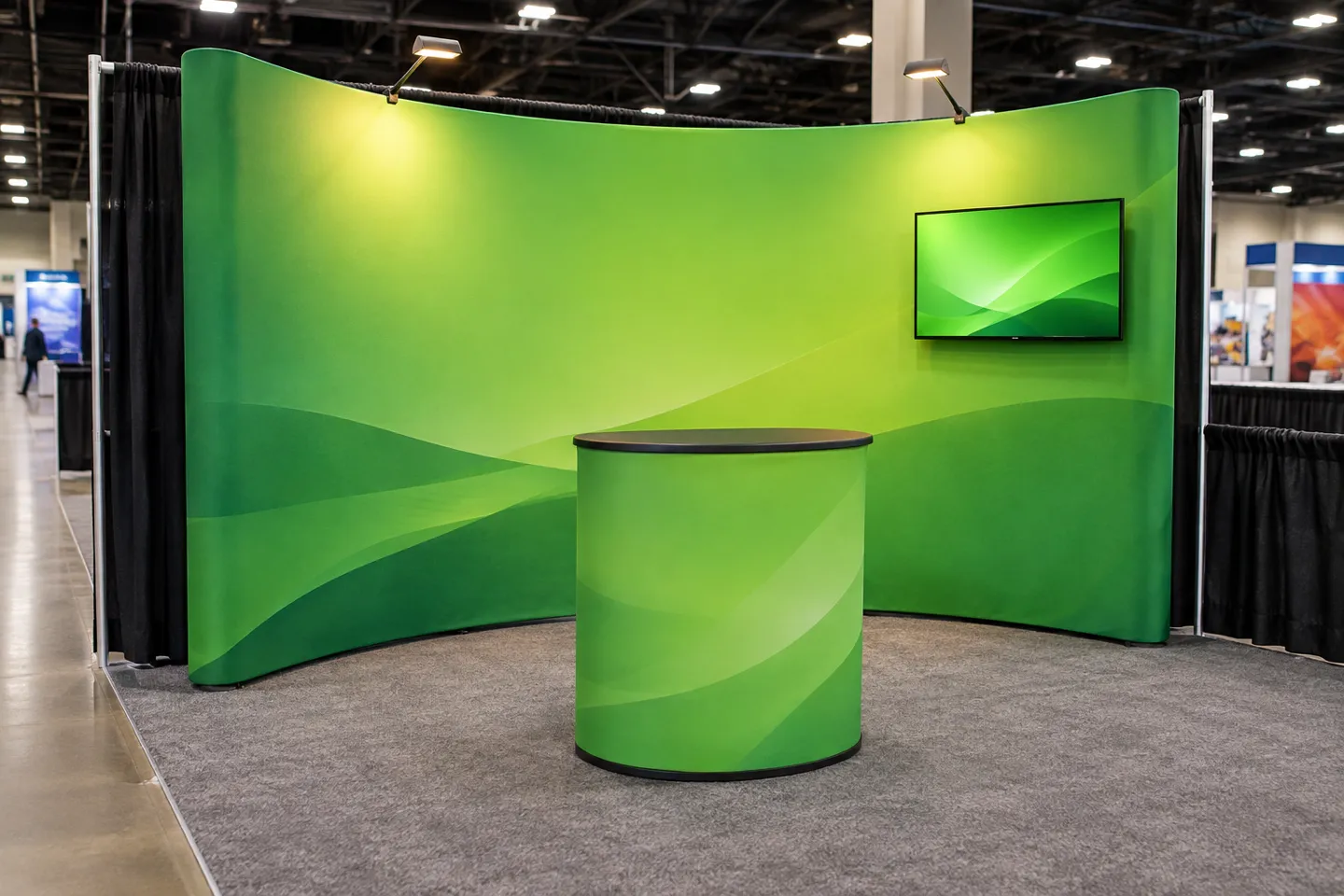
The counter is where conversations start, so its job is storage as much as looks. A counter with internal storage swallows literature, sample kits, chargers, and your team’s coats, which keeps the 10×10 space clean across an eight-hour day. A counter without storage forces every one of those items into sight or into a back room you have to walk to. One budget trick from the manufacturer community: order the case-to-counter wrap, so the rolling case your backwall ships in converts into the counter itself, and the piece of luggage disappears from your booth (Classic Exhibits, 2026).
The Monitor Mount
Screens sell motion, and motion stops traffic in a hall of static walls. Mounting one on a pop-up frame has two routes. The cut-through route integrates the screen into the fabric, with the graphic cut and reinforced around the mount, which reads as one finished unit but means the graphic and the mount must be engineered together from the start. The separate-mount route uses stand-off hardware off the frame’s channel bars, which is simpler to reconfigure but puts visible hardware in play. Either way, confirm the frame was engineered for screen weight; accessories like monitor mounts and shelves are exactly the items that budget pop-up kits leave out, and bolting a 40-inch screen to a frame that was never rated for it is how booths end the show leaning (Classic Exhibits, 2026).
Lighting
Lighting splits into the same two families as the backwall discussion: aimable arm lights clipped to the frame, or backlighting built behind SEG faces. Arm lights are the flexible option, they travel in the case, and they plug into your booth’s electrical order. Backlighting is the premium option with the obligations described earlier. What both share is the hidden line they add to your venue paperwork: a power order, placed in advance, priced by the venue. Lighting that arrives without a power plan is the most common self-inflicted setup delay in small booths.
Configuration self-check for a 10×10 pop up
Reception counter
Solves greeting and storage, hides the cost of one more shipping piece.
Monitor mount
Solves motion and proof, hides the cost of frame engineering and pack precision.
Arm or back lighting
Solves visibility after hours dim, hides the cost of the venue power order.
Case-to-counter wrap
Solves furniture budget, hides the cost of a scuffed case in full public view.
Run that checklist against your own floor plan, not against the catalog. A booth whose job is demoing one product with a screen needs the mount and the counter. A booth collecting leads at a crowded expo needs the counter and open floor, and maybe not the screen at all. Configure by traffic flow, and every piece you skip is a piece that cannot be lost, mis-packed, or billed twice.
Buy, Rent or Hybrid: The Real Cost Decision
Now the decision that sits under every design choice: do you own this booth, rent it, or split the difference? The honest answer depends on one number most exhibitors never write down, which is how many shows this booth must actually serve.
Three Routes and Where They Fit
Buying outright makes sense when the booth works three or more shows a year and your footprint is stable or growing. Modular aluminum systems add sections and scale from a 10×10 toward larger footprints instead of being replaced. Renting makes sense when usage is thin. If you exhibit once or twice a year, most of what you would own sits in a warehouse paying storage fees between engagements. Rented modular systems hand the maintenance and storage problem to someone else. The hybrid route owns the identity piece, typically the backwall, and rents the volume pieces around it per show, which keeps the brand consistent while the configuration flexes.
This is also the fork where the supplier conversation changes character, so here is how we look at it. Aplus Expo builds custom booths on wooden frameworks with unlimited design flexibility. We also run a separate booth rental line of modular aluminum structures for exhibitors who show once or twice a year and never want to store a crate. We also build the in-between, a mixed exhibit that pairs modular fitments with custom elements, in footprints from 10×10 up to 30×30-and-larger plus special sizes, with custom booth options quoted after a free 3D design and an itemized estimate. Whichever route you pursue, get the design settled before the hardware is, because the design is the part the aisle actually sees.
Tell Aplus Expo your show calendar and footprint, and your route comes back priced with numbers.
Get My Free 3D DesignThe Gap Between Catalog Price and Show-Floor Total
Here is the number mismatch that catches first-time buyers. Catalog listings for complete pop-up kits start around $852 (ExpoMarketing, 2026). Meanwhile, one small-business owner who runs a 10×10 program tallies his true cost at roughly $25,000 per event all-in, booth, travel, and logistics together (Reddit: r/Entrepreneur, 2024). By his account, a basic custom booth is a five-figure item before the show even opens. Both numbers are true. They are just measuring different things, and the difference between them has a name: the show floor.
The venue charges for everything that moves. Material handling, the industry calls it drayage, is billed per item moved from your freight to your booth space, and the same exhibitor thread puts small-package handling around $200 minimum with pallets adding roughly $1,000 on top. Veteran exhibitors use a blunt rule of thumb for a fully handled booth build in the US: budget around $150 per square foot and you are at market (Reddit: r/Entrepreneur, 2024). A 10×10 space is 100 square feet. Do that arithmetic and the catalog-to-reality gap stops being surprising.
The Real Cost Decision
The $852 catalog kit and the $150-per-square-foot show-floor build are different purchases. The gap between them is paid at the venue, not at checkout.
The first buys hardware. The second buys a booth standing at the venue, handled, lit, and built.
So put the routes against that arithmetic. The matrix below is the boundary check to run before you commit money to any column.
Buy, Rent or Hybrid: The Boundary Matrix
| Route | It fits when | It holds while | Switch when |
|---|---|---|---|
| Buy outright | You exhibit 3+ shows a year and the footprint is stable or growing | You have storage and a reuse plan | Shows drop off, or your design needs a refresh every cycle |
| Rent | You exhibit once or twice a year | You want zero storage and zero maintenance | Rentals stop being cheaper than owning a worn-out asset |
| Hybrid | You own the identity piece and rent per-show volume around it | Your backwall design is stable while configurations change | The owned core ages out or the brand repositions |
Show-Site Execution: Packing, Shipping and Setup Traps
Whatever you buy or rent has to survive five steps between the workshop and the opened hall. Each step carries one judgment that separates the smooth shows from the horror stories.
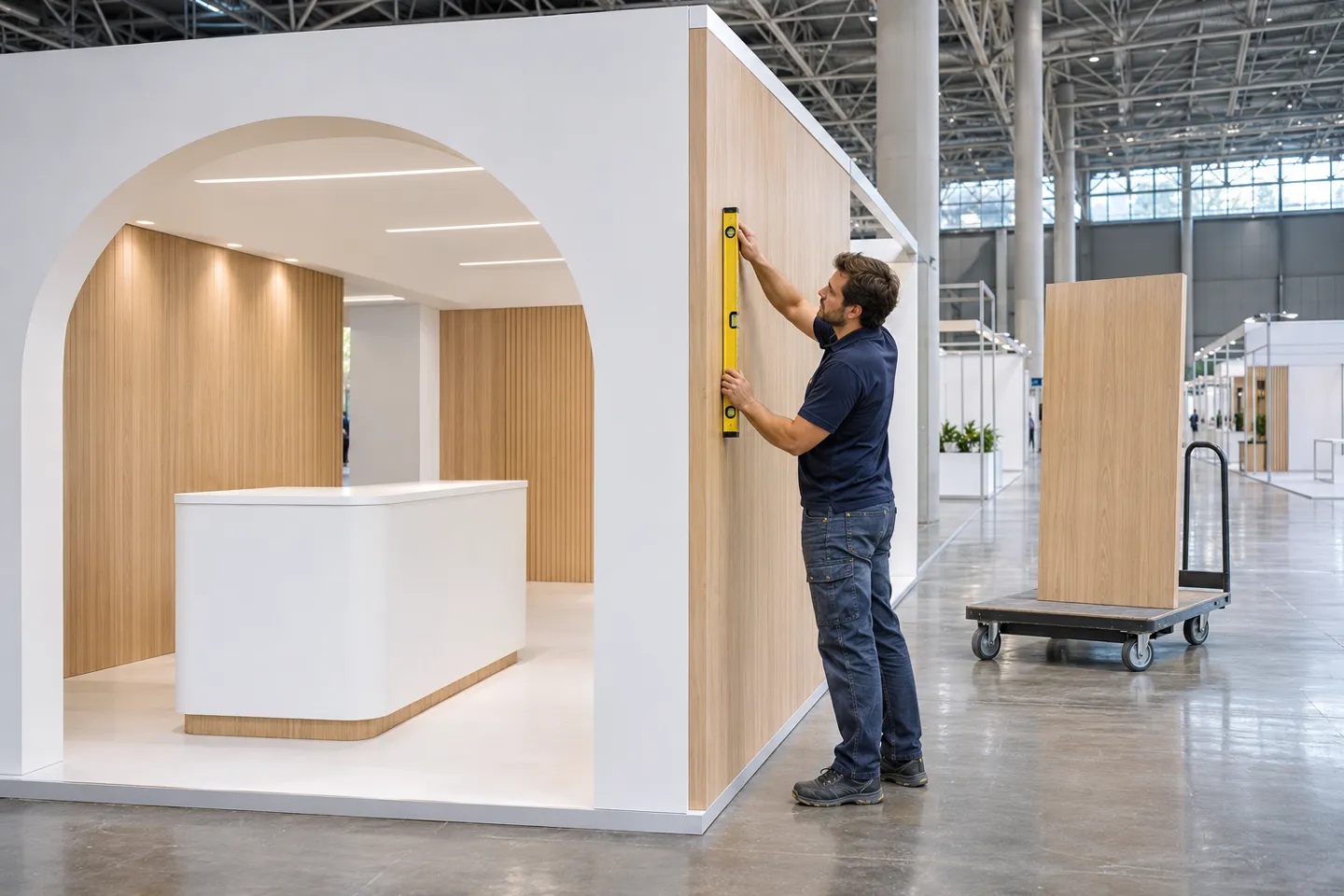
Step one is design confirmation. Before anything is fabricated, insist on seeing your booth fully stood up, even as photos, because a 3D render proves the idea while a photograph proves the object. Suppliers with their own factory floor run exactly this kind of trial assembly as a standard step. A supplier who resists showing you a built booth is telling you something.
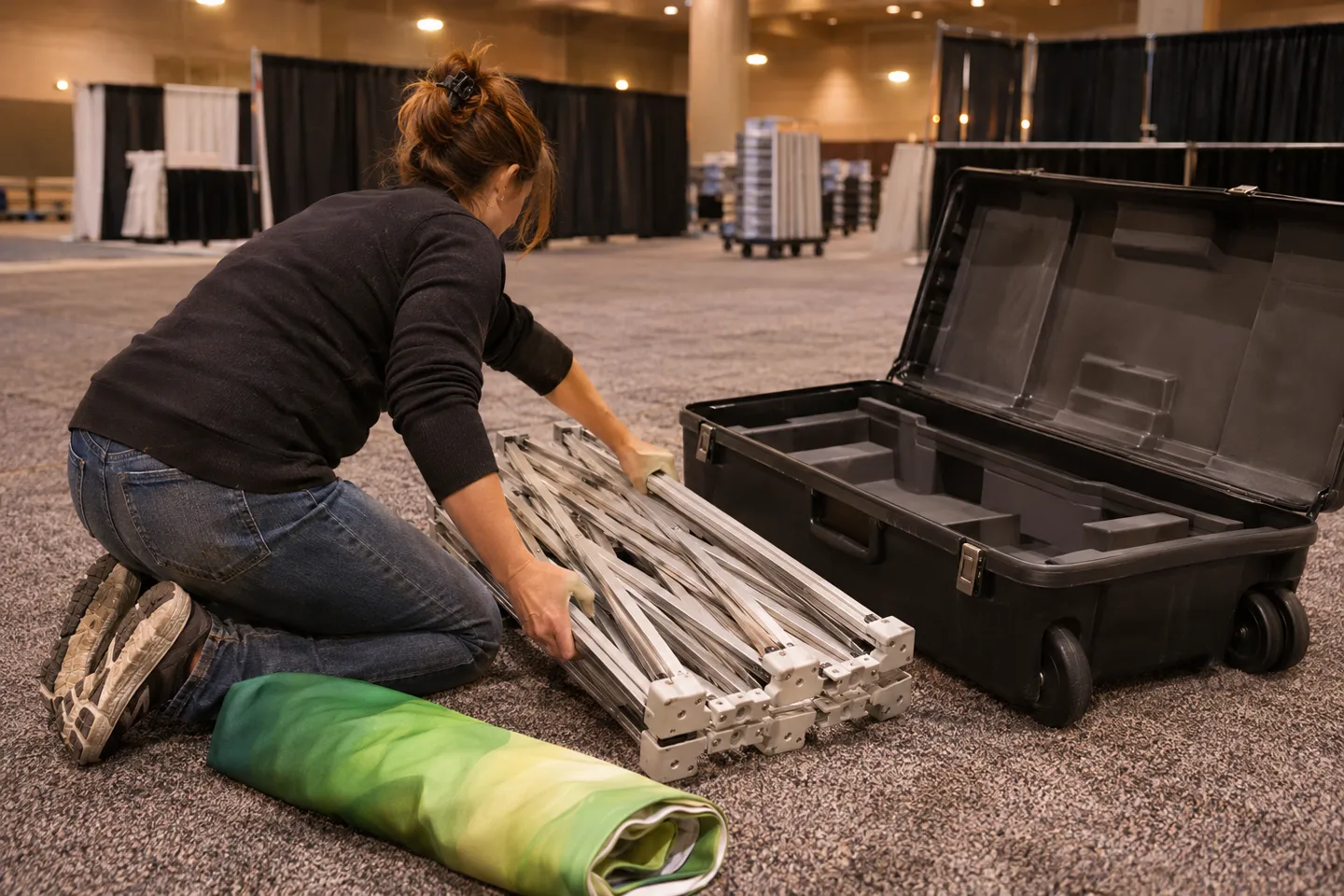
Step two is packing. This is where cheap systems quietly become expensive, because pop-up frames only re-pack if the pieces go back in the right arrangement. The manufacturer community is direct about it: assemblies must be packed carefully or they never fit again (Classic Exhibits, 2026). Lost panels and broken connectors head their list of show-floor horror stories.
Step three is shipping, and the judgment is knowing what the venue will charge you for. General contractors move everything that arrives at the dock, and their material-handling bills run per piece and per pallet (Reddit: r/Entrepreneur, 2024). That is why experienced exhibitors either ship to a nearby hotel and roll the booth in themselves, or hand the whole logistics chain to their booth builder and see the handling cost as one predictable line.
Step four is the on-site build itself. Set-up hours are mostly decided before the truck opens. A booth that arrives pre-assembled in large sections goes up in a fraction of the time of one that arrives as a crate of parts. In union venues where hourly labor is billed on site, that difference is money every hour. The first morning of the show is when problems surface, so confirm who is on call that morning and how fast they can physically reach the hall.
Step five is aftercare: a planned dismantle, outbound shipment, and a settled account. Drayage-style surprises after the show are common enough in this industry that you should ask, in writing, what happens after the doors close.
Three ways pop-up booths fail on site, all real, all reported by exhibitors
Which brings the whole purchase down to three questions worth asking any supplier before you sign. How many pieces does the system break into? How is it packed? How many on-site hours does setup take? A supplier who answers all three with numbers has built this booth before. One who answers with adjectives has not.
What This Means for Your Booth Plan
Put the four sections together and your pop-up booth plan reorders itself around the show floor rather than the catalog.
Budget by the venue, not by the checkout page. The catalog price covers hardware, and the venue adds handling, labor, power, and time, so give those their own line items before you compare supplier quotes. A quote that already includes delivery, installation, and dismantling is a different financial object from a cheaper quote that ends at the crate, even when the crate number looks better.
Configure by traffic flow, not by catalog completeness. You now know each component charges rent in pieces, weight, and site hours. So the counter earns its place only if people will actually lean on it, and the screen earns its place only if motion changes your conversion. Skipping a component is not a downgrade, it is one less part that can be lost, mis-packed, or billed twice.
Let frequency make the ownership call. One or two shows a year points at renting or owning just the identity piece, three or more with a growing footprint starts to justify owning modular hardware that scales. And write the three execution questions, pieces, packing, site hours, directly into your request for quote, because the answers separate builders from resellers faster than any portfolio.
Run your plan through that order: frequency first, then configuration, then budget lines, then the three questions. The pop-up decision becomes what it should have been all along, a logistics purchase with a design on the front. Judge it by whether it stands up early, works all day, and packs out without a story. The booths that impress on a show floor are rarely the ones with the wildest render. They are the ones whose worst morning was already rehearsed in a factory.
Get Your Free 3D Design and Estimate
Aplus Expo builds custom, rental, and hybrid booths in its own factory, and puts a 3D design plus an itemized quote in front of you before you commit to hardware.
Start My Free DesignReferences
- r/Entrepreneur. “What Are Your Trade Show Booth Secrets?” Reddit, 2024. https://www.reddit.com/r/Entrepreneur/comments/19dtri0/what_are_your_trade_show_booth_secrets/
- r/tradeshows. “Best Exhibitor Booth Vendor: Basic 10×10 Pop-Up?” Reddit, 2025. https://www.reddit.com/r/tradeshows/comments/1ihobzf/best_exhibitor_booth_vendor_basic_10x10_popup/
 English
 Spanish
 German
 French
 Italian
 Korean
 Chinese