
What an Exhibitor Manual Actually Is
Every confirmed exhibitor gets the same email. It holds a link to the show’s exhibitor manual, and it lands months before anyone ships a single crate. Open the file and you find rules, deadlines, and dozens of order forms, published by the show organizer and its general contractor, the company that manages the hall.
Some shows call the same document an exhibitor kit or a service manual. The name moves around, the contents do not. It is not a product user manual, and it has nothing to do with the display hardware catalog that borrows a similar name. It is the operating document for your booth: what you may build, whom you must hire, what you pay for, and when each of those things stops being negotiable.

Most manuals organize the same material into a familiar set of sections:
- General information: dates, hours, venue maps, key contacts
- Rules and regulations: what you can build, and where your neighbor’s space begins
- Deadlines and order forms: the section that quietly runs the whole show
- Shipping and material handling: warehouse addresses, labels, and drayage
- Electrical, internet, and utilities: what the venue sells directly
- Rigging and signage: what hangs from the ceiling, and who is allowed to hang it
- Insurance: the certificate of insurance (COI) you file before anyone works
- Booth approval: drawings to submit whenever your design needs a sign-off
- Marketing and directory listings: your listing copy, on a hard editorial deadline
- Move-in and move-out: the schedule your freight plan has to obey
A first-time exhibitor with a 10×10 booth does not need every section on day one. Double-deck approvals and heavy rigging mostly concern island booths, and a small inline booth can skim past them. Two sections deserve your attention before the rest: the deadline list and the booth rules. Everything else can wait its turn.
One note on format. Some shows still publish a PDF, and others run the manual through an online portal. The wrapper differs, the sections and deadlines inside are the same animal. Whichever version lands in your inbox, find the one-page deadline checklist near the front. That page is the real table of contents.
The Deadline System: Three Prices and the Forms That Cannot Wait
Most exhibiting problems are not design problems. They are date problems. The manual encodes its money in deadlines, and the same form carries three different prices depending on when you send it in.
From Paper PDF to Online Portal: the Format Changed, the Calendar Did Not
More organizers move their manuals into online portals every year, and the portal is genuinely better at search and status tracking. It is not better at protecting you from the one thing that actually costs money: a date that passed while nobody was looking. The fix is analog. Before you read anything else, open the deadline checklist and move every date that carries a price onto your own calendar, with the form name attached to each one. Reading the manual comes after that. The calendar comes first.
Why the Same Order Form Has Three Prices
Nearly every service in the manual is sold on a tiered clock. Order inside the discount window and you pay the advance rate. Miss that window and the same order rolls onto the standard rate. Miss the standard date too, or wait until the show floor, and you pay whatever the after-deadline schedule says, which is the worst price on the page. The HH Americas deadline checklist puts the logic plainly: complete all required forms by the deadline date to ensure your orders are filled and to avoid late fees (HH Americas, 2026).
Do not assume the deadlines cluster around one convenient number of weeks before the show. They do not. Each form carries its own date, set by whoever supplies that service, and the dates can sit weeks apart inside a single event. That is exactly why the checklist exists as a separate page: it is the only place where the whole price calendar appears in one view.
The Three-Price Clock Behind Every Order Form
| Order window | What you pay | What it means |
|---|---|---|
| Discount (advance) rate | filed by that form’s advance deadline | the best price the form will ever carry |
| Standard rate | filed after the advance date passes | the same service, a higher line item |
| After-deadline / on-site rate | filed past the final date or ordered on the show floor | the worst price, sometimes with no availability at all |
The Four Forms You File First
Triage the forms by what they unlock. Four of them sit in front of everything else.
- 1Certificate of insurance (COI): proof of commercial general liability, filed before any crew works.
- 2Booth approval drawings: submitted by the review date if your design exceeds standard rules.
- 3Electrical and rigging orders: venue-controlled, capacity-bound, scheduled early.
- 4Directory and listing copy: a hard editorial deadline tied to printing schedules.
The COI deserves its own warning. Show management requires proof of commercial general liability before your crew or your contractor touches the floor. The requirements are specific: ASHA’s convention agreement, for example, sets the minimum at $1,000,000 per occurrence and names both the organization and the convention center as additional insured (ASHA, 2026). Miss this form and the failure mode is not a fee. It is a crew standing idle at the dock, with the clock running.

Advance Warehouse or Direct-to-Site: Pick Your Route Early
The shipping section offers two addresses. The advance warehouse receives your freight before move-in and holds it until the hall is ready. Direct-to-site delivers your crates straight to the building during your assigned move-in window. The two routes differ in timing, in paperwork, and in cost structure, and the warehouse route closes earlier than the direct one. Make the choice while the choice is still cheap. What that choice does to your invoice is the next section’s business.
When every form carries three prices,
we file yours at the first one.
What Each Section Costs: Drayage, Labor, and the Fees Nobody Quotes Up Front
Every section that takes an order is a future invoice line. Three of them generate most of the surprises: material handling, labor rules, and the billing tail that follows the show home.
Drayage: The Charge Most Exhibitors Meet at the Invoice
Drayage, or material handling, is the general contractor’s fee for moving your freight inside the building (GES, 2026). The fee covers three movements: delivery from the dock to your booth space, storage of empty crates during the show, and the return trip to the loading dock at the end. It is mandatory, it is billed by weight, and the unit is the CWT, one hundred pounds of shipment weight.
Rates are set per show, so a price only means something when you name the show. At Process Expo 2023, freight shipped direct to the hall cost $116 per CWT (DTS One, 2023). The same handling through the advance warehouse ran $138.25 per CWT, close to 20 percent more. Neither route is the cheap one in general. Warehouse shipping can win money back on the freight line and then give part of it back on the handling line. The only reliable comparison adds freight and handling together for your actual weights on both routes, then picks the smaller total.
Drayage math on a real crate
$116
per CWT, shipped direct to the hall
$138.25
per CWT through the advance warehouse
Process Expo 2023 rates. One 400 lb crate at $116 per CWT means $464 in handling alone, before freight, labor, or rental costs. CWT is one hundred pounds of shipment weight.
Labor Rules: What You Cannot Install Yourself
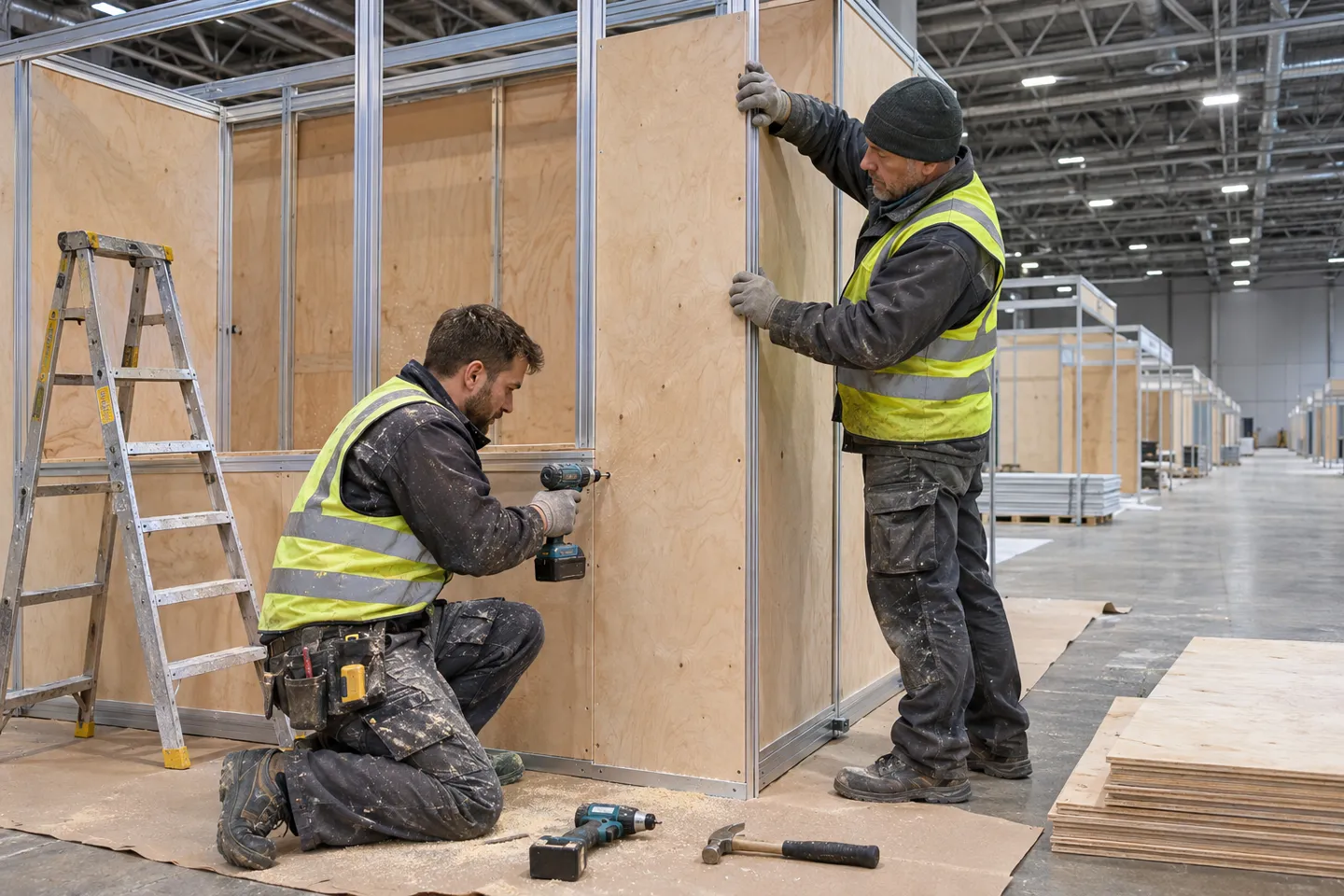
Union jurisdictions change from city to city, and the manual tells you which local rules your particular show inherits. In cities like Chicago and New York, crews for carpentry, freight handling, electrical work, and rigging operate under union jurisdictions, billed in straight time, overtime, and double-time windows (Condit, 2026). The Exhibitor Appointed Contractors Association publishes the jurisdiction tables that show how far the rules swing between venues (EACA, 2024).
Two boundaries matter more than the rest. Rigging and electrical are exclusive venue services in many halls, which means you buy them from the show’s own contractor whether or not you would prefer otherwise (Condit, 2026). And while most venues let exhibitors unpack small, hand-carried items at their own booths, anything that needs tools or ladders crosses into crew territory. The labor section draws that line for your specific hall. Read it as a list of things you cannot do yourself, not as a suggestion.
Change Orders, Rush Rates, and the Bill That Arrives After the Show
The three-tier clock bites twice as hard at the end. Forms past their final dates price at the top tier, and orders placed on the show floor price higher still, if the service is still available at all. Then there is the billing tail. Some charges are reconciled only after the doors close: a weight correction on drayage, an extra labor call, a damaged-floor report. Those invoices surface weeks later from parties you never signed anything with directly, which is exactly the moment when nobody is positioned to dispute them.
Post-show invoices are the industry’s slowest surprise. Weight corrections, extra labor calls, and organizer charges can surface weeks after you fly home. Before the show, ask in writing who reconciles each category of charge, and get every outstanding line settled before teardown ends.
Who Does What: Splitting the Manual Three Ways
Once you see the manual as priced machinery, the next question is operational: which of these items actually need your hands? Almost every line in the file falls into one of three buckets. Some items only you can file. Some your booth builder files as your Exhibitor Appointed Contractor (EAC). And some can only be bought from the venue’s exclusive contractor, no matter who asks. That three-way split is the most useful sentence in this entire article, and the matrix below turns it into a working tool.
The Three-Way Split of a Typical Exhibitor Manual
| Manual item | Who files it | Deadline sensitivity | Confirm this before it bites |
|---|---|---|---|
| Certificate of insurance (COI) | You, or your office | Blocks all show-floor work until it is on file | Wording matters: additional insured must name the show and venue, limits must match the manual’s minimum |
| EAC registration | Your booth builder | Required before their crew may work | Registration date versus contract date, and your signed authorization form |
| Booth approval drawings | Your booth builder | Fixed review date, late means redesign risk | Who submits, to which portal, and where the confirmation lands |
| Electrical order | Venue’s exclusive contractor | Capacity-bound, schedules fill early | Your builder specs the circuits and submits, you approve the quote |
| Rigging and hanging signs | Venue’s exclusive contractor | Early cutoff, drawings under review | Builder supplies drawings and weights, booked alongside the graphics order |
| Shipping and drayage | The decorator bills it, you route the freight | Warehouse closes earlier than direct | Which address, which labels, whose carrier, and keep the weight tickets |
| Graphics production and approval | Your booth builder | Tied to the booth approval date | Fire certificates on materials, and the reprint turnaround if something is rejected |
| Install and dismantle labor | Your builder or an EAC | Labor windows and overtime rules apply | Hours booked at straight time, and who supervises on site |
| Directory and online listing | You, marketing owns the copy | Hard editorial deadline | Copy, booth number, category, and who proofreads the final version |
The matrix doubles as the fastest audit of a builder’s quote. Ask the builder to map their proposal line by line against the manual’s order forms, and to name the items they will file on your behalf. A quote that covers electricity, rigging, labor, and approvals as one coordinated package removes most of the forms from your desk. A quote that stays silent on them leaves the forms, and their deadlines, sitting in your lap.
One boundary deserves its own sentence: putting an item in the wrong bucket costs money. Routing a venue-exclusive item through your builder does not create a discount, it adds a markup on top of the same exclusive price. And an EAC registration that arrives past its deadline turns your builder’s arrival into a negotiation with the dock manager.
Every line in the manual has exactly one rightful owner: you, your booth builder, or the venue’s exclusive contractor.
The Manual as a Buying Checklist
By this point the manual has told you what things cost, when they stop being cheap, and who files what. Read backwards, it stops being homework and becomes a buying tool.
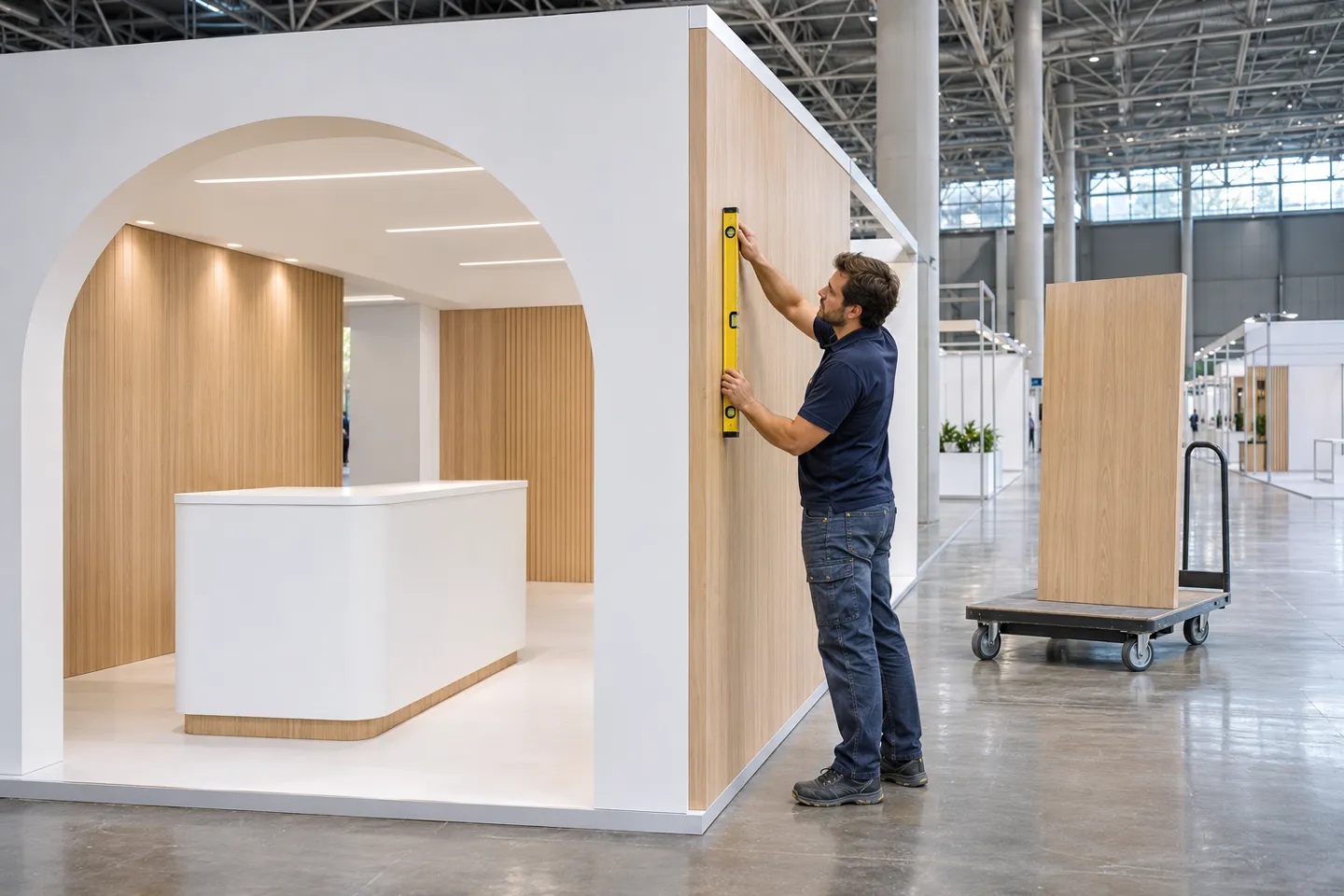
The deadline system prices every form on a clock, so the calendar you built earlier is the first thing to hand over. A builder who takes the forms on early keeps your orders inside the discount tier instead of rescuing them later at the standard rate. The same logic runs through the build itself. When a booth reaches the hall already assembled, photographed, and approved in a factory, the on-site crew faces a re-assembly, not a construction project. The labor line in the invoice shows the difference.
The cost section argues for one contract clause above the rest: settlement. Drayage corrections and organizer charges are where post-show invoices breed, so the clean question to ask any provider is simple. After the show closes, does anyone send me another bill? A structure that reconciles every charge, including show-organizer fees, before teardown ends, converts the billing tail into a closed number.
So use the manual the way it was built to be used, as a delegation map. Keep three things in your own hands: the deadline calendar, the insurance certificate, and the habit of checking a builder’s quote against the manual, line by line. Everything else in that file is somebody else’s form to file, at a price you approved, on a date that was never allowed to surprise you.
Our team at Aplus Expo takes over the manual’s order forms as part of trade show project management: electrical, rigging, labor, booth approvals, filed on time and reconciled on one bill. Every charge, including show-organizer fees, is settled before the show closes, and dismantle is part of the package, so the number you approved is the number you pay.
One team, every form, one final number
Send the manual and your booth sketch. The quote that comes back maps every line item to its form, its deadline, and its price tier.
References
- American Speech-Language-Hearing Association. “Convention Liability Agreement and Conditions.” 2026. https://marketing.asha.org/all-opportunities/asha-convention/convention-liability-agreement/
- Exhibitor Appointed Contractor Association. “Union Work Rules: Jurisdictions.” 2024. https://eaca.com/wp-content/uploads/2024/07/24-Union-Work-RulesJurisdictions.pdf
- Home Textiles Sourcing and Texworld New York City. “Exhibitor Deadline Checklist.” 2026. https://fall.hh-americas.com/assets/service-manual/exhibitor-deadline-checklist.pdf



 English
 Spanish
 German
 French
 Italian
 Korean
 Chinese