
Trade show booth repair sounds like an emergency topic. Sometimes, it is. But the biggest mistake exhibitors make is treating it as one. By the time you are standing next to a crushed panel three days before move-in, the repair was already decided weeks earlier: by how the booth was packed, by who stored it, and by how far the nearest workshop actually is from your show.
This article walks the damage timeline in order: where booth damage really comes from, what you can fix yourself, what a repair actually costs to arrange, and the questions worth asking a builder before you need one.
Where Trade Show Booth Damage Actually Comes From
Ask any installation crew where booths get hurt, and the answer is rarely “on the show floor.” Industry estimates put roughly 70% of trade show exhibit damage at dismantling, packing, and shipping, not at the event itself (EDE Corp, exhibit services firm, no date). The booth’s most dangerous journey is the one it takes when nobody is looking at it.
Where damage happens
70%
Industry estimate, edecorp.com
of trade show exhibit damage happens in dismantling, packing and shipping, not at the show itself.
Four moments account for most of it:
- Dismantling and packing. The crew that built the booth is gone, the packing foam was thrown out during setup, and crates get stuffed by whoever is left. What goes into the crate unprotected comes out of it damaged.
- Transit. Crate skids fall off, casters break, forklifts pierce walls. If the crate itself is tired, the exhibit inside pays for it.
- Storage. Laminates chip and bubble, proprietary light fixtures fail, and carpet that goes into the warehouse damp comes out delaminated.
- On-site handling. Repeated assembly loosens joints and hinges that were fine the first ten times.
So when you inspect a booth and find damage, the first question is not “who caused it,” but which category it falls into, because that decides everything downstream:
- Cosmetic damage affects appearance only: scuffed paint, dog-eared graphic edges, adhesive residue, a bubbled laminate corner. It does not threaten the structure and does not stop a show.
- Structural damage affects how the booth stands, connects, or carries: broken joints and hinges, cracked load-bearing frames, failed seams on tension-fabric walls, anything involving electrical. A structural problem is a “do not assemble” problem until it is fixed.
The rule that exhibit crews actually work with: if you have to ask whether it is structural, treat it as structural and get a professional opinion before move-in. Cosmetic fixes are cheap. Structural ones get expensive in a hurry.
What You Can Fix Yourself — and What You Shouldn’t
For owned displays (pop-ups, modular walls, portable systems), a good share of cosmetic wear is legitimately do-it-yourself between shows. The industry’s own maintenance practice guides are explicit about what belongs in a well-stocked gang box: touch-up paint matched to your laminate, small brushes, no-streak cleaners, and lint-free rags for adhesive residue (EXHIBITOR magazine, “Trade Show Tune-Ups”). Before each show, the same playbook says: inspect joints and hinges, check tension-fabric seams for overstretch, look for dog-eared graphics that need trimming, and check your crates’ wheels and skids, because a broken crate is how exhibits get damaged inside it.
Fix it yourself or call a professional?
| You can usually handle | Leave to a professional |
|---|---|
| Touch-up paint & marker on laminate | Structural joints, hinges & locks |
| Dog-eared graphic edges (trim or reapply) | Anything electrical or lighting |
| Adhesive residue & surface cleaning | Tension-fabric seams (overstretch = failure) |
| Loose screws in non-structural trim | Large laminate chips, bubbles & cracks |
| Damaged crates & shipping cases |
Two boundaries keep this honest:
- DIY applies only to assets you own. If the booth is rented, do not repair it yourself. Most rental agreements make the provider responsible for maintenance, and unauthorized field repairs are how damage disputes start.
- Cosmetic fixes stay cosmetic. A Sharpie over a scuff is fine. A Sharpie over a cracked joint is how a wall falls on your product demo.
And when should you check? Right after the show, not right before the next one. Damage found the week after a show is a calm, scheduled repair. Damage found the week before is an emergency with an overtime price tag, which is exactly the difference the next two sections are about.
The Repair Ladder: Maintain, Refurbish, Replace — and Who Pays
Every repair decision is really a question of where you are on the maintenance ladder, and each rung has its own trigger:
The repair ladder
Routine maintenance — after every show: clean, tighten, test, photograph
Small repairs — cosmetic fixes, component swaps between shows
Scheduled refurbishment — re-laminate, LED upgrades, re-skin graphics
Major rebuild — structural rework, full re-paint, new layout
Replacement — retire and replace the exhibit
The rungs — and how you know you’ve moved up one
Routine maintenance is the cheapest rung and the one most exhibits skip. Post-show cleaning, tightening standard hardware, testing lighting and electrical, and inspecting before storage is the documented baseline for extending exhibit life (Highway 85 and Blazer Exhibits, exhibit houses). Skipping it does not break a booth overnight; it moves every future problem one rung up the ladder.
Small repairs cover the cosmetic category from the previous section, done properly: re-laminating a panel face, replacing a hinge, trimming graphics. This is warehouse work at regular rates. The window to catch it is the days after a show, before the exhibit goes into storage.
Refurbishment is the point where exhibits get better, not just whole again: swapping halogen for LED lighting, updating corporate ID headers, refacing hard walls with new laminate, replacing worn carpet. When the fix is “change the color scheme,” you have left repair and entered refurbishment: a different budget, usually a different conversation with your builder.
Replacement triggers are the ones exhibitors most often miss. The industry’s working rule is that an exhibit has a point where repairs start to compound: connections loosen from repeated assembly, install times creep upward show after show, and patching stops holding (Steadfast Displays, Aug 2026). Two compounding repairs in a row is the signal to cost out a rebuild or a rental before spending a third repair budget on a dying asset.
Owned or rented: who pays for all of this?
Here is the part most repair articles never mention, because most repair content assumes you own the booth. The ownership structure decides who eats every rung of the ladder:
| Owned exhibit | Rented exhibit (custom rental) | |
|---|---|---|
| Repairs, cleaning, re-painting before shows | Your budget. The owner is fully responsible (Quora, industry practitioners on owning vs renting) | The rental provider’s obligation, written into the agreement |
| Storage between shows | Monthly commercial warehouse fees, year-round | Provided by the builder; assets stay in their system |
| Refurbishment & graphic updates | You pay every refresh, every re-brand | Part of the service cycle; graphics are re-printed per show |
| Damage found at move-in | Your problem to arrange, possibly on show-weekend rates | The provider’s problem; typically fixed before install, or at their cost |
| Post-show bills | — | Confirm in the agreement: some builders settle everything at the show and bill nothing afterward |
That last column is the quiet shift in the industry. Multiple practitioners now argue that for a company exhibiting once or twice a year, renting beats owning precisely because it moves repair, storage, and refresh costs off the exhibitor’s balance sheet and onto the provider’s (Quora, industry practitioners). If you own an exhibit you use twice a year, the repair ladder above is your job description.
If you rent your booth, verify who answers for what before you sign.
When the Clock Is Against You: Pre-Show Windows, On-Site Response, and Who Answers for What
Repairs are cheap in one currency and expensive in another: time. The same scratch costs $40 in your warehouse and $400 on a show floor at 9 pm on a union overtime rate, if anyone is even available. This is where “trade show booth repair” stops being a maintenance topic and becomes a procurement topic.
The windows
| Window | What can still be done | What it costs | The right move |
|---|---|---|---|
| Months out (after last show) | Anything: full repair, refurbishment, re-design | Regular rates, calm schedule | Do the post-show inspection; book the work before storage |
| 2–4 weeks out | Warehouse-level repairs, re-lamination, re-print graphics | Standard rates; still flexible | Ship the damage list to your builder now. This is the last “cheap” window |
| 1 week out | Rush repairs only, depending on workshop capacity and distance | Rush rates; production slots squeezed | Ask for a commitment in writing: what gets fixed, and by which day |
| Days before / move-in | Local response only: someone physically near the hall | Emergency rates; overtime possible | The builder 10 minutes away can help; the one on another continent cannot |
| During the show | On-site fixes, graphic swaps, AV repair, with someone standing by | Baked into a standby arrangement or billed per call | Day one is when problems surface; know who is on site |
What “fast” actually means
Every builder claims fast repairs. “Fast” is only measurable in three ways, and all three are geographic:
- How far is the workshop from the hall? A repair that happens in a factory 10 minutes from the convention center is a same-day event. A repair that requires shipping a panel across the country is a three-to-five-day event no matter how fast the shop is. Same damage, different zip code, different show.
- Can graphics be re-printed locally? Damaged or wrong graphics are the most common on-site problem. If the builder owns a print shop, a graphic discovered at 8 am can be re-printed and re-mounted the same day. If the graphics come from an outside vendor in another city, the design file has to travel and the print has to be proofed and shipped; the show opens without it.
- Is anyone actually standing by? Problems cluster on day one of a show. The practical difference is between a provider with a project manager on call through the event and a provider who is reachable by email from another time zone.
One more cost layer deserves its own warning: union-city labor rules. In cities like Chicago and New York, exhibit setup and repair work on the show floor runs through union labor, and the rules and rates are a standing blind spot for first-time exhibitors. Industry veterans note that venue labor costs, including mandatory union labor, are almost never itemized before an exhibitor has already booked the space (Quora, Ed Marquez, Mark Bric Display Corp.). The practical consequence: if your booth needs floor-level work in a union city, the hours, and the bill, multiply.
Union-city rule of thumb
The more a builder completes in its own factory before move-in, the fewer show-floor hours you pay for.
Who pays when something breaks?
When damage happens, four parties are in the picture, and each covers a different slice:
| Party | Covers | What you must do |
|---|---|---|
| Carrier (freight / drayage) | Damage in transit, if it can be tied to handling | Inspect at delivery, photograph with timestamps, file within the carrier’s claim window. Do not sign a clean receipt for a damaged crate |
| Builder / contractor | Damage during install, dismantle, or their storage | Agree on a condition report at install; photograph the booth as it is handed over |
| You (the exhibitor) | Wear-and-tear and self-inflicted damage on owned exhibits | Post-show inspection and scheduled repairs: the whole point of the ladder above |
| Insurance | Large losses and third-party damage | Know your policy’s exhibit coverage and its claim deadline before you need it |
The evidence discipline that makes all four work is simple and rarely followed: photograph everything, with timestamps, and keep the paperwork moving in writing. Professional teardown protocols run on exactly this: packing lists attached to each crate, progress photos at close of each day, and a copy of the outbound bill of lading submitted a few hours before the deadline so there is time to catch an error (EDE Corp). Exhibitors who skip this end up in the classic dispute: the builder blames the carrier, the carrier blames the drayage, and the photos that would have settled it in an afternoon were never taken (Reddit, r/marketing, Nov 2024). And one more piece of teardown advice from the same playbook: do not throw away the packing foam during setup. The exhibit needs it again on the way home. Roughly 70% of exhibit damage happens on the road, and most of that is a packing problem.
Put Repair Capability in the Contract, Not in the Hope
Pull the threads together and the picture is consistent. Damage mostly happens in transit and storage, so the repair capacity that matters lives in warehouses and workshops near the show circuit, not in your office. The problems that survive until show week are graphic swaps and structural fixes, which only a local workshop with its own print and build capacity can solve on show timing. And if you rent rather than own, all of that is supposed to be the provider’s obligation. Which means the entire repair conversation should happen before you sign, not after something breaks.
That is why the three questions worth asking every booth builder are these:
- Where is your workshop, and how far is it from my show’s hall? Distance is the single best predictor of whether a pre-show repair happens in hours or days.
- Do you print graphics in-house, and can you re-print same-day? Graphics are the most common last-minute failure. In-house printing is the difference between a repaired wall and a blank one.
- When is my bill final? Does the quote cover the whole cycle (build, install, on-site support, dismantle), and is everything settled at the show, or do invoices keep arriving for weeks afterward?
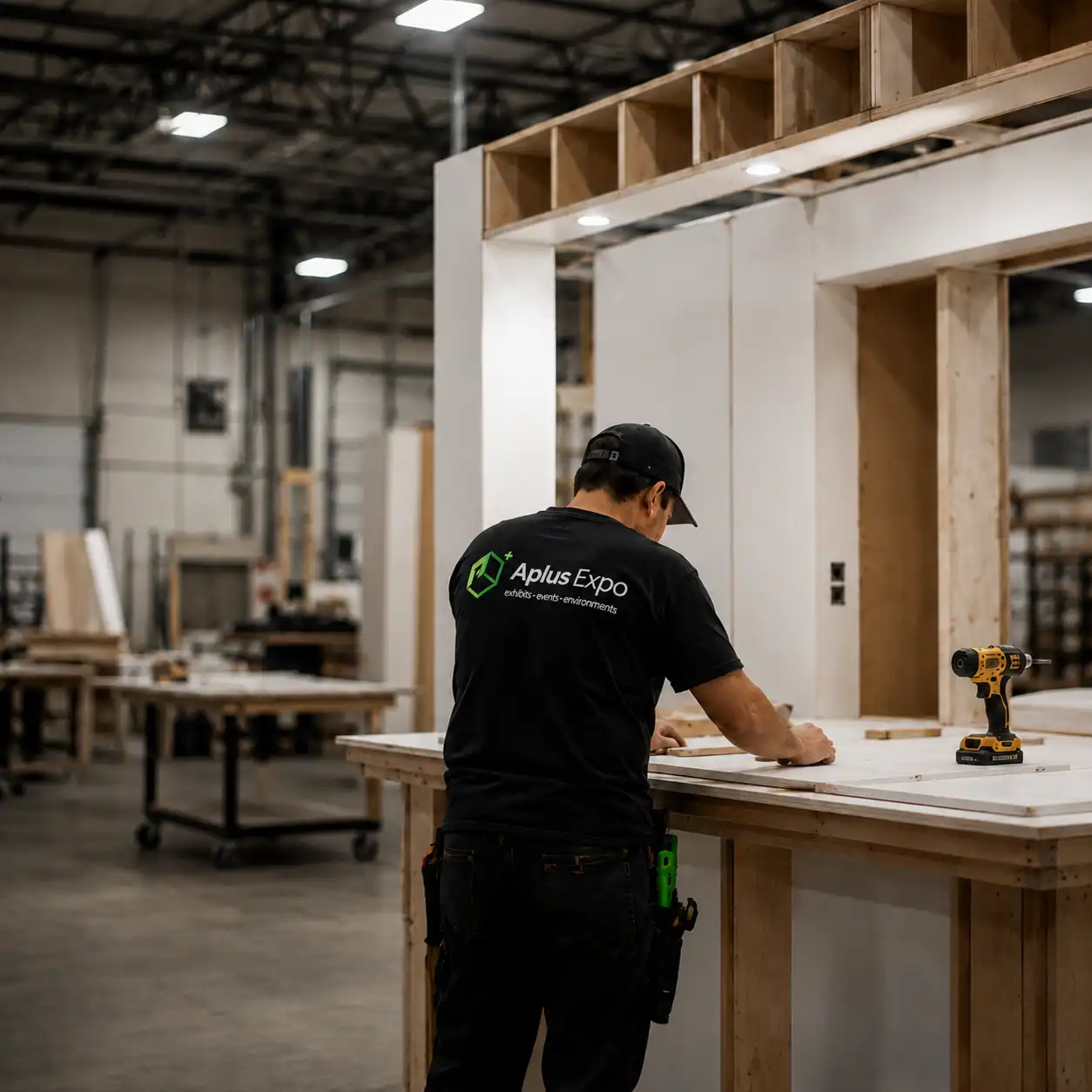
At Aplus Expo, those three questions get direct answers because of how we are built. Our own 12,500-square-foot factory sits ten minutes from the Las Vegas convention district, with dedicated production, painting, printing, and trial-build workshops under one roof (Aplus Expo, About). Every booth is trial-built in our factory first: structure up, graphics on the walls, photographed for your sign-off. The problems that normally surface on show week get found and fixed in our warehouse, where they are cheap, instead of on the show floor, where they are not. Our print shop re-prints damaged graphics the same day, our crews handle install and dismantle, and we keep a standby presence through the show (Aplus Expo, services and 24/7 standby). Your bill is finalized before the show closes. No post-show invoices from us.
One honest boundary: local capability is not a universal answer. If you exhibit once a year with a small portable display you own, the DIY section of this article is your repair strategy, and a local builder’s premium may not be worth it. But if your booth is a 20×20 custom structure, if you exhibit in multiple cities, or if the show is in a union city, that is exactly when distance, response time, and billing discipline stop being fine print and start being the product.
When you send your next booth inquiry, add the three questions above and see which builders can answer all three in writing. If you would like ours in the first reply, start a project here.
Get a quote that covers the whole cycle
Factory pre-build, graphics, install, on-site support and dismantle: one itemized quote, settled before the show closes. Ask us the three questions in your first message.
Get your free design and quoteReferences
- EDE Corp. “Finishing the Job: Effective Exhibit Teardown.” (No date.) https://www.edecorp.com/blog/finishing-the-job-effective-exhibit-teardown/
- Steadfast Displays. “Refresh or Replace? Getting More Shows Out of an Exhibit.” Aug 25, 2026. https://www.steadfastdisplays.com/blog/trade-show-booth-refresh-vs-replace/
- EXHIBITOR Magazine. “Trade Show Tune-Ups.” (No date.) https://www.exhibitoronline.com/topics/article.asp?ID=2453
- Quora. “What are the hidden costs of owning a trade show booth vs renting one?” (Practitioner answers incl. Ed Marquez.) https://www.quora.com/What-are-the-hidden-costs-of-owning-a-trade-show-booth-vs-renting-one
- Highway 85 Exhibits. “Routine Maintenance That Extends the Life of a Trade Show Exhibit.” (No date.) https://highway85.com/trade-show-exhibit-maintenance-routine/
- Blazer Exhibits. “How To Keep And Maintain Your Trade Show Exhibit.” (No date.) https://www.blazerexhibits.com/keep-maintain-trade-show-exhibit/
- Reddit r/marketing. “Who would you say is to blame for this trade show f*** up.” Nov 2024. https://www.reddit.com/r/marketing/comments/1h0n9v1/who_would_you_say_is_to_blame_for_this_trade_show/
- Aplus Expo. “Booth Rentals.” https://www.aplusexpo.com/service/booth-rentals/
- Aplus Expo. “Custom Booth.” https://www.aplusexpo.com/service/custom-booth-8/
- Aplus Expo. “Graphics Printing Displays.” https://www.aplusexpo.com/service/graphics-printing-displays/
- Aplus Expo. “About Us.” https://www.aplusexpo.com/about-us/
- Aplus Expo. “Contact.” https://www.aplusexpo.com/contact/
- Aplus Expo. Home. https://www.aplusexpo.com/



 English
  Spanish
  German
  French
  Italian
  Korean
  Chinese