
Driving into downtown Denver for a show at the Colorado Convention Center comes down to one building and one decision: where your vehicle actually belongs. The center runs a public parking garage with published hourly rates, but the same block also operates a freight system with 48 loading docks, and the rules could not be more different. This guide walks through the official garage, every alternative within walking distance, what happens on big-show days, and the vehicle rules that catch first-time exhibitors off guard.
Official Colorado Convention Center Parking: Rates, Rules, and the 8’2″ Ceiling
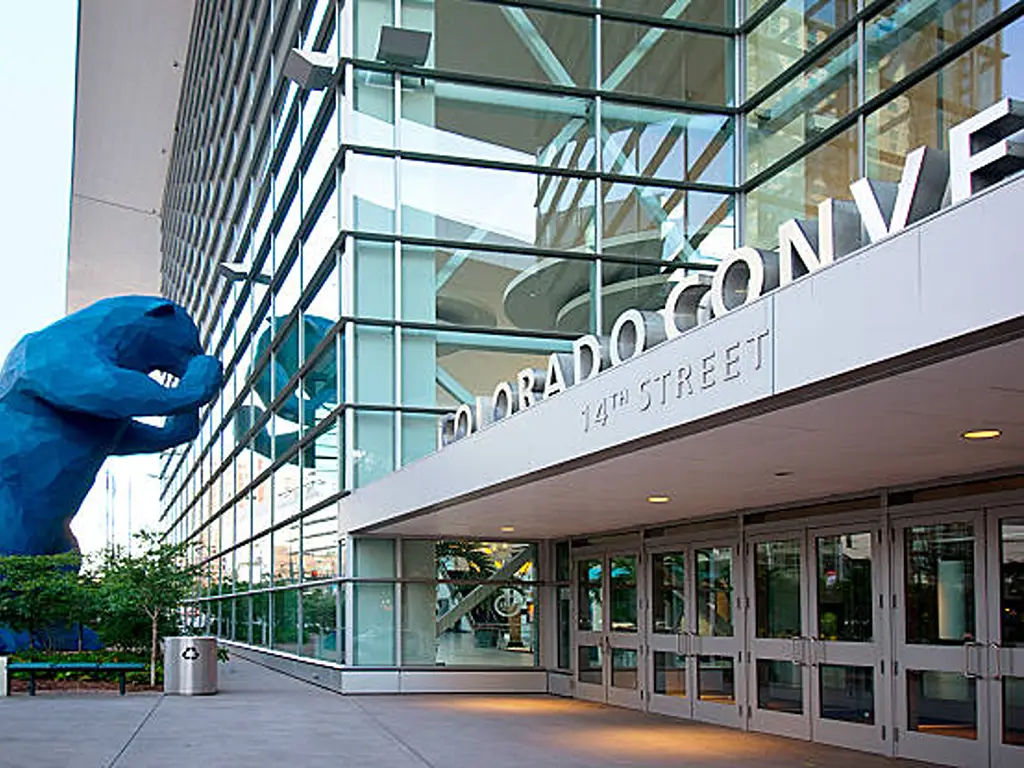
The Colorado Convention Center sits at 700 14th Street in downtown Denver. Its attached parking garage is the closest option you’ll find: roughly 600 spaces, according to the venue’s own specifications (Visit Denver, 2026). Rates are tiered by duration rather than a single flat price (Colorado Convention Center, 2026):
- Up to 8 hours: $13
- Up to 12 hours: $16
- Up to 18 hours: $18
- Up to 24 hours: $26
- Monthly: $190 for 30 days, 24/7 access (purchased at the automated pay stations with a major credit card; you display a printed receipt)
Payment runs through automated pay stations, with contactless options by text or QR code (Colorado Convention Center, 2026). Accessible parking is available on all three garage levels on a first-come, first-served basis with a valid state placard or plate; note that you still pay at the machines.
The official garage at a glance
Four rules at this garage are hard walls, not suggestions (Colorado Convention Center, 2026):
- Vehicle clearance is 8’2″, maximum length 19’0″. Roof racks, ladder racks, and some full-size vans with upfits should measure first.
- No trailers or oversized vehicles. There is no version of this garage that accepts your trailer. This is structural, not a staff discretion..
- No in-and-out parking. If your vehicle leaves the garage at any point, a new purchase is required to re-enter. A day split into “morning session / lunch off-site / afternoon session” costs two entries, not one.
- No free parking at any time. The venue states this plainly; “someone online said Sunday is free” is street-parking lore, not garage policy.
One more line from the venue’s own parking page previews the rest of this guide: the garage fills quickly during events (Colorado Convention Center, 2026).
Every Way to Park Near the CCC — and What Each Really Costs
Once you look beyond the attached garage, downtown Denver gives you four workable strategies. The right one depends on how many days you’re staying, what your vehicle is, and how much walking you’ll tolerate.
The official garage — pay for proximity, not price
At $26 for 24 hours, the attached garage is rarely the cheapest option, but it is the shortest walk and the simplest decision. It fits you best when you’re making a single same-day trip, carrying things between car and hall, or arriving in weather. It fits you worst when you’re staying multiple days (the monthly rate aside, daily re-parking adds up), or when your vehicle is anywhere near the 8’2″ ceiling. Reserve ahead through aggregators like SpotHero or ParkWhiz if you want a guaranteed spot on event days.
Third-party garages in the walking circle — where locals send you
A block or two in any direction, several garages undercut the official rate. Parking.com lists entrances at 1320 Glenarm Place (about a 2-minute walk) and 1448 Champa Street (about 3 minutes) (Parking.com, 2026). Locals repeatedly point across the street to the Hyatt Regency’s public garage, which enters at 14th & Welton (r/Denver, 2026). Another local favorite sits about a 10-minute walk away. Users there reported roughly $20 on weekdays and $12 on weekends (r/Denver, 2024). Those figures are a couple of years old; treat them as a range, not a quote.
The trade is walking time for dollars, plus one more thing: these garages have their own in/out policies. Before you prepay a multi-day rate somewhere, confirm whether that rate includes re-entry; otherwise the in-and-out trap follows you off the official lot.
Street parking and the “free parking” myth
Metered parking around downtown Denver exists, and the ParkMobile app shows spots starting as low as $2 depending on day, time, and duration (ParkMobile, 2026). That number is real, but it is the floor of a range, not the typical price, and street parking downtown carries enforcement risk that garages don’t. The venue’s own “no free parking at any time” line only covers its garage; free-street claims you’ll find in listicles don’t survive contact with Denver’s metered blocks and tow zones. If you use street parking, do three things: read the meter’s time limit, check the street-sweeping signs, and set the ParkMobile extension alarm. A lunch that runs long shouldn’t turn into a citation.
Reservations vs. drive-up vs. monthly — how the bill actually changes
How to park near the CCC without overpaying
| Strategy | Best for | Real cost behavior | Fails when |
|---|---|---|---|
| Official garage, drive-up | Same-day trips, weather, hauling between car and hall | Tiered $13–$26 by duration; re-entry restarts the meter | Midday departure (double purchase); late arrival on big-show days |
| Third-party garage | Multi-day stays, budget-conscious drivers | Roughly $12–$20/day locally reported; verify in/out policy | Rate assumed to include re-entry but doesn’t |
| Street parking (ParkMobile) | Short errands, early arrivals | From $2 depending on block/time; enforcement risk | Event-day surges, street sweeping, time-limit overruns |
| Monthly pass ($190) | Week-long runs, crews working the show | Cheapest per-day if you park 5+ days | Short stays (you pay for unused days) |
The pattern behind all four rows: static prices mislead because duration is the multiplier. A $13 morning becomes $26 by dinner if you stay; a two-entry day at any garage doubles its sticker price. Decide your pattern first, then pick the row, not the other way around.
When 600 Spaces Aren’t Enough: Big-Show Days
The garage’s own guidance is blunt: it fills quickly during events, and overflow means walking from wherever you find space (Colorado Convention Center, 2026). Around 600 spaces serve a 577,000 sq ft exhibit hall plus a 5,000-seat theatre. On opening mornings of major conventions, demand can outrun that supply before mid-morning (Visit Denver, 2026). Event-day pricing can also climb: ParkMobile flags that prices near the center run higher during special events (ParkMobile, 2026).
Big-show day rule
Arrive before 9 AM, pre-book a specific garage, or don’t drive. “I’ll circle and find something” is the most expensive plan on the board; locals are already complaining that downtown parking keeps getting pricier (r/Denver, 2024).
So on peak days, compare driving against the alternatives honestly. The free 16th Street FreeRide shuttle runs the length of downtown between Union Station and Civic Center and stops within a block of the center (RTD, 2026). One catch for 2026: RTD has suspended the D, H, and L light rail lines for the Downtown Rail Reconstruction Project that began June 7, 2026 (Colorado Convention Center, 2026). Check your rail connection before assuming it exists. Driving to an outlying garage or station and finishing by shuttle or rideshare is often faster than hunting for a downtown spot after 10 AM. And with 13,000+ hotel rooms within walking distance of the hall (Visit Denver, 2026), many attendees simply skip the car entirely once they’ve checked in.
The decision rule: if your day has a hard start time and the show is big, remove driving from the critical path: park early somewhere specific, or don’t drive at all.
Move-In Day: Your Truck Doesn’t Fit the Parking Garage
Now shift the lens. Everything above assumes you’re a person driving a car to attend something. Move-in day is different: you’re driving a working vehicle, a pickup loaded with booth parts or a cargo van, maybe even a small trailer, to deliver and assemble. And the garage that served you perfectly as a visitor is structurally closed to you.
This is the fact that reframes the whole topic:
The same building runs two vehicle systems: a public garage that turns away anything over 8’2″, anything longer than 19′, or anything towing, and a freight operation with 48 covered loading docks that can accommodate 70-foot trucks, 24 bays per side (Visit Denver, 2026).
The two vehicle systems
One building, two vehicle systems.
Public garage
- Turns away anything over 8’2″
- 19’0″ maximum length
- No trailers, period
Freight docks
- 48 covered loading docks
- 70-foot trucks accommodated
- 24 bays per side
Source: (Visit Denver, 2026)
Why the garage can’t help you on move-in day
Run the working vehicle against the garage rules and three failures appear immediately. A pickup with a loaded rack or a high-top van may brush the 8’2″ clearance. Anything towing a utility trailer is out. No trailers, period. And even when the vehicle physically fits, the no-in-and-out rule is brutal for unloading. You park, hand-carry everything in, and the vehicle stays put until you’re ready to buy a second entry. Exhibitors asking “can I just drive to the loading dock and unload?” is one of the most common first-show questions on exhibitor forums (r/comiccon, 2024). At this venue, the answer starts with “not through the parking garage.”
Where working vehicles actually go
Freight and booth materials move through the dock system, not the public garage. For the classic exhibitor pickup with a few crates, most shows run a move-in/move-out process: designated short-term unloading zones and time windows. The show’s general service contractor administers them. The exact rules (which door, which hours, how long you can leave the vehicle while you hand-carry) are set per show, not per venue. That makes your first action concrete, not generic: when your exhibitor kit arrives, read the move-in section for vehicle instructions and note the unloading window before you plan your drive.
Where the vehicle parks after it unloads
After unloading, the working vehicle needs a legal home. The options collapse back into the map above: a third-party garage that fits its height, a monthly pass for a week-long crew, or an off-site lot with a shuttle. What doesn’t work is circling the docks: dock aprons are working zones controlled by the show, and leaving a private vehicle there invites a ticket or a tow. Plan the unload and the park as two separate decisions with two separate locations.
Vehicle-to-access matrix: find your row before move-in day
| Vehicle | Official garage? | Where it belongs | Boundary that fails it |
|---|---|---|---|
| Sedan / SUV | Yes (under 8’2″ and 19′) | Garage or any option above | Roof boxes: measure total height first |
| High-top cargo van | Measure first | Third-party garage with taller clearance; designated unload zone | 8’2″ ceiling; re-entry restart on multi-trip unloading |
| Pickup, empty or lightly loaded | Usually yes | Garage after unloading; short-term zone during unload | No re-entry while you hand-carry loads |
| Pickup + utility trailer | No | Per-show move-in process; trailer detaches before parking | “No trailers” is absolute |
| Box truck / semi | No | Dock system / per-show freight process | Entirely different system (next section) |
The action this table asks of you: measure your loaded vehicle (height with rack, length with trailer), then confirm your show’s move-in vehicle rules from the exhibitor kit before drive day. Both take ten minutes; both prevent the two most common move-in morning failures.
Freight, Docks, and Marshalling: How Booths Actually Arrive
Crated freight (booth structure, crated graphics, machinery) never touches the parking conversation. It runs on the venue’s freight infrastructure and the show’s logistics schedule. Four things to understand, in order.
1. The dock system is the freight front door. The center operates 48 covered loading docks that can accommodate 70-foot trucks, with 24 bays per side (Visit Denver, 2026). Your carrier’s target is a dock assignment with a date and window, not the building’s street address.
2. Big shows stage trucks at a marshalling yard. For large events at this venue, the general service contractor establishes a marshalling yard to ease congestion around the facility and sequence trucks into the available dock space. If your show uses one, your driver checks in at the yard, gets a dock call number, and arrives at the venue when called. Arriving at the docks directly during a marshalled show puts you at the back of the line.
3. “700 14th Street” is not truck directions. This failure is documented in trucking forums, nearly verbatim: a driver picking up a load from the convention center asked where “the heck” the semi entrance even was, because the public address points you to the front door and garage (TheTruckersReport, 2014). Carriers still trade notes on the lower-level docks before first deliveries (r/Truckers, 2025). The fix is unglamorous: your driver’s dispatch needs the dock address, the target floor, the check-in phone number, and the arrival window. Your exhibitor kit or carrier instructions lists them; the venue’s marketing address does not.
4. Advance warehouse or direct? Most large shows offer an advance warehouse: freight arrives days early to the contractor’s warehouse and is delivered to your booth space before move-in, in exchange for earlier deadlines and material-handling fees. Direct shipping targets your dock window during move-in instead. Whether your show runs an advance warehouse, and its cutoff dates, is per-show information. Confirm it in the exhibitor kit before booking transport.
Freight arrival path
Confirm target: dock delivery or advance warehouse
Book carrier with dock address, floor, window and check-in contact
Marshalled show? Driver checks in at yard, waits for dock call
Deliver within window; carry paperwork and tracking numbers
Direct-to-dock vs advance warehouse
| Direct to dock | Advance warehouse | |
|---|---|---|
| Deadline | Tighter: must hit your move-in window | Earlier (often 1–2+ weeks pre-show) |
| Risk | Missed window = delayed booth | Carrier delay absorbed before show week |
| Best for | Smaller shipments, tight schedules | Full booth shipments, long-haul freight |
Which path is right depends on your show’s deadlines and how much schedule risk you’ll accept; answer that from the exhibitor kit, not from a general rule.
Budgeting Vehicle Logistics as Part of the Booth
Step back from the tactics and the pattern is hard to miss. Getting vehicles to the Colorado Convention Center is not one problem. It’s three systems stacked on top of each other: consumer parking rules, a freight dock operation with per-show windows, and big-show capacity that resets all the math. The failure samples above all share one shape: someone treated a working-vehicle problem as a parking problem on the morning it mattered.
If you’re the person accountable for the booth, that suggests a different budgeting stance. Vehicle arrival is a deliverable of the booth project, not an errand attached to it. Before contracts are signed, write down who owns each line and ask whoever builds and transports your booth: Which vehicle makes the move-in run, and does it fit the garage rules? Does freight ship direct or to the advance warehouse, and who books it? Who puts the dock address and window into the driver’s dispatch? Where do the crew’s vehicles park for the week? Each of those questions has a concrete answer in your exhibitor kit; the only variable is whether someone owns it before drive day or improvises on the morning.
A booth that arrives late doesn’t get graded on how good it looks. Whichever way you staff it (in-house, or folded into your builder’s scope), make vehicle logistics someone’s named job: dock address in the dispatch, vehicle measured before drive day.
Hand the vehicle plan to the team that builds the booth
Aplus builds exhibit booths in Denver and runs its own transportation and logistics crew, so dock windows, dispatch details and crew parking arrive as one coordinated delivery.
Get a project quoteReferences
- Colorado Convention Center. “Parking — Rates, Rules, Accessibility.” 2026. https://denverconvention.com/parking/
- Colorado Convention Center. “Getting to the Center.” 2026. https://denverconvention.com/attend-an-event/getting-to-the-center
- Visit Denver. “Colorado Convention Center General Information.” 2026. https://www.visitdenver.com/meetings/convention-center/general-information/
- Parking.com. “Colorado Convention Center Parking | Denver Parking Lots.” 2026. https://parking.com/denver/convention-centers/colorado-convention-center
- ParkMobile. “Parking Near Colorado Convention Center.” 2026. https://parkmobile.io/parking/locations/co/denver-parking/destination/colorado-convention-center
- RTD. “16th Street FreeRide.” 2026. https://www.rtd-denver.com/routes-services/other-services/16th-street-freeride
- r/Denver. “Parking Recs for Convention Center.” 2026. https://www.reddit.com/r/Denver/comments/1s35qx9/parking_recs_for_convention_center/
- r/Denver. “Convention Center Parking.” 2024. https://www.reddit.com/r/Denver/comments/1b6iyqp/convention_center_parking/
- r/Denver. “Convention Center Parking No Longer a Good Buy.” 2024. https://www.reddit.com/r/Denver/comments/1es2kqt/convention_center_parking_no_longer_a_good_buy/
- r/comiccon. “Are Exhibitors Able to Drive to Loading Dock and Unload?” 2024. https://www.reddit.com/r/comiccon/comments/1cwshdn/are_exhibitors_able_to_drive_to_loading_dock_and/
- r/Truckers. “Anyone Deliver with a 53′ Trailer to Lower-Level Docks at Colorado Convention Center?” 2025. https://www.reddit.com/r/Truckers/comments/1g8xtoo/anyone_deliver_with_a_53_trailer_to_lower_level/
- TheTruckersReport. “Any Body Have Been to Colorado Convention Center?” 2014. https://www.thetruckersreport.com/truckingindustryforum/threads/any-body-have-been-to-colorado-convention-center.257777/
- SpotHero. “Find and Reserve Parking Near Colorado Convention Center.” 2026. https://spothero.com/destination/denver/colorado-convention-center-parking
- Aplus Exhibits. “Transportation & Logistics.” 2026. https://www.aplusexpo.com/service_categories/transportation-logistics/
- Aplus Exhibits. “Homepage.” 2026. https://www.aplusexpo.com/
 English
  Spanish
  German
  French
  Italian
  Korean
  Chinese