
Every year, thousands of companies walk onto a show floor for the first time. Most of them find out what exhibiting costs a few weeks after the doors close. This guide follows the money: what each line item really is, how it is billed, and where the overruns hide. Every number carries its qualifier, because that qualifier is usually the difference between your budget holding and not.
Why a 10×10 Booth Can Cost $3,000 — or $40,000
One clarification before the numbers. This is a working guide for exhibitors, not the official exhibitor manual that show management mails out. That document, the one full of order forms and deadlines, lives with your show organizer, and you should read it cover to cover.
The first truth of trade show budgeting: floor space is a poor predictor of what you will spend. Exhibitors on Quora report paying as little as $3,000 for a 10×10 space at a smaller regional show. At a major US B2B event, the same 400 square feet runs $10,000–$15,000 by the common $100–150 per square foot benchmark. And the all-in cost of a first-time 10×10 at a US B2B show (space, exhibit, shipping, labor, services, travel, marketing) typically lands between $15,000 and $40,000.
The gap is the difference between buying the floor space and putting a working booth on it. The space gets you a rectangle on a hall map. Everything that makes that rectangle represent your brand is billed separately, in five or six different ways: the structure, the graphics, the freight, the people who assemble it, the power, the carpet.
The real cost of a first show
10×10 floor spacefrom $3,000 — smaller regional shows (exhibitor-reported)
First show, all-in$15,000–$40,000 at US B2B events
The differenceevery line item beyond the space itself — exhibit, freight, labor, services, travel
That is the frame for everything that follows. The space is your ticket; the rest is the show.
What’s Actually in Your Budget: Every Line Item, and How Each One Is Billed
Trade show budgets fail in the same place almost every time. Exhibitors budget by categories, while vendors bill by units: square feet, pounds, hours, and work orders. A category budget cannot see an overrun forming, because the overrun accrues inside units nobody tracked. This table attaches the billing unit to each category, so you can see where control is lost before you sign anything.
The trade show budget, by billing unit
| Line item | How it is billed | Typical scale | Window that saves money |
|---|---|---|---|
| Floor space | Per square foot, listed price | $100–$150/sq ft at US B2B shows; less at regional shows | Book early: exhibitors report early-bird savings of 10–20% six-plus months out |
| Exhibit (design, build, graphics) | One-time price or per-show rental | Rental runs about a third of purchase price (exhibitor-reported); graphics need refreshing about yearly | Decide rent vs buy before graphics spend |
| Shipping and drayage | By weight and arrival window; often settled after the show | Largest wildcard; surprise fees common | Ship to the advance warehouse up to 30 days early |
| Labor and installation | By the hour; union cities add rates and minimums | Hourly crew rates can exceed $170/hr in union cities (exhibitor-reported) | The more that arrives pre-assembled, the fewer billed hours |
| Show services (power, rigging, furniture, carpet) | Work orders placed through the show’s ordering site | Separate bills, some arriving after the show | Meet order deadlines in the exhibitor manual |
| Staff travel and lodging | Market rates, inflated in show cities | Hotels surge during major events | Book through the official room block; register early |
| Pre-show marketing and giveaways | Agency or in-house cost | Easy to defer, easy to overspend | Plan before booth design locks your message |
Three estimation methods circulate in the industry, and each answers a different question. The 3× rule (total ≈ three times floor-space cost) is the fastest sanity check. It is also the right tool when you have no history; use it as a ballpark. The historical cost-per-square-foot method divides last year’s spend by last year’s footage and scales to the new booth size. That works only when you have run the same or a similar show before, and it misleads when the city, booth, or show tier changes. The cost-per-lead method divides total spend by expected leads. It is the only one tied to marketing results, yet the least useful for forecasting: you cannot predict lead volume before your first show. Pick the method that matches the data you actually have. Mixing them is the most common budgeting mistake.
One number anchors all three: floor space typically lands around 30% of a well-run show budget. That is consistent with the 3× rule, where space is one third of the total. If space is eating more than a third, something downstream is under-budgeted. It will surface later as a surprise bill.
Pick one method — match it to your data
No history? Use the 3× rule. Same show as last year? Use cost per square foot. Building to a pipeline target? Use cost per lead. Mixing methods is the most common budgeting mistake.
Rent, Buy, or Kit: the Real Economics of Each Way to Get a Booth
The biggest single decision in your budget, and the one most guides skate over, is how you acquire the booth itself. The industry shorthand is “rent vs. buy,” but that is really one comparison on a spectrum of four options. Each has its own amortization logic.
The Four Ways to Put a Booth on the Floor
Portable pop-up kits, the fabric-and-frame displays that pack into a car trunk, run roughly $2,000–$5,000 for a small booth (exhibitor-reported). For a company exhibiting once, with no design support, they are often the right call at 10×10. Their failure boundary is size and ambition. At 10×20 and up, or when you need real product presence, a kit reads as a kit.
Owned modular systems, extruded aluminum or fabric tension panels you brand and re-use, amortize well if you exhibit two or more times a year at a consistent size. The costs the sales pitch omits are unglamorous: storage between shows, maintenance, refreshed graphics on roughly a yearly cycle (typical graphics lifetime is about a year), and your own staff’s hours managing it.
Rental, from a stock catalog or as a custom build a contractor designs, manufactures, and installs for one event, is what the majority of exhibitors actually do (most rent from the official service provider or an exhibitor-appointed contractor). Rental prices typically run about one third of the purchase price of an equivalent owned exhibit (exhibitor-reported). A custom rental bundles design, production, freight, and installation into one accountable quote. Its weakness is the flip side. Rent five-plus times a year in the same city at the same size, and you will pay in rentals what you could have capitalized once.
Purchased custom exhibits suit organizations that exhibit often, in controlled conditions, with staff to manage the asset. The purchase price is only the entry fee. Add storage, refurbishment, graphics refreshes, and shipping, and the true cost lands on a per-show basis that only math can compare against rentals.
The rule that resolves most first-time decisions: rent custom when you have no history, buy when you have a schedule. A first-time exhibitor renting custom gets a fixed, accountable quote. He also gets a supplier who has done this exact job hundreds of times, which is precisely the risk profile a first show needs.
A Decision Matrix for Your First Booth
How to acquire your booth: decision matrix
| Option | Choose it when | Switch away when |
|---|---|---|
| Portable pop-up kit | One show, 10×10, no design team, brand can be simple | You need real product presence or 10×20+ |
| Owned modular system | Two-plus shows a year, consistent size, you can manage storage and logistics | Your shows change size or city often; your team has no bandwidth |
| Custom rental | First show, no history, need a fixed accountable quote with design/freight/install included | You exhibit five-plus times yearly at the same size and city |
| Purchased custom | Stable annual schedule, owned warehouse or long-term plan, large-scale presence | Your strategy is exploratory; specs will change |
One decision cost applies to every option: graphics. They age in about a year, so a “buy once” decision quietly becomes “buy once, refresh yearly.” That is why the math above always includes the refresh. And if a quote does not say what it covers beyond the structure (design, print, freight, install, dismantle), it is not a complete price, whatever the headline number says.
Union Cities, Overtime, and Who Actually Orders Your Show Services
The most expensive surprises in exhibiting do not come from the booth. They come from the hourly people and the work orders around it. Two mechanisms decide whether your final bill looks like your quote.
Why the Same Booth Costs More in Some Cities
In Chicago, New York, and a number of other cities, convention-center labor is union labor, and exhibitors cannot opt out. First-time exhibitors, especially companies from Europe or from non-union home cities like Las Vegas, routinely discover this only when the first invoice arrives.
The reported market reality, straight from exhibitors on Reddit’s r/Entrepreneur: standard decorator labor around $171/hour, overtime at roughly $286.50/hour, with minimum-hour charges and opaque add-ons that first-timers are “often blindsided by.” Those are exhibitor-reported rates, not official price lists. But the mechanism is the point. On-site labor is billed by the hour, and a booth assembled from crates on the floor consumes days of those hours.
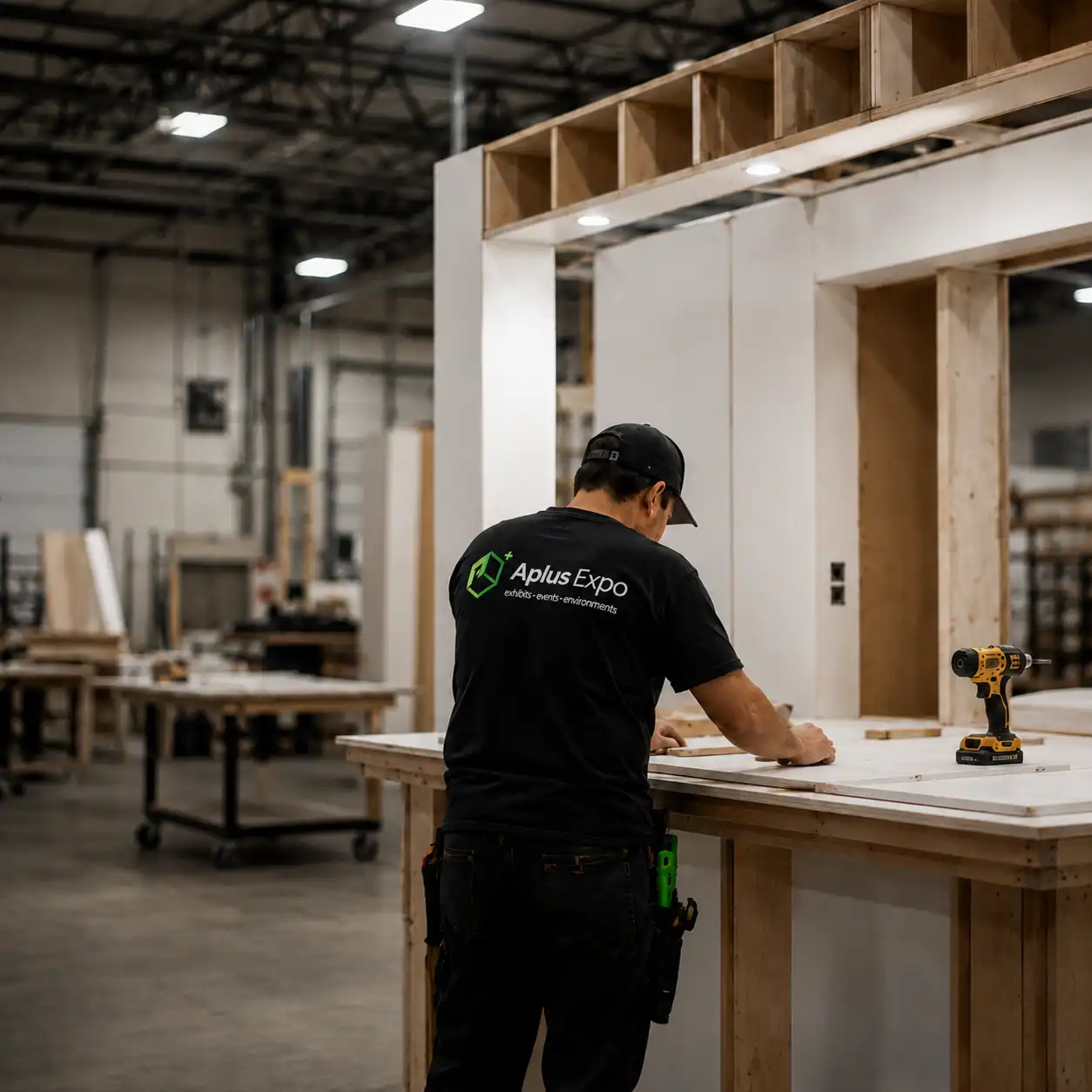
The counter-mechanism is the one piece of insider knowledge this guide rests on. The same booth gets built twice: once in a factory, fully stood up, dressed with graphics, and photographed for approval. Once at the show, the crew re-assembles what was already proven to work. A 20×20 that would take a crew days to build from scratch then goes together in two to three hours. Do the arithmetic on reported union rates. A single eight-hour day with a small crew is thousands of dollars; a two-hour re-assembly is a rounding error by comparison.
The same pre-assembly logic runs through a first-time exhibitor checklist. It is built around arriving with everything ordered, labeled, and confirmed so on-site work stays minimal.
Built twice. Billed by the hour.
2–3 hrs
on-site re-assembly of a pre-built booth
A booth fully stood up, dressed with graphics, and photographed for approval in the factory re-assembles on site in hours — not the days a from-scratch build would bill.
Union decorator labor, exhibitor-reported: ~$171/hr standard · ~$286.50/hr overtime (Reddit r/Entrepreneur, Jan 2025)
None of this applies the same way in non-union show cities. Las Vegas, Orlando, and much of the South operate with cheaper, more flexible labor. That is one reason identical booths carry very different price tags by city. If your show is in Chicago or New York, ask every supplier two questions: which crew builds on site, and how much of the booth arrives pre-assembled.
Who Orders the Services — and Who Bills You
The second mechanism is organizational. Every show has an official service contractor, the show management’s exclusive provider of rigging, furniture, carpet, material handling, electrical, and labor. Orders placed through the show’s ordering system go to that contractor. Some are billed after the show closes. Official service contractors are candid about material handling: moving your freight from the dock to your booth and back is often billed at the end of the show.
But the official contractor is not your only option for the booth itself. Exhibitors can appoint their own exhibitor-appointed contractor (EAC) to supply and install the exhibit. That is where the full-service model lives: one contractor who designs, builds, pre-assembles, ships, installs, and stands by during the show, and who answers to you, not to show management. Map the responsibility split before you order anything.
Who orders, who bills: service responsibility map
| Service | Who places the order | Who bills you | When the bill arrives |
|---|---|---|---|
| Floor space | You (through show registration) | Show organizer | Before the show |
| Power, rigging, furniture, carpet | You (exhibitor ordering site) | Official service contractor | Some items after the show |
| Material handling (drayage) | You or your freight partner | Official service contractor | After the show, by weight and arrival window |
| Exhibit design, build, install | Your exhibitor-appointed contractor | Your EAC | Per your contract |
| Dismantle and removal | Your EAC or official contractor | Whoever you appointed | End of the show or after |
The pattern: the lines that arrive after the show are the ones ordered through the show’s own channels. The lines under your control are the ones your own contractor manages under a contract you signed. That is exactly where surprise bills come from, and the next section shows how to stop them.
Where Surprise Bills Come From — and How to Head Them Off
The horror stories are real, and they share a shape. A marketing manager on Reddit’s r/marketing describes a union-city show where a mid-show solution ended with the union charging roughly $90,000 over expectations. Exhibit logistics firms call material handling the “exit fee that surprises newbies.” Budgeting guides also concede that “the only certainty is that there will be at least one surprise expense.”
The surprise-bill pattern
Hourly labor in union cities + services ordered through the show’s own system + settlement after the show closes = invoices that arrive after your budget meeting is over.
The defenses are boring, which is why they work.
Before the show: ask for one itemized quote naming every line: design, production, graphics, freight, install, dismantle, on-site support. Then ask when the account is settled. “Will any bill arrive after the show?” is the best question a first-time exhibitor can ask a contractor. The answer separates full-service quotes from opening bids. Read the exhibitor manual for service order deadlines, and confirm a material handling agreement (MHA) for every outbound destination.
At the show: watch the clock on anything billed hourly. Workers are on the meter from the moment they arrive. Label every empty box before it goes to storage; anything still inside a stored container is unreachable for the whole show. Test demo equipment before doors open, not during the first rush.
At teardown: appoint one person to oversee packing and shipping. Verify every service invoice at the service desk before you leave. Follow up with every lead within a week. The investment decays fast once the carpet comes up.
The defense chain
Before the show: get one itemized quote naming design, production, graphics, freight, install, and dismantle.
Before the show: ask when the account settles — and whether any bill arrives after the show.
Before the show: read exhibitor manual service deadlines and confirm MHAs for every destination.
At the show: track hourly labor, label every stored box, and test everything before doors open.
At teardown: verify every invoice at the service desk and follow up with leads within one week.
Make It a Program, Not an Event: Multi-Show Economics
If your first show goes well, the second is already on the calendar. Exhibiting stops being an event and starts being a program, with different economics.
Turn One-Time Costs into Per-Show Rates
The core habit of the multi-show exhibitor is amortization: every cost expressed per show. Graphics refreshed yearly spread across three shows cost a third as much per show as for a single event. A custom exhibit rented per show carries a predictable per-show rate with no storage line. The same exhibit purchased needs storage, maintenance, and refurbishment added before it can be compared fairly. For a company exhibiting twice a year in the same city at the same size, ownership eventually wins on paper. But the paper never includes your team’s hours managing the asset. Most exhibitors, including the most experienced, keep renting custom for exactly that reason: the per-show rate is the total cost, and someone else carries the warehouse.
Measure, Then Improve — and Audit Your Vendor the Same Way
Program economics run on three numbers: cost per square foot year over year, cost per lead, and the conversion of the leads you follow up within the week. Compute all three after every show. Trends appear that no single event can show you.
When you have those numbers, one pattern emerges. The budget lines you can actually defend are the hourly ones (labor, logistics, on-site work), because they move with how the work is organized. The defense that works is not negotiating harder on space. It is moving assembly off the show floor and into a factory.
Audit any supplier the way you audit your own program. How much of the booth arrives pre-assembled? What is the on-site labor estimate, teardown included? Does the itemized quote name every line and the settlement date?
Audit any supplier with three questions
How much of the booth arrives pre-assembled?Tests whether the factory did the work before the show.
What’s the on-site labor estimate, teardown included?Tests billable hours in both directions.
Does the itemized quote name every line and the settlement date?Tests whether any bill can still arrive after the show.
We answer all three in writing. Our in-house exhibit manufacturing is set up to show you, and our free 3D booth design puts a line-item quote in your inbox within 48 hours, usually after three rounds of revisions or fewer. A vendor who has already removed these surprises for hundreds of first-timers is worth more than any discount on the space.
If you are weighing a first show, start the conversation the way you would start the budget: with the line items, not the brochure. Get a free design and itemized quote and see what the whole picture (including the parts other quotes leave for later) actually costs.
See Your Booth’s Full Price Before You Sign
Free 3D design and a line-item quote within 48 hours — with the factory pre-build, install, dismantle, and the settlement date all named in writing.
Request My Free Quote- r/Entrepreneur. “It’s Time to Talk About Trade Show Unions.” https://www.reddit.com/r/Entrepreneur/comments/1hvefsf/its_time-to-talk-about-trade-show-unions-freeman/
- r/marketing. “Who Would You Say Is to Blame for This Trade Show F*** Up Costing $90K?” https://www.reddit.com/r/marketing/comments/1h0n9v1/who-would-you-say-is-to-blame-for-this-trade-show/
- Quora. “How Much Should I Budget for My First Trade Show?” https://www.quora.com/How-much-should-I-budget-for-my-first-trade-show
- Aplus Expo. “In-House Exhibit Manufacturing.” https://www.aplusexpo.com/service/exhibit-manufacturing/
- Aplus Expo. “Free 3D Booth Design.” https://www.aplusexpo.com/service/booth-design/
- Aplus Expo. “Contact.” https://www.aplusexpo.com/contact/
- Aplus Expo. “Home.” https://www.aplusexpo.com/


 English
  Spanish
  German
  French
  Italian
  Korean
  Chinese