
Every search result for “hotels near moscone center” hands you the same thing: a ranked list of hotel names, star ratings, and distances measured in a straight line. The lists are fine as far as they go. What they never tell you is that the answer changes depending on when you’re asking. Moscone Center’s show calendar reshapes price, availability, and even which streets feel right to walk. This guide covers the geography the booking sites blur, plus the calendar mechanics behind sold-out weeks. It also sorts out the channel traps (including the fake-housing kind) and the block-by-block reality of the surrounding streets. The last section is the one that only matters if you’re staffing a booth rather than attending one.
Which Hotels Are Actually Near Moscone Center?
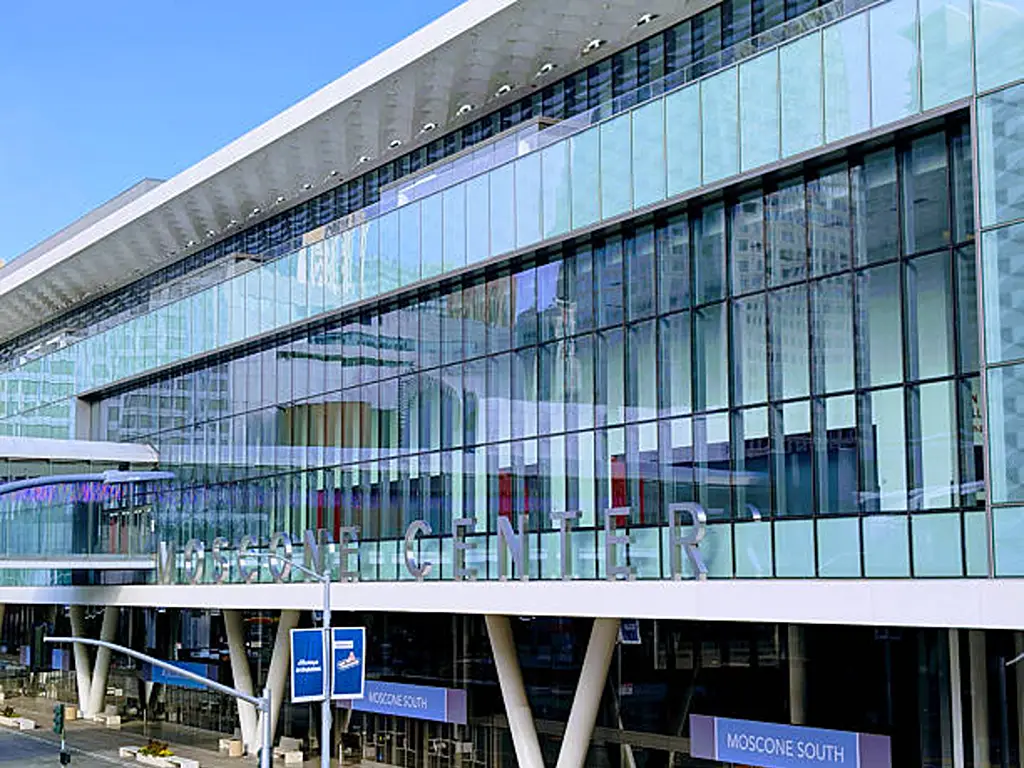
Moscone Center is not one building. It’s a complex of three halls (South, North, and West) strung along Howard Street between 3rd and 5th in SoMa. A 2019 expansion grew the connected exhibit space by 21%, to nearly 505,000 square feet (Meeting Professionals International, 2019). Big shows take all three halls at once. That makes the hotel question a geography question: where you sleep matters less than which corridor connects you to Howard Street.
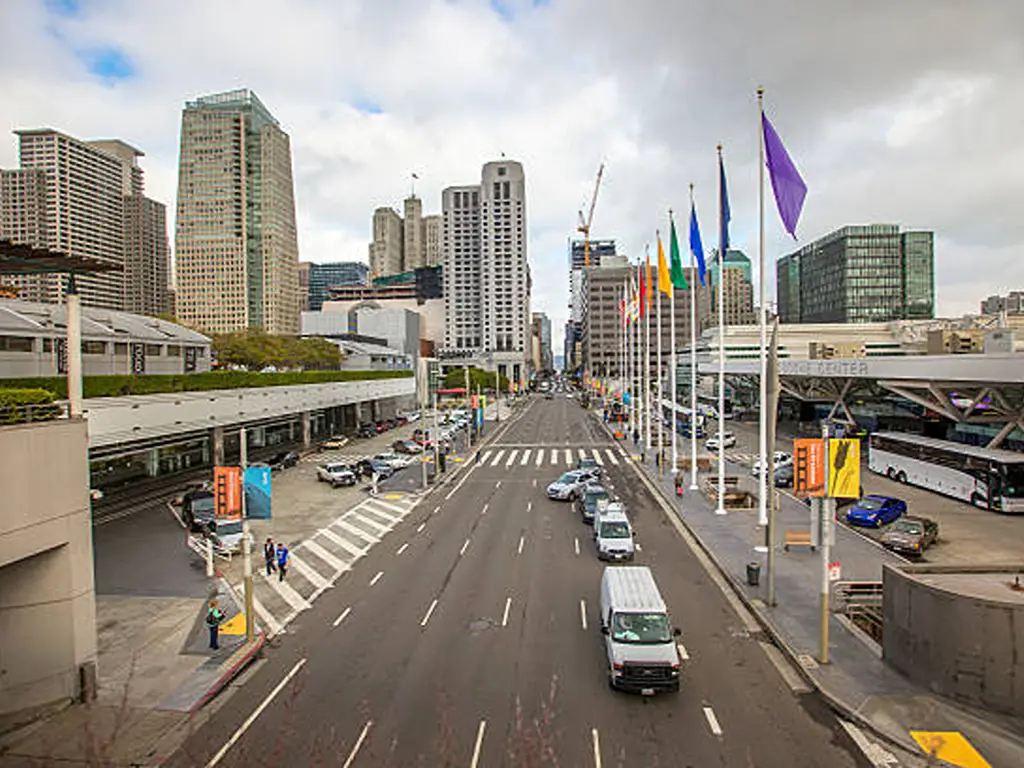
The corridor that matters is 4th Street. It runs from the Moscone West corner at 4th and Howard straight up to Market Street, past Yerba Buena Gardens and the Metreon. At the top sits Powell Street station, where the BART and Muni lines from the airport arrive. Hotels within two or three blocks of that vein are genuinely close. Hotels that map close but sit a few blocks east or south of it are the ones that generate one-star reviews from surprised travelers.
The 4th Street corridor
Booking sites blur this. Their “near Moscone” filters routinely include properties a mile away by straight-line measurement, such as the Embarcadero hotels near the Ferry Building. They also list Fisherman’s Wharf properties that sit a 30-to-40-minute walk from the exhibit halls. A useful rule: before you book, check which side of Market Street the hotel sits on, then picture the walk at 10 p.m., not at noon.
| Zone | Typical properties | Real walk to Moscone South | What to know |
|---|---|---|---|
| Across Howard Street | Marriott Marquis, InterContinental | 2-5 min | Closest of the close; show-week premiums start here |
| 4th St corridor / SoMa core | W, St. Regis, Four Seasons, Hotel Zelos, Zetta, The Mosser | 5-10 min | Lively day and night along the main vein |
| Union Square southern edge | Parc 55, Handlery, Chancellor, Beacon Grand | 8-12 min | Full restaurant and retail cover; you cross Market each way |
| Market Street classics | Palace Hotel, The Pickwick, Villa Florence | 8-15 min | Check the cross streets; quality shifts block by block |
| The inflation zone | Embarcadero and Wharf properties on OTA lists | 20-40 min | Listed as “near” by filters; not near in any useful sense |
One more thing the lists won’t sort for you: the neighborhood character changes at the edges of this map. That matters more after dark than it does in a booking-site filter, and it gets its own section below.
How the Moscone Show Calendar Resets Price and Availability
The same room at the same hotel can be $180 in one week and effectively unavailable the next. That isn’t surge pricing whimsy. It’s the single most predictable pattern around Moscone, and it runs on a calendar that is published months in advance.
The calendar is public. Pricing follows it.
Moscone’s biggest shows are fixed annual anchors. Dreamforce 2026 runs September 15-17 across all three Moscone halls (Salesforce, 2026), drawing a crowd estimated at more than 43,000 (ABC7 News, 2026). RSAC 2026 took over the same halls March 23-26 (Moscone Center, 2026), in an event that now draws over 44,000 attendees a year (RSAC, 2026). GDC, rebranded this year as the GDC Festival of Gaming, filled the complex March 9-13 (Moscone Center, 2026) with roughly 20,000 attendees (Game Developer, 2026). Add the Winter Fancy Food Show, AWS events, TechCrunch Disrupt at Moscone West, and dozens of medical and trade associations, and the calendar stays crowded nearly year-round.
None of this is a secret. The dates are public long before the rooms are gone. That means the pricing pattern is visible in advance to anyone who looks.
How fast rooms actually disappear
Here’s the mechanic most first-time visitors never see: the group business books first, and it books enormous. For 2026, San Francisco Travel had 618,160 Moscone-associated hotel room nights under contract across 30 events before the year began, targeting 650,000 (San Francisco Business Times, 2025). Those blocks are locked with hotels a year or more out. By the time an individual traveler searches “hotels near moscone center” for a show week, the group inventory has already claimed the best rooms at contract rates. What remains is what the hotels chose to hold back.
The citywide math makes the squeeze vivid. San Francisco has about 34,000 hotel rooms in total. Moscone’s own materials note that more than two-thirds of them sit within walking distance of the halls (LUMA Hotel, 2026, citing Moscone Center). Now put one big show against that inventory:
Show-week supply math
When the calendar tops out, price stops being the constraint. Existence is the constraint.
Why overlapping weeks hit harder than single shows
A single big show is hard. Back-to-back shows are worse, for an unglamorous reason: housekeeping can’t turn over the entire downtown in one night. GDC exited in mid-March and RSAC arrived ten days later. Hotels were reselling the same rooms to different crowds with barely a gap. Late bookers for the second show discovered that the first show’s attendees had effectively already taken their room. Weekend shows add another wrinkle, because leisure travelers who booked “cheap Sunday nights” months earlier are competing for the same rooms as Saturday-night conference goers.
The practical takeaway: any “$from” rate you see attached to a Moscone show week is quoting a price from the calendar’s quiet stretches. In a show week, the honest answer is whatever’s left after the group blocks. And “whatever’s left” can mean nothing at all.
Official Hotel Blocks, Direct Rates, and Housing Pirates
Once you accept that show weeks run on a different system, the channel question gets simpler. There are four doors, and only one of them occasionally bites.
Start with the official housing desk. Big organizers funnel attendees there on purpose. Salesforce’s own Dreamforce registration pages push visitors to book early precisely because “Dreamforce hotels sell out fast,” with room inventory held across the Bay Area for attendees (Salesforce, 2026). Blocks release unsold rooms back to hotels over time, so an official-desk room that appears “gone” in January can reappear in June at a fair rate.
Second, price the direct rate at the same hotel. A direct reservation puts you, not a middleman, on the phone with the hotel when a show shifts dates, and it keeps your loyalty night credits. During show weeks, direct rates are usually competitive with anything legitimate on the OTA listings anyway, because the hotels know demand is coming to them.
Third, read OTA listings for what they are. Aggregators are excellent for scanning the field and checking cancellation terms side by side. Just treat a show-week “deal” with suspicion: if a rate looks drastically under the market, find out why before paying, not after.
Fourth, vet anyone who contacts tu. The booking scam pattern is well documented across major trade shows. Third-party firms pose as the official housing partner, take deposits, and deliver nothing. That’s why show organizers keep repeating that only the official housing partner should be used (Rollstack, 2026, describing HLTH’s warning; the same template is standard across large events). Run any outbound offer through this list:
Housing-offer checklist
- Match the company name against the organizer’s published housing partner, letter by letter.
- Refuse full upfront payment; legitimate desks take deposits or card guarantees, not wire transfers.
- Demand a confirmation number you can verify directly with the named hotel.
- Be suspicious of firms that recently changed names or have no history before this year.
- If pressured to “confirm today or lose the rate,” walk away; real inventory reappears, fake inventory doesn’t.
The boundary worth stating plainly: a nonrefundable bargain in a show week is not a discount, it’s an unhedged bet. Shows do cancel and move. GDC 2020 was scrapped about three weeks before its March dates when the pandemic hit (Los Angeles Times, 2020). Attendees holding flexible rates rebooked; the nonrefundable crowd ate the loss. A refundable rate that costs ten or fifteen percent more is the cheapest insurance sold in the hotel business.
SoMa, Union Square, or Mid-Market: Picking a Block You Can Walk at Night
Every hotel in the walkable zone is not equal, because the streets around Moscone change character fast, and they change most after dark. Repeat visitors learn this map through bumps; here it is up front.
The 4th Street corridor: the default route
From Moscone West up to Powell Street station, 4th Street is the show-town main street. Foot traffic runs heavy during events, storefronts stay open, and constables and event staff appear during big shows. Hotels along it or one block off it are the safest all-around picks for first-timers, solo travelers, and anyone dragging a roller bag at 9 p.m. When Salesforce attendees ask whether their Dreamforce hotel is in a safe spot, the recurring local advice is to orient toward the big well-lit properties and main veins (Reddit, r/salesforce, 2025).
Union Square’s southern edge: services and foot traffic
Cross Market Street and you’re in the Union Square zone, where the hotel stock is dense and the restaurant, pharmacy, and retail cover is the best in the city. The 8-to-12-minute walk down to Moscone stays busy into the evening, which is exactly what you want. The tradeoff is money: this zone holds its price hardest during show weeks because it serves both the convention crowd and leisure shoppers at once.
The Mid-Market edge: cheap, close, and a different place after dark
Along Market Street toward 6th and 7th, room rates drop and proximity stays excellent on the map. This is the zone that catches travelers who book on price. The cautionary example is on the record: a solo international conference attendee booked eight nights near the Warfield at Market and Taylor (Tripadvisor, 2023). They then discovered the neighborhood’s reputation and posted asking whether to rebook entirely. The blocks around 6th and Market sit at the edge of the Tenderloin and Mid-Market corridors. In daylight they’re simply gritty. After dark the character shifts in ways that booking-site filters never mention. If budget forces you here, choose properties on Market itself with busy entrances, and plan evening walks along Market rather than the numbered cross streets.
Deep SoMa: quiet streets that empty out
South and west of Moscone, past about 8th Street, the blocks turn residential-industrial. Hotels there can be genuinely good value and a ten-minute walk from the halls, but the streets empty after the convention crowd goes home. For a group of colleagues walking back from a vendor dinner at 10 p.m., that quiet is the problem. This zone works for car-based travelers and for show veterans who know exactly which corners they’ll cross. It’s the wrong default for a first visit.
| Block | Daytime | After dark | Ideale per | Fails when |
|---|---|---|---|---|
| 4th St corridor | Busy, direct, event-staffed | Active on the main vein | First-timers, solo travelers, team members with gear | Show-week prices bite hardest right at the halls |
| Union Square south edge | Full services, shopping crowds | Well-lit and busy | Teams mixing work and client dinners | Budgets; premiums persist all week |
| Mid-Market edge | Gritty but functional | Character changes; use Market itself | Rate-constrained travelers who plan routes | Bookers who assume “close” means “fine at 10 p.m.” |
| Deep SoMa | Quiet, easy walking | Streets empty out | Car-based repeat visitors | First-timers and evening group movement |
Whichever block you pick, remember the choice only holds if the room exists on your dates. That brings the calendar back into the picture.
The Exhibitor’s Lodging Playbook for Moscone Show Week
Everything above assumes you’re an attendee. If you’re the person running a booth, the lodging question has three structural differences, and they change how you should book.
Your dates start at move-in, not at opening day
Attendees arrive with the show. Exhibitors arrive before it: booth builds, freight pickups, and staff rehearsals happen in the day or three before the doors open. That’s precisely when attendee-priced inventory is still fat but exhibitor schedules are already locked. Your room window is longer, your first morning starts earlier, and your booking dates must be set from the move-in schedule, not the show dates printed on the banner. Keep the two logistics streams separate in your head as well: freight moves through the advanced warehouse and drayage, and people move through hotels and the 4th Street corridor. Exhibitors who blur those two streams end up with a rental car nobody needs and a hotel nobody can reach by noon.
The rush contrast: what can and can’t be expedited
Here’s the asymmetry that should drive your whole booking sequence. On the booth side, time is compressible: builders pre-fabricate in their own shops, and late decisions get absorbed. Some shops run standard production in two to three days and rush builds in three to four when a show sneaks up on a team. On the hotel side, time is not compressible at all. No amount of budget summons a sold-out room back into existence. So the single most valuable scheduling move available to an exhibitor is, unglamorously, booking refundable rooms early:
Exhibitor lodging timeline
Treat the lodging line as part of the exhibit project budget, next to the space rental and the build, not inside the travel budget. It behaves like the booth: it’s a cost of existing at the show, it’s date-locked to the show calendar, and it rewards early commitment with flexibility.
If you’re planning a Moscone build and want to see what that compressible side looks like, that’s our business at Aplus Expo. We design and build custom and rental booths for San Francisco shows. Our standard production runs two to three days, and we have delivered rush builds in as little as three to four. In practice we aim to have every project delivered and standing the day before the doors open. The rooms, though, are the one part no builder can rush for you. Lock them early, keep them refundable, and let the calendar work for you instead of against you.
Get a Moscone Booth Quote From Aplus Expo
Custom and rental booths for San Francisco shows — tell us your dates and we’ll plan the build backward from move-in.
Request Your Booth QuoteRiferimenti
- Salesforce. “Dreamforce 2026.” 2026. https://www.salesforce.com/dreamforce/
- Moscone Center. “Salesforce Dreamforce 2026.” 2026. https://www.moscone.com/events/salesforce-dreamforce-2026
- ABC7 News. “Dreamforce Welcomes More Than 43,000 to SF.” 2026. https://www.facebook.com/abc7news/videos/1071537352458088/
- Moscone Center. “RSAC 2026 Conference.” 2026. https://www.moscone.com/events/rsac-2026-conference
- RSAC. “Frequently Asked Questions.” 2026. https://www.rsaconference.com/about/faq
- Moscone Center. “GDC Festival of Gaming.” 2026. https://www.moscone.com/events/game-developers-conference-gdc-festival-gaming
- Game Developer. “Rebranded GDC Festival of Gaming Attracts 20,000 Attendees.” 2026. https://www.gamedeveloper.com/business/rebranded-gdc-festival-of-gaming-attracts-20-000-attendees
- San Francisco Business Times. “Moscone Center Convention Bookings Boost S.F. Hotel Pace.” 2025. https://www.bizjournals.com/sanfrancisco/news/2025/09/03/moscone-center-sf-travel-pace-visitor-summit.html
- LUMA Hotel San Francisco. “Business Travel Near Moscone Center.” 2026. https://www.lumahotels.com/blog/business-travel-near-moscone-center-luma-sf/
- Meeting Professionals International. “Moscone Center Expansion Ushers in a New Era for Meetings and Events.” 2019. https://www.mpi.org/media/blog/articles/article/moscone-center-expansion-ushers-in-a-new-era-for-meetings-and-events
- Salesforce. “Dreamforce 2026 Pre-Registration (Official Housing).” 2026. https://www.salesforce.com/dreamforce-pre-reg/
- Rollstack. “HLTH USA 2026: Overview & Attendee Guide.” 2026. https://www.rollstack.com/articles/hlth-2026
- Los Angeles Times. “San Francisco’s Game Developers Conference Canceled Over Coronavirus Fears.” 2020. https://www.latimes.com/entertainment-arts/story/2020-02-28/san-franciscos-game-developers-conference-canceled-over-coronavirus-fears
- Reddit, r/salesforce. “Dreamforce Hotel Location Secure?” 2025. https://www.reddit.com/r/salesforce/comments/1l4oedv/dreamforce_hotel_location_secure/
- Tripadvisor. “Traveling for Conference in Moscone Centre, San Francisco.” 2023. https://www.tripadvisor.com/ShowTopic-g60713-i30-k14512528-Traveling_for_conference_in_moscone_centre_san_francisco-San_Francisco_California.html
- Aplus Expo. “Trade Show Displays San Francisco.” 2026. https://www.aplusexpo.com/exhibit-service-san-francisco/
- Aplus Expo. “Homepage.” 2026. https://www.aplusexpo.com/
 English
  Spanish
  German
  French
  Italian
  Korean
  Chinese