
Hotels Near George R. Brown Convention Center: What’s Actually Where
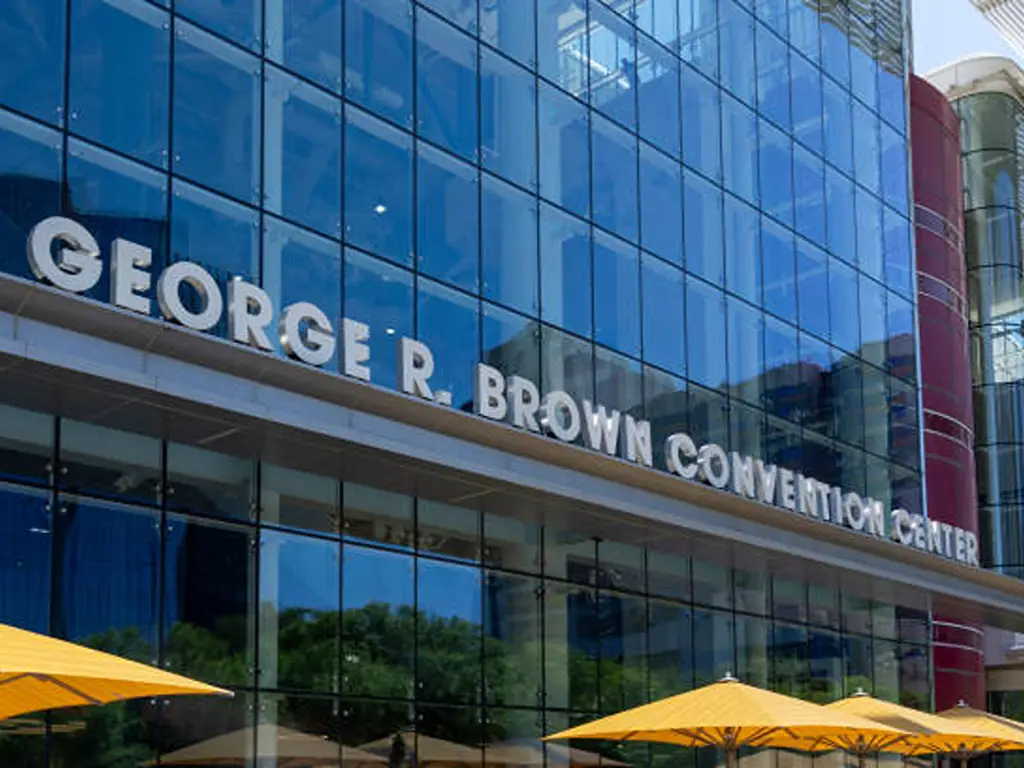
Quick clarification first: this guide is about the George R. Brown Convention Center (GRB) at 1001 Avenida de las Americas in downtown Houston (not the college in Toronto that shares part of the name).
GRB is one of the ten largest convention centers in the country, with 1.9 million usable square feet of event space (Houston First, 2026). Around it sits one of the more walkable hotel clusters in Houston, and the layout is easy to split into three rings.
The first ring is the convention campus itself. Two hotels connect directly to GRB through skybridges: Hilton Americas-Houston, a 1,200-room property on the south side, and Marriott Marquis Houston, a 1,000-room hotel on the north side with the Texas-shaped lazy river on its rooftop (GRB Houston FAQ, 2026). You can go from bed to exhibit hall without crossing a street.
The second ring is the walkable block around it, roughly ten minutes on foot. That’s where Embassy Suites Houston Downtown, Club Quarters Hotel Downtown, the Hampton Inn near the convention center, and the Holiday Inn Express & Suites Houston Downtown-Convention Center sit, among others. Prices here usually run a tier below the two connected properties.
The third ring is everything else: Midtown hotels linked by the METRORail, the cheaper corridor toward the airport, and the neighborhoods east of the venue. Those east-side blocks can save real money, but the streets get quieter after dark. Most first-time visitors treat them as a drive-in option rather than a strolling one.
One table covers the landscape. Rates shown are typical off-peak baselines, not promises — show weeks change them, which is the subject of the third section below.
Hotels Around George R. Brown at a Glance
| Ring | Esempi | Connection to GRB | Typical rate band | Ideale per |
|---|---|---|---|---|
| Skybridge campus | Hilton Americas-Houston; Marriott Marquis Houston | Indoor skybridge, no street crossing | $$$ | All-day agendas, bad weather, short stays |
| Walkable ring (~10 min) | Embassy Suites Downtown; Club Quarters; Hampton Inn; Holiday Inn Express & Suites Downtown-Convention Center | 5–10 minute walk | $$ | Standard trips, per-diem budgets |
| Short hop | Midtown hotels via METRORail; airport-corridor motels | Rail or 10–15 minute drive | $ | Longer stays, price-sensitive visitors |
If you want to price the rings yourself, hotel platforms list them directly: Kayak’s baseline for the area starts around $98 a night (Kayak, 2026), and sampled listings showed roughly $130 at Hilton Americas versus $253 at Marriott Marquis on the same search (Trivago, 2026). Treat those as calm-week numbers. Boutique properties and apartment-style rentals fill out the map — they exist and they’re bookable, but their availability swings hardest when a big show comes to town.
Skybridge Hotels vs. Three Blocks Out: Is the Premium Worth It?
The honest answer: for some agendas the skybridge is worth every dollar, and for others it’s $100 a night for a hallway you’ll never use. The difference is how locked-in your days are.
The connected hotels earn their rate when your hours belong to the building. If your agenda runs wall-to-wall inside GRB — morning sessions, working lunches, an afternoon you’d rather spend resting than commuting — the bridge pays you back several times a day. It also matters in July and August, when a five-minute indoor walk and a fifteen-minute street walk are not the same experience, and during thunderstorm weeks, which Houston has plenty of.
Three blocks out wins when your evenings leave the venue. Downtown restaurants, a client dinner in Midtown, an early rideshare to the airport — none of these get better because your hotel has a bridge. And the saving compounds: an $80–120 nightly gap over a three-night stay is a real line item, not a rounding error.
Three checks settle it faster than any review site:
- Count how many hours per day you’ll actually be inside GRB. Four or more, and the bridge starts paying rent.
- Check whether you need midday access to your room — to rest, change, or take calls. If yes, distance costs multiply.
- Price the same nights in both rings before deciding. The premium shrinks in slow weeks and doubles in show weeks, so the right answer in March may be wrong in September.
One boundary to keep in mind: “walkable” assumes weather cooperates and you’re carrying nothing heavier than a laptop bag. If your days involve hauling samples or booth gear, move yourself one ring closer, not two.

Why the Same Room Costs Double During Show Weeks
How the Inventory Disappears
Downtown inventory is spoken for long before most travelers start looking. Organizers of major events reserve room blocks months to years ahead, and those blocks sit off the public market until they’re released or expire. What’s left for open booking shrinks in steps — first the cheap rooms go, then the mid-tier, until the only things flashing “available” are the rates nobody wanted at any price. Dynamic pricing simply follows the remaining supply, which is why the climb feels sudden when you watch it from the outside.
The Price Steps and Your Real Booking Window
Think of the run-up to a big event as three steps. More than three months out, availability is wide and teams can still negotiate. Around six to twelve weeks, room-block cutoffs approach and open-market rates start their climb — this is the last comfortable window for most individuals. Inside two weeks, you’re choosing among leftovers at peak rates, and your phone starts ringing with third-party “housing” offers, which the fifth section covers in detail.
The prices in the first section make sense once you sort them this way. Kayak’s from-$98 baseline and the $130 Hilton sample are calm-week floors, not show-week expectations (Kayak, 2026). During something like CERAWeek, which packs more than 10,000 delegates from 90 countries into GRB and the connected Hilton each March (venue confirmed by CERAWeek’s own FAQ, 2026), downtown rooms behave like airline seats at holiday peak. That’s effectively what they are.
Your booking window at a glance
Houston’s Calendar Reality
This is a busy building: the venue and its district host more than 250 events and meetings annually (Houston First, 2026), which is why the price swings feel random if you don’t check what’s in town. Before you book anything, look at the venue’s event calendar (GRB Houston, 2026) and match it against your dates.
One honest boundary: not every week is expensive. A two-hundred-person medical meeting barely dents downtown inventory, and last-minute travelers do find fair rates in those weeks. The skill is telling the two kinds of weeks apart — the calendar tells you, and it takes two minutes.
When the calendar says your week is a show week, the booth schedule is the first domino — Aplus Expo returns a free 3D design and an itemized quote within 48 hours.
Start My Booth QuoteWhere Booth Crews Stay: Living on Move-In Time
Exhibiting crews run on a different clock than visitors, and it changes the hotel math. Shows at GRB typically begin move-in a day or two before doors open. One current GRB show’s exhibitor manual, for example, schedules move-in on Thursday afternoon and Friday ahead of a weekend opening. Your own show’s exact windows live in its exhibitor kit (GRB Exhibitor Guidelines, 2026).
That schedule makes one variable dominant: minutes from the loading dock and the hall entrance. A crew member starting at 7 a.m. doesn’t care about rooftop pools. Walk time to the door, early breakfast, and a bed you can reach at 10 p.m. after a teardown rehearsal — that’s the whole spec.
Crews also book as a unit or they book badly. Scattering five people across three hotels “to save money” costs the savings back in morning rendezvous, forgotten badges, and lunches that start at noon because someone took the wrong rail line. One property, ideally one floor, close enough that nobody drives.
And then there’s teardown night, which visitor-style bookings always miss. Tear-down regularly runs late into the evening after the show closes, which collides head-on with a standard morning checkout. Either reserve through the night after the show ends (the genuinely useful move), or confirm the hotel will store bags and let the crew clean up late. Decide this when you book, not at 9 p.m. on teardown day when the lobby is full of people asking the same question.
A quick check before any crew booking:
Before you book for a crew
Booking for a Team: Room Blocks, Middlemen, and the Paperwork
Booking for two people is a search; booking for a team is a small procurement exercise, and it has exactly three traps: the contract you didn’t read, the middleman you didn’t vet, and the cutoff you didn’t calendar.
How Room Blocks Actually Work
A room block is a contract: the hotel holds a set number of rooms for your group until a cutoff date, usually a few weeks before the event. Two clauses decide whether it’s a good deal. The attrition clause sets how many reserved rooms you must actually fill — fall short and you pay penalties on the empty ones. The comp ratio is the hotel’s thank-you: one free room per forty booked is a common shape. Neither clause is hidden, but both live in documents teams sign in a hurry. Read them when the offer arrives, and if your headcount is uncertain, negotiate a smaller block plus an overflow rate rather than a big block with teeth.
How to Spot a Housing Middleman
Every major show week, exhibitors get calls and emails from companies claiming to be the event’s “official housing partner.” Some are legitimate agencies; many are room poachers that take your money, book nothing, or resell rooms at a markup (Meetings Today, 2013). The pattern is old enough that shows now publish warnings on their own sites — the Craft Brewers Conference flatly states that any third party soliciting as its official housing company is not affiliated with the event (Craft Brewers Conference, 2026), and exhibitor forums fill each season with first-timers asking whether this month’s caller is real (r/tradeshows, 2025).
Three checks filter almost all of them:
- Match the caller against the show’s published official housing list — it’s on the event website or one email to show management away.
- Verify the company exists beyond a logo: a physical address, state registration, a phone that a human answers.
- Pay by credit card and treat any request for a wire transfer or full prepayment of a nonrefundable reservation as a stop sign, not a detail.
If the caller knows your name, your company, and the show you’re attending, that information came from a public exhibitor list. It proves nothing except that they can read the same list you can.
The Channel Matrix: What to Confirm Before You Sign
Team Booking Channels Compared
| Channel | Ideale per | Attenzione a | Confirm before you commit |
|---|---|---|---|
| Official room block | Teams of 5+ at big shows; want rooms near colleagues | Attrition penalties; cutoff dates arriving before you’re ready | Fill-rate obligation, cutoff date, comp ratio, cancellation terms |
| Hotel direct / OTA | Teams under ~4; irregular schedules | Show-week rates climbing while you compare tabs | Free-cancellation window; rate is per-night final |
| Third-party housing company | Handing off logistics entirely (rarely worth it) | Markup, bait-and-switch, nonrefundable prepay | Official-partner claim against the show’s housing list; card payment only |
| Split booking (crew near, guests flexible) | Mixed groups: booth staff plus visiting executives | Two itineraries to manage | Crew property is walkable to the hall; guests can live with a rail ride |
One boundary keeps this section honest: a block is not automatically the pro move. For a team of three at a mid-size event, attrition risk and paperwork can cost more than the rate saving — booking direct with free cancellation is the better contract. Blocks earn their complexity once you’re holding five or more rooms through a major week.
Putting Hotel Week on the Show Critical Path
Step back from the channels and the whole exercise has a simpler shape. Your team’s arrival date isn’t really a travel decision — it’s a production date. The booth is built off-site, shipped, and installed during move-in, with most build schedules staged so the stand is finished and inspected the day before doors open. Your crew’s first hotel night has to land on that schedule. That puts the room block on the same timeline as the build and freight plans, decided months out, not tacked onto a flight search.
It helps to keep two lines separate on that timeline. Freight moves first — crates and displays ship to arrive well before move-in, commonly a week or more ahead for out-of-state shows. People move on the show’s clock: in the night before move-in or opening, out after teardown, with the teardown-night extension already booked. When those two lines get merged into one “ship it and fly in” date, the freight and the crew both end up improvising.
Budget follows the same logic. Put the walking-distance money where the schedule pressure is: the crew that works mornings and teardown nights. Let visitors, guests, and flexible staff take the rail-ring rooms where the rates are calmer. That’s the whole allocation strategy — pay for proximity exactly in proportion to how nailed-down someone’s hours are.
None of this applies to every trip, and pretending otherwise is how advice becomes noise. A local team that drives in each morning needs none of it. A solo micro-exhibitor with a pop-up display can book direct a month out and do fine. A regular conference week with no big show in town barely moves rates. The strategy earns its keep when the calendar is loaded, the crew is real, and the booth is a project — which is precisely when rooms are scarcest and the cost of deciding late is steepest.
Key takeaway
Your booth is usually delivered the day before the show opens — which means your team’s arrival date was decided months ago.
Put the room block on the build timeline, not the flight search.
That is how we look at it at Aplus Expo, from the build side of the equation. We stage and pre-build every booth in our own factory so it arrives in Houston ready to assemble, and on our projects the stand is delivered the day before opening, with a project manager on call and standby support across show days. The same logic drives our pricing model — our all-inclusive booth rental quotes cover design, production, install and dismantle, and every bill, including show-organizer charges, is settled before the show closes, so there are no invoices waiting after you fly home. We run the same playbook for every city we serve; our Houston trade show service page covers the local details.
If you want a booth plan your Houston schedule can be built around, Aplus Expo offers a free 3D design and itemized quote within 48 hours.
Get a Booth Plan That Ships Before Move-In
Aplus Expo pre-builds every booth in its own factory and delivers the day before doors open — design, production, install and dismantle in one all-inclusive quote.
Get a Free 3D Design & QuoteRiferimenti
- Houston First Corporation. “George R. Brown Convention Center.” 2026. https://www.houstonfirst.com/venues-1/george-r-brown-convention-center/
- Houston First Corporation. “Convention District Transformation.” 2026. https://www.houstonfirst.com/convention-district-transformation-1/
- GRB Houston. “Convention Center FAQs, Information, Help.” 2026. https://www.grbhouston.com/attendees/faqs
- GRB Houston. “George R. Brown Convention Center | Events in Houston, TX.” 2026. https://www.grbhouston.com/
- GRB Houston. “Exhibitor Guidelines.” 2026. https://www.grbhouston.com/exhibitors/exhibitor-guidelines/
- CERAWeek by S&P Global. “Frequently Asked Questions.” 2026. https://www.ceraweek.com/en/about/faq
- Kayak. “Houston Hotels Near George R. Brown Convention Center.” 2026. https://www.kayak.com/Houston-Hotels_George-R-Brown-Convention-Center.L8885.31193.hotel.ksp
- Trivago. “Hotels Near George R Brown Convention Center.” 2026. https://www.trivago.com/en-US/opr/hotels-near-george-r-brown-convention-center?search=500-2464911
- Craft Brewers Conference. “CBC Attendee Scams.” 2026. https://www.craftbrewersconference.com/cbc-attendee-scams
- Meetings Today. “Beware of Room Poachers.” 2013. https://www.meetings-conventions.com/Third-Party/Beware-of-Room-Poachers/94933
- Reddit, r/tradeshows. “Exhibitors Hub Hotel Booking Question.” 2025. https://www.reddit.com/r/tradeshows/comments/1l8z0ud/exhibitors_hub_hotel_booking_question/
- Aplus Expo. “Booth Rental.” 2026. https://www.aplusexpo.com/service_categories/booth-rental/
- Aplus Expo. “Trade Show Displays Houston.” 2026. https://aplusexpo.com/exhibit-service-houston/
- Aplus Expo. “Contact — Get Your Free Design.” 2026. https://www.aplusexpo.com/contact/
- Aplus Expo. “Trade Show Services and Booth Display Specialist.” 2026. https://www.aplusexpo.com/
 English
  Spanish
  German
  French
  Italian
  Korean
  Chinese