
Where Trade Show Booth Rules Actually Live
Ask five exhibitors where “trade show booth rules” live, and you will get five answers. The rules are not one document. They are a stack of documents written by three different authorities, and each of them can fine you, delay you, or shut you down.
The three layers:
- The show organizer. Your prospectus, terms and conditions, booth-space rental contract, and the exhibitor services manual. This is the layer that actually governs your booth. The manual is the single most important document you will sign against, because it is the one show management enforces first.
- The venue. Convention centers publish their own facility rules on top of the show’s. Seattle Convention Center’s exhibitor guidelines, for example, sit between you and everything from electrical hookups to empty cardboard boxes.
- The law. The ADA, local fire codes, music-licensing law, and (in some cities) union work rules apply whether the show mentions them or not.
That stack explains a frustrating thing you have probably already hit: numbers online contradict each other. One source says booth height tops out at 8 ft, another says 30 ft. Both are right. Height depends on your booth type, then on the venue, then often on the specific hall. That is why every source in this guide ends the same way: your exhibitor services manual, for your booth type, at your show, wins. Treat everything else as a map of what to expect and what to ask about.
The problem was never the existence of the rules. It is that they arrive scattered, in different documents, on different schedules. Most of the money you can lose sits in the timing, not in the rules themselves. That is what the rest of this guide decodes.
Your Booth Type Sets Your Rule Book
Before any rule applies to you, the show assigns you a booth configuration, and the configuration decides which geometry rules you live under. The practical difference is mostly about height and sight lines: what you may build up to, and where you may block the view of the exhibitor next door.
| Booth type | Typical max structure height | What the sight-line rules do | 매달린 간판은 |
|---|---|---|---|
| Inline / linear (10×10, 10×20) | 8 ft back wall | Nothing over 4 ft tall in the front half of your space; sidewalls above 4 ft only in the back 5 ft | Generally not permitted over inline booths |
| Corner inline | 8 ft | Same 4 ft front-half rule on both aisle sides | Not permitted; check show exceptions |
| Perimeter wall | 12 ft | 4 ft front-half rule still applies | Not permitted for perimeter wall booths |
| Peninsula (20×20+, aisles on 3 sides) | 16–20 ft typical; back wall must be finished blank toward neighbors | Back-wall height steps down near adjacent booths | Permitted with approval |
| Island (20×20+, aisles on 4 sides) | 16 ft up to 20–30 ft by hall and venue | Fewer restrictions: you have no neighbors’ sight lines | Permitted; double-sided signs set back 10 ft from neighbors |
The ranges above follow the most widely used U.S. convention-hall pattern (the compilation published by Classic Exhibits tracks real hall splits: one Las Vegas center allows 30 ft in its North Hall and Central Halls 3–5, 20 ft in Central Halls 1–2, and 22 ft in South Halls). Do not design to these numbers. Design to your manual, then have the builder confirm the hall’s current rules.
Two rules in this station are near-universal, so they are worth internalizing now:
- Line of sight. In any inline space, nothing over 4 ft tall goes in the front half of the booth, because it blocks the view of neighboring exhibits. If you genuinely need the height up front, the only practical path is a variance signed off by the exhibitors next to you. Gift and craft shows sometimes drop this rule entirely; your manual tells you.
- Confines and flooring. Everything (products, literature, mascots) stays inside your rented perimeter, and most shows require you to cover your space wall-to-wall with carpet or flooring regardless of the hall’s own floor.
Islands, and anything with a roof or a second level, generally require you to submit structural drawings to show management. Drawings mean approval, approval means a schedule, and the schedule is where the bill gets written.
The Deadline Axis: Every Rule Has a Time
Read as a list, and the rules read like a wall of do-nots. Read as a calendar, and they line up as dates: each one is cheap before its deadline and expensive after it.
Miss the date, and a rule that cost nothing inside a design file now costs you labor, overtime, or a reprint, on the floor, against the clock.
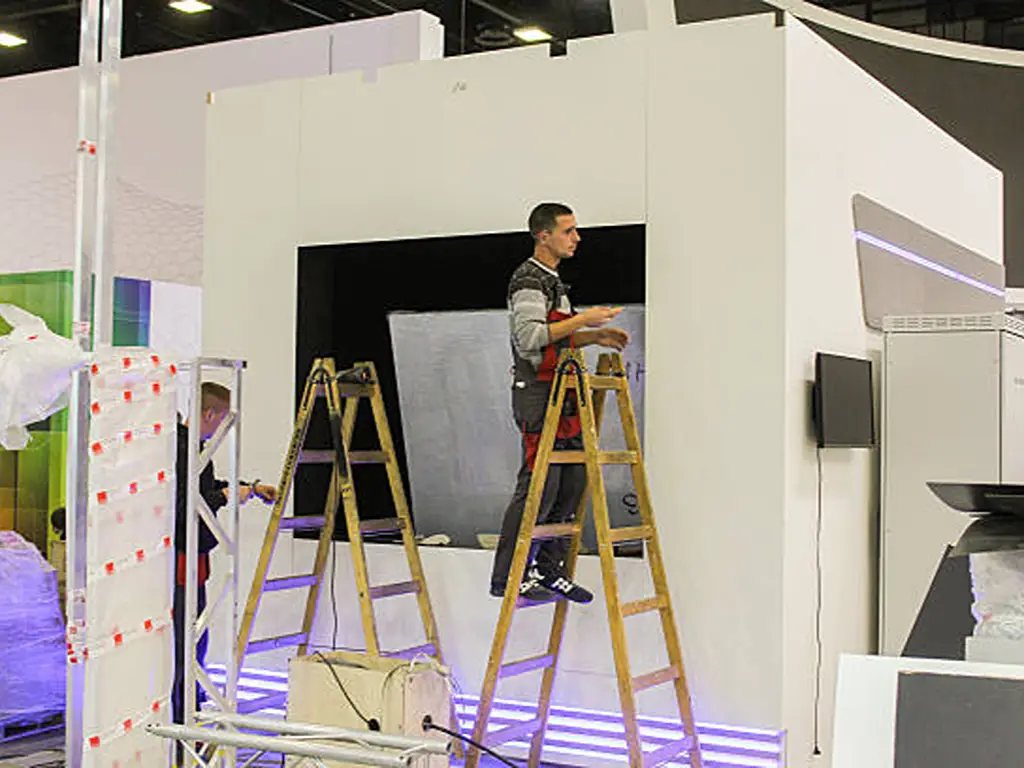
Design freezes catch geometry and material mistakes for free
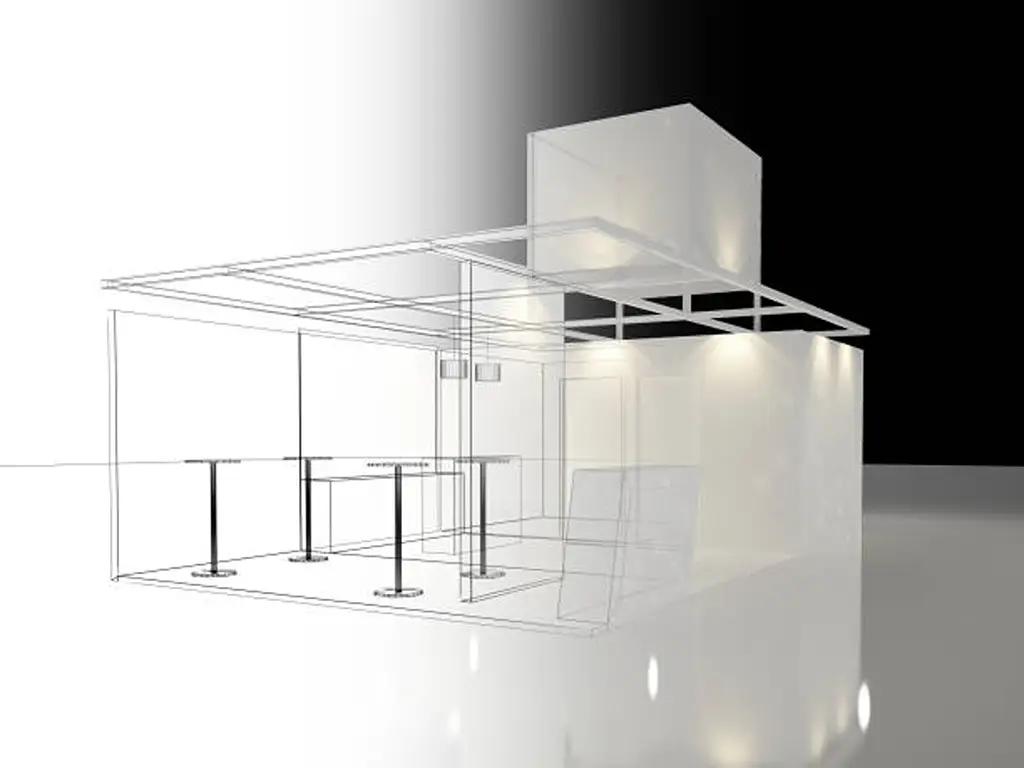
Height, sight lines, and canopy clearance (a canopy bottom must generally sit at least 7 ft above the floor near aisles) are all rules about drawings. While the booth is still a 3D file, breaking them costs nothing; the designer moves a wall. Once the structure is built, the same correction is labor at show rates. This is the single cheapest compliance step in the entire process, and it is the one first-time exhibitors skip because nobody told them the rules belonged in the design brief.
Fire, fabric, and the 100-square-foot ceiling
Materials are the second design-stage gate. Fabrics, drapes, carpet used vertically, and decorative materials must generally be flame-retardant, and the certificate of flame resistance stays in the booth for inspection (Seattle Convention Center requires the paperwork on site; most halls follow the same pattern). The bigger trigger is the roof: any booth with a covered area of 100 sq ft or more must submit a booth plan to fire-code review. Seattle’s official exhibitor guidelines tell exhibitors to allow three months for that approval. A small canopy does not get you out of everything: covered spaces are commonly held to one smoke detector per 900 sq ft regardless.
Service orders: the deadline that sets your bill
Electricity, rigging, internet, and cleaning each have an ordering deadline set by the venue or the official contractor. Order before it and you pay the advance rate. Order after it and you pay the on-site rate and join the queue. A few venue-level specifics that commonly surprise people:
- Power rules differ by building. The general U.S. pattern, per Exhibitor Magazine’s reporting: UL-rated equipment, 14-gauge flat cords, grounded plugs, and 220V equipment connected by the venue’s electricians only. Some centers, including the Las Vegas Convention Center, prohibit cube taps. Seattle forbids exhibitor-supplied power of any kind beyond small devices: no power banks, no batteries.
- Rigging (hanging signs, trusses) needs engineering review and often a designated rigging contractor, and hanging-sign approval has its own published deadline.
- Exhibit theatrics (haze machines, vehicles with fuel, open flame) are outright banned in many venues. Confirm before you design the demo.
Who Builds, Who Bills: Labor Rules on the Floor
Move-in is where the abstract rules turn into invoices with your name on them, because who is allowed to build your booth is regulated, and the labor is billed by the hour. Three paths exist, and which one is available depends on the city and the venue:
Who is allowed to touch your booth
Your own staff or hired labor. Many venues allow exhibitors to install with their own people. Seattle, for instance, lets exhibitors bring their own contract labor if every worker signs in with a photo ID and a work badge. Simple, cheap, and it evaporates the moment the venue or the show designates otherwise.
An exhibitor-appointed contractor (EAC). The builder you hired assembles your booth at the show. Nearly every venue also reserves certain tasks for itself or its exclusive providers: electrical, rigging, material handling, and food and beverage are the usual exclusives. That is why “we’ll do everything ourselves” is rarely true end to end. Your services manual lists which services only the official providers may touch, and ordering them late is where advance rates become on-site rates.
Union labor, in union cities. Chicago, New York, and several other convention cities require union crews for I&D work, and the rates are a different world. Nothing about this is negotiable at the dock; it is a function of the city you chose. What you can control is how many of those hours your booth actually needs.
Union-city labor · community-reported rates
Four-hour minimums bill even when the job takes ten minutes. The rate ladder is fixed; the number of hours is not.
Why the booth that arrives pre-built is cheaper
Put the hourly rates next to how much work happens on site, and the second rule of floor labor appears: the less your booth needs to be built at the show, the smaller the labor bill.
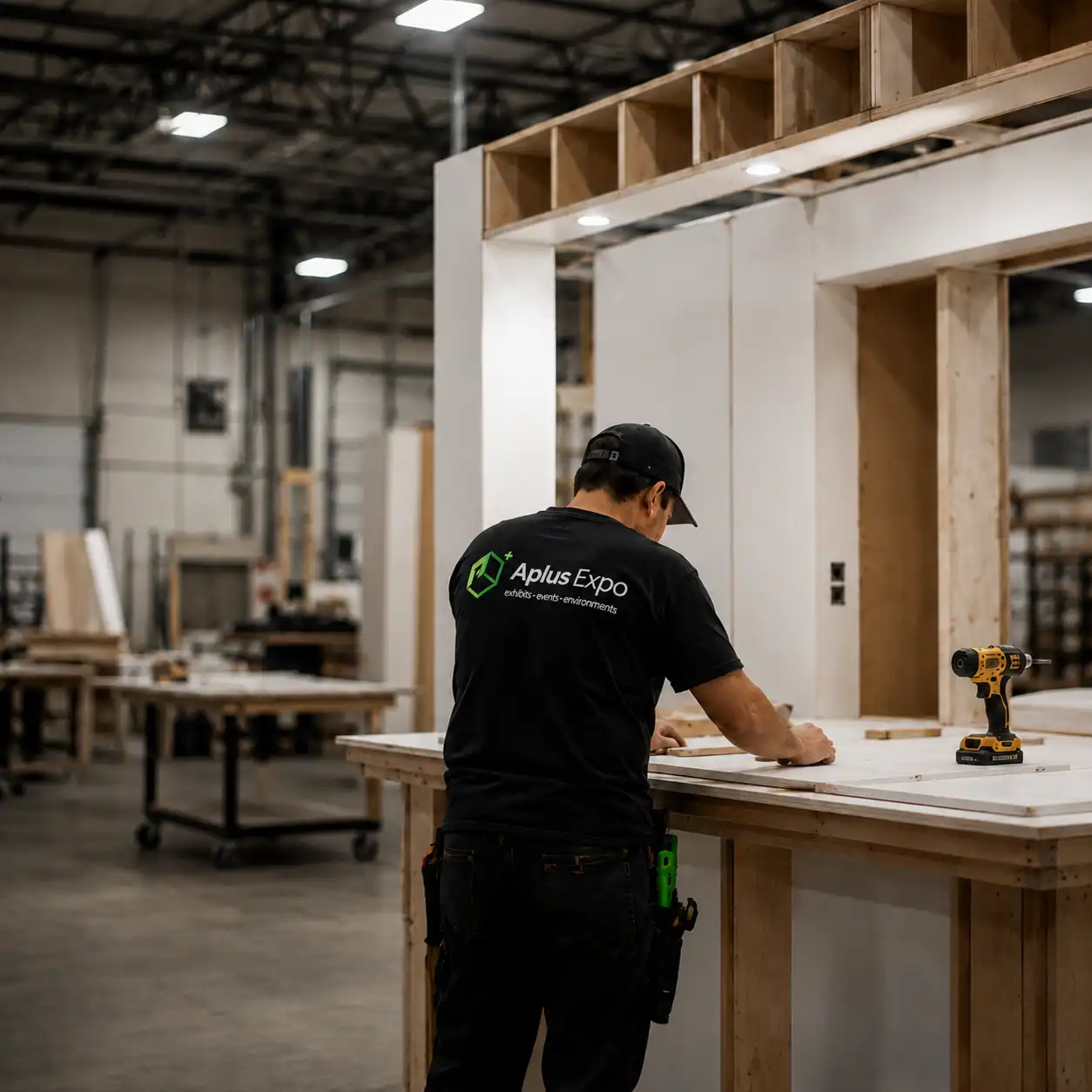
The mechanism is trial-building. A booth built once in a factory (structure up, graphics on the walls, photographed for sign-off) ships as a proven kit, and the on-site crew’s job is reassembly, not construction. Exhibitors who do this routinely compress I&D from days to a few hours. At roughly $171/hr for standard labor, the difference between a two-day assembly and a four-hour re-assembly is not a rounding error; it is usually the difference between two very different final quotes.
There is an expensive corollary to the height rules from station two. A violation caught during setup gets corrected at straight time; the same violation discovered after the show opens gets corrected after hours, on overtime. Exhibitor Magazine describes exactly this: the floor manager catches it during move-in, it is fixed in hours; miss that window and the fix happens on the OT rate after close.
Who touches your booth, and who bills
| Service | Who must do it | When to order | What missing the window costs |
|---|---|---|---|
| 전기 설비 | Venue / exclusive electrician | Before advance deadline | On-site rate + queue |
| Rigging & hanging signs | Approved contractor, engineering review | Published deadline | Late approval = no sign |
| Material handling (dock to booth) | Venue / GSC | With freight delivery | Storage & re-delivery fees |
| I&D labor | Your EAC, own crew, or union (by city) | Reserve move-in window | OT rates after window |
| Cleaning | Official provider | Advance order | Premium on-site rates |
| Food & beverage | Venue’s exclusive caterer (usually) | Show approval | Waiver fee or forfeited sampling |
On the Floor: What Gets Enforced
By opening morning, the geometry and labor rules are behind you.
The floor’s enforcement ladder
- Staffing and badges. Your booth must be attended and staffed during all published show hours. Badges are not transferable, and only contracted exhibitors may sell. “Staffed” is enforced; organizers walk the floor.
- Where you may market. Confines-of-booth applies to people too: no flyering in aisles or lobbies, no roaming mascots. Suitcasing (an attendee selling to exhibitors without renting space) and outboarding (a non-exhibitor hosting off-site hospitality to pull buyers away) are the two offenses organizers treat as existential, and the reported consequences run from ejection to being banned for life.
- Noise and music. Sound that carries beyond your booth is the usual test. WESA’s code of conduct, typical of many shows, prohibits music audible outside the booth entirely. Where limits are numeric, expect roughly 85 dB or the level in your manual, and know that a second warning can mean disconnection. Music also carries copyright: playing recorded or live music can require BMI/ASCAP/SESAC licensing that runs into hundreds of dollars per event for popular tracks.
- Nothing changes until close. Most rules require your booth to remain exactly as displayed at opening until official close. WESA’s rules cite a $1,000 penalty for breaking down early, and boxed stock or packing crates visible before closing is itself a violation. Even food sampling has rules: if you are not a food exhibitor, the venue’s exclusive caterer usually controls what you may serve, and the waiver economics can make “free water” surprisingly expensive.
Turn the manual into a schedule
Send us your exhibitor manual with your booth plans. We’ll map every deadline and labor rule onto the build calendar before you approve a single design.
Get your free 48-hour designTwo items belong to dedicated guides rather than this one. ADA accessibility is one: exhibits count as “public accommodations,” so booth design must serve disabled attendees, and DOJ civil penalties (inflation-adjusted in July 2025) now reach $118,225 for a first violation and $236,451 for subsequent ones. Exhibitor insurance certificates are the other. Both are summarized here, not repeated.
One more thing to know before the close. The real invoices often arrive after the show. Venue services are frequently billed on a single post-event invoice; Seattle’s exhibitor guidelines describe exactly that model, which is how exhibitors end up surprised weeks later. If your contractor’s bill is settled before you leave the floor, that is not normal. It is a choice someone made for you.
Pre-show-day self-check
What Booth Rules Actually Cost (and Who Should Manage Them)
Pull the numbers from the previous stations together and the whole topic reduces to one equation: your final bill is the sum of every rule you satisfied early enough. Nothing in this article said the rules are unfair, or that compliance is optional, or that booths cannot be creative inside them. What the evidence says is narrower and more useful: the same compliant booth costs dramatically different amounts depending on when each of its requirements was handled.
A bill map, assembled from what you have just read
| Compliance action | Cheap moment | Expensive moment |
|---|---|---|
| Height & sight-line corrections | In the design file (free) | On the floor, after opening (OT rate) |
| Flame-retardant materials | Specified before manufacture | Replaced at the show |
| Covered-booth plan (100 sq ft+) | Submitted with 3 months of lead | Show management approval backlog |
| Power, rigging, cleaning orders | Before the advance deadline | On-site rates, queue, late rigging denied |
| I&D labor hours | Booth pre-built in factory → hours of reassembly | Booth built from scratch at $171/hr+ |
| Early teardown / visible cartons | — | Fines (WESA cites $1,000) plus lost goodwill |
| Post-show surprises | Bill settled before move-out | Venue invoices arriving weeks later |
Three things to demand from whoever builds your booth
Because most of the expensive column is managed by someone else (the builder, the general contractor, the venue), the practical question is who you hand the deadline axis to. Three verifiable tests separate the contractors who manage rules from the ones who merely sell booths:
- Ask for their rule sheet. Can they show you a compliance checklist keyed to your show and your booth type? Can they name who verifies the hall’s current height and fire rules before manufacturing starts? A builder who checks rules at the design stage has already spent zero dollars to save you the expensive column above.
- Ask who owns the deadlines. Are power, rigging, and union coordination ordered by them, before the advance dates, with the receipts in the quote? The on-site-rate gap is pure margin leakage if nobody owns it.
- Ask for the labor-hours estimate in writing. For union cities especially, the quote should state projected on-site hours and overtime exposure. At ~$171/hr standard and ~$286.50/hr overtime, a booth that arrives 80–90% assembled is a different project than one that arrives as parts, and the difference shows in the number, not the sales pitch.
One honest boundary on all three tests: rules are local, and so is enforcement. A contractor across the country can check a checklist; it cannot fix your booth ten minutes before the doors open. If your show matters enough to have rules worth this much attention, the people managing them should be close enough to walk the floor when something breaks.
At Aplus Expo, every booth we build is first assembled in our Las Vegas factory (structure up, graphics on the walls, photographed for your approval), then shipped as a proven kit and reassembled at the show by the same crew. That is our manufacturing and trial-build process, and it is why the on-site labor column of our quotes is usually the shortest one. If you are pricing a show in Las Vegas or any city with union rules, send us your booth plans and your exhibitor manual. We will read the rules before we draw a single wall, and come back within 48 hours with a design and an itemized quote that shows the labor hours.
Trade show booth rules are not a document you read once. They are a schedule you keep, and the exhibitor who treats them that way is the one whose final bill matches the quote.
Your booth, built to its rules — and your budget
Free 3D design and an itemized quote within 48 hours, with labor hours shown line by line and union cities coordinated. The bill is settled before the show closes.
Send us your booth plans참고문헌
- DOJ, Civil Rights Division. 28 CFR Part 85 — Civil Monetary Penalties Inflation Adjustment (ADA Title III: $118,225 first / $236,451 subsequent violation). July 3, 2025.
- Classic Exhibits. Standard USA Booth Regulations and Types.
- Exhibitor Magazine (Candy Adams). Play by the Rules.
- Seattle Convention Center. Event Services — Exhibitor Guidelines. 2024.
- WESA. Trade Show Rules, Regulations, and Codes of Conduct.
- r/Entrepreneur community discussion. It’s Time to Talk About Trade Show Unions. January 2025.
- Aplus Expo. Exhibit Manufacturing & Trial-Build Process.
- Aplus Expo. 연락처.
- Aplus Expo. Homepage.


 English
  Spanish
  German
  French
  Italian
  Korean
  Chinese