
The lead retrieval add-on usually shows up on the exhibitor order form somewhere between carpet and cleaning, priced like an afterthought: a handheld scanner at $549, an app license at $369, a deadline that raises both if you order late. It is the cheapest line item on the form, yet the only one that decides whether your show produces a follow-up list or a folder of orphaned scans. Below we walk the three ways exhibitors capture leads at trade shows, what each path actually costs in 2026, and how to pick between them without re-litigating the decision every show.
What a Trade Show Badge Scanner Actually Does
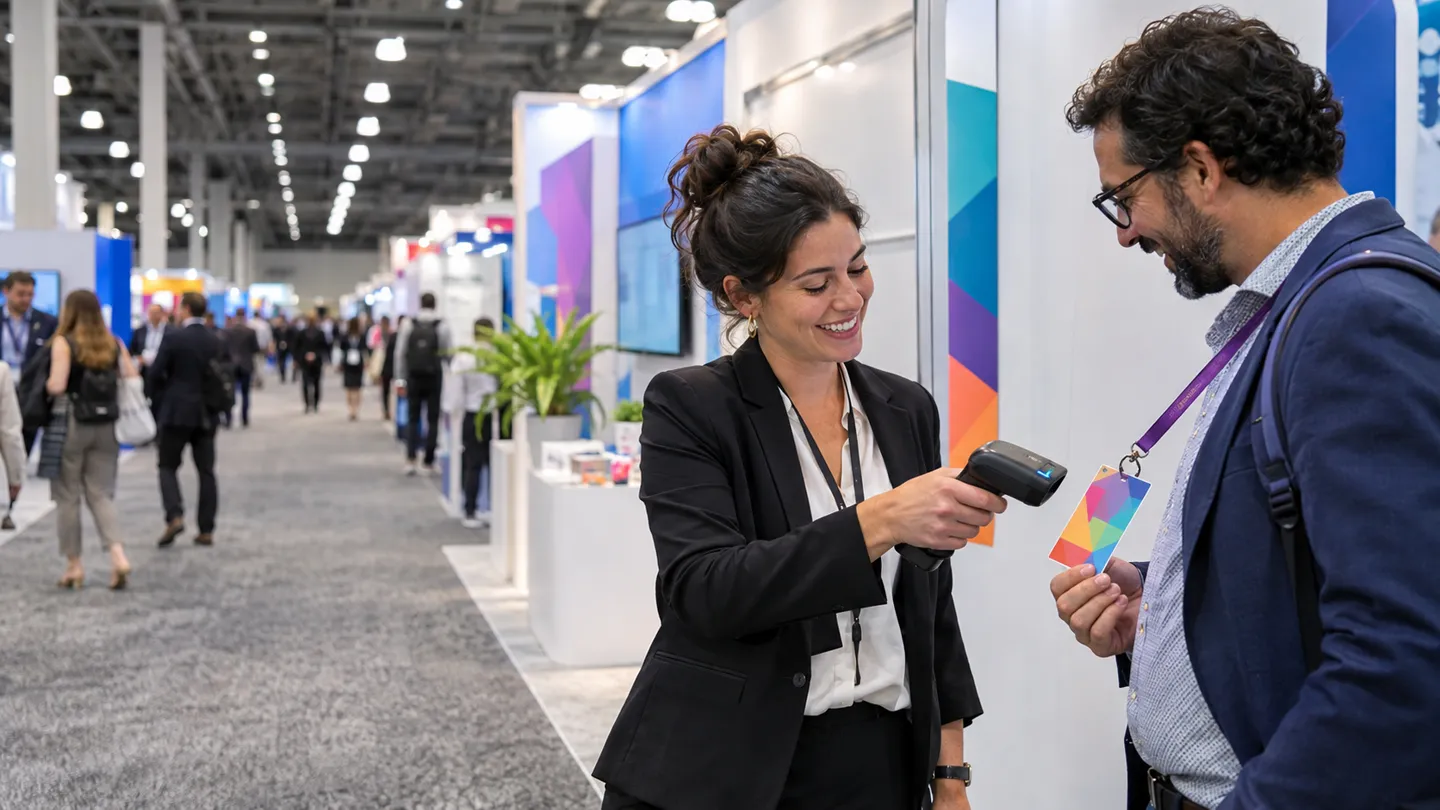
Every attendee badge at a US trade show carries machine-readable data. Most badges hold a QR code or barcode; larger shows often add RFID or NFC. Whatever the format, the scanner’s job is the same: it turns a badge into a contact record so a ten-second booth conversation can be followed up weeks later.
That record is the entire point. Badge scanning for trade shows sits at the end of a conversation and the start of a pipeline. Without it, the contact lives on a business card in a pocket or in someone’s memory of a good chat.
One quick distinction keeps this article on track. Exhibitors scan attendee badges to capture leads; organizers scan badges at the entrance to track check-ins. The second job belongs to the event’s registration system and is not something you buy as an exhibitor. Everything below is about the first job: getting visitor contacts off the show floor and into your funnel.
And one expectation to set early: the scanner only records what the conversation produced. It cannot make a two-minute badge-collector into a buyer. Keep that in mind, because it comes back with numbers in the second half of this article.
The Three Ways Exhibitors Capture Leads at Trade Shows
You have three realistic paths, and every exhibitor at every show is on one of them.
Manual and free. Business cards, badge photos, a QR code linked to a short form, a raffle box. This path costs nothing in equipment and works at any show, because it does not depend on the badge format at all. Sales teams have used versions of it forever: snap a photo of the badge, find the person on LinkedIn that evening, send a note while the conversation is fresh. Its weakness is discipline. Cards get lost, photos pile up unsorted, and a raffle draws plenty of people who want the prize more than your product.
The official show rental. Most large shows contract lead retrieval to a specialist, then rent its scanners or app licenses to exhibitors. On 2026 order forms the common systems are Maritz SWAP, XPress lead capture, and CMR. This is the only channel that decodes the ID encoded inside the official badge, which is why its data is complete and clean. The trade-offs are cost per device and timing: your leads sit in the organizer’s portal until an export arrives, often days after the show closes.
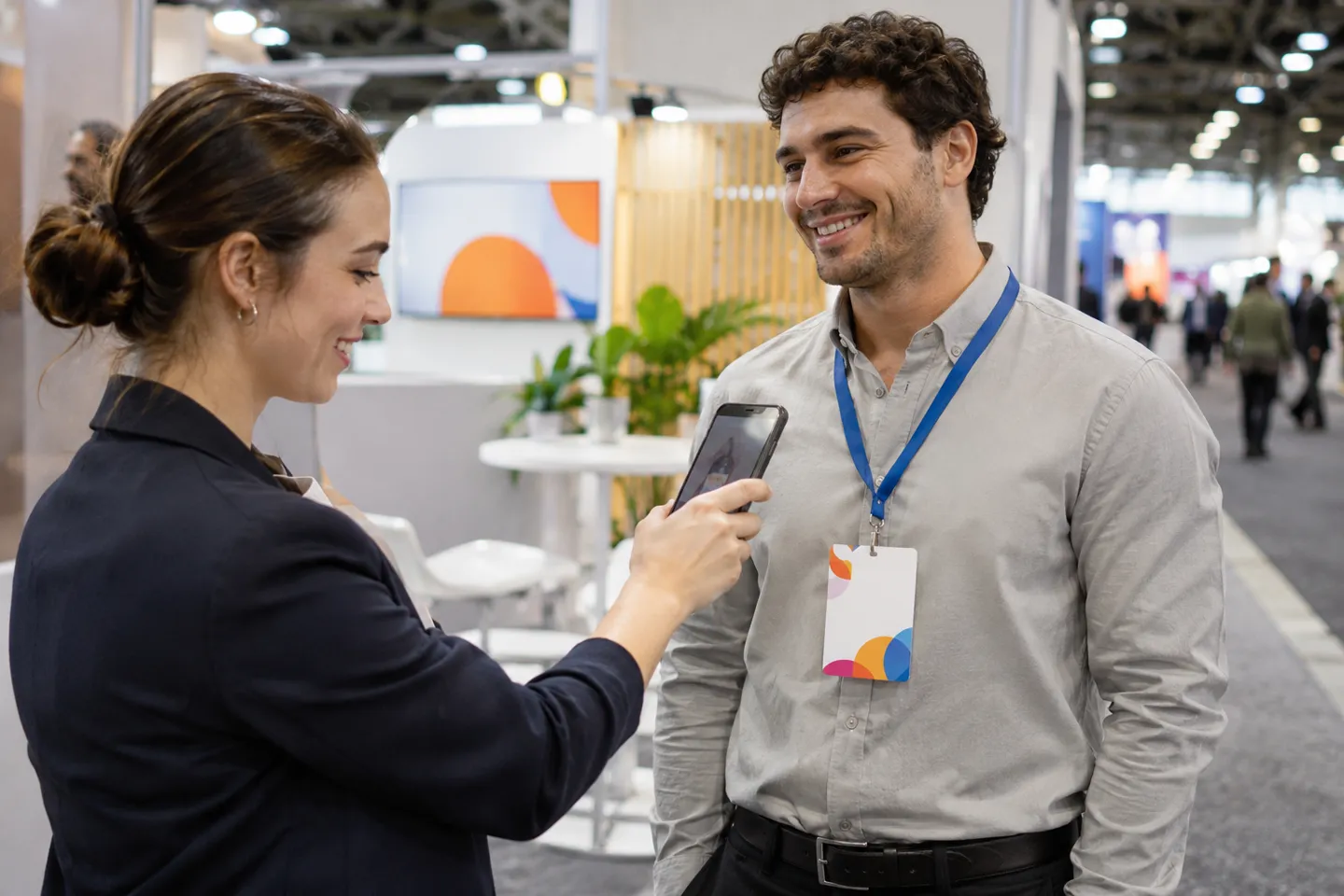
An app you own. Lead capture apps such as iCapture, Popl, or momencio run on your own phones. They read the printed name and company on any badge with OCR, enrich the contact from data providers, and push leads into your CRM while the conversation is still warm. One boundary matters here: without the show’s official badge kit, these apps cannot decode the badge’s encoded ID, so they read the printed surface instead. At most shows that surface contains what you need.
Three ways exhibitors capture leads
| Capture path | How the data gets in | Where the data ends up | Where it breaks on the floor |
|---|---|---|---|
| Manual and free | Cards, badge photos, visitor-typed QR forms | Wherever your team carries it | Lost cards, unsorted photos, prize hunters, no shows without badges to photograph |
| Official rental | Decodes the badge’s encoded ID (official kit only) | Organizer’s portal, exported after the show | Export arrives days later; price climbs at each order deadline; Wi-Fi dead zones stall rented handhelds |
| Owned app | OCR of the printed badge plus enrichment | Your CRM, in real time | Cannot decode encoded IDs without the show’s badge kit; enrichment favors English-language data |
None of the three paths dominates the others. Which one fits depends on two things, and the next two sections take them in order. First, what this show actually costs you. Second, where the data has to end up for your follow-up to work.
What Lead Retrieval Really Costs (2026 Numbers)
Rental pricing has no national rate card. Each show sets its own prices, each vendor escalates at each ordering deadline, and the headline device price is only the beginning.
What the order forms actually show
The 2026 NAMM Show order form (lead management by Maritz SWAP) listed handheld scanner rentals at $549, $579, or $599 depending on the order date. Tablet rentals ran $479 to $549, and a mobile app license cost $549 to $599 for three users, with additional users at $149 each. The ICCFA 2026 first-time exhibitor form (American Tradeshow Services) came in lower. Handhelds there cost $369 discounted or $419 at the show rate, and app licenses ran $359 to $409 for the first seat with extra seats at $99 to $149.
Other published forms land in the same band with real spread. One roundup of 2026 forms put handhelds at $495 to $545 at one major show and $605 to $735 at another (VenueSight, 2026; Wave Connect, 2026). The same roundup summarized the rental market as roughly $350 to $735 per rep per show (Wave Connect, 2026). Real decisions bracket those numbers. One medical-device exhibitor at MD&M in New York was quoted about $700 for the scan tool and walked away, choosing badge photos and LinkedIn lookups instead (r/sales, 2025). Another exhibitor paid $600 for a rental app at a large show, scanned 400 visitors, and worked the cost out to $1.50 per lead (r/tradeshows, 2026).
What published 2026 exhibitor order forms charge
| 항목 | NAMM 2026 (Maritz SWAP) | ICCFA 2026 (ATS) |
|---|---|---|
| Handheld scanner rental | $549 / $579 / $599 by order date | $369 discounted, $419 show rate |
| Tablet scanner rental | $479 / $499 / $549 | not listed |
| Mobile app license | $549-$599 for 3 users, +$149 each | $359-$409 first, +$99-$149 each |
| Booth delivery | $200 | not listed |
| Survey setup | $99 | not listed |
| Processing fee | $9.99 (waived online) | not listed |
| Cancellation | $100, none inside 30 days | not listed |
Sources: published 2026 exhibitor order forms, reviewed October 2026. Prices vary by show and order date.
The fees that never make the headline number
The device or license price is where the quote starts, not where it ends. On the NAMM form above, booth delivery of the rented hardware adds $200, survey setup adds $99, and a $9.99 processing fee applies unless you order through the vendor’s portal. Cancelling more than 30 days out still costs $100, and inside 30 days there is no refund at all (VenueSight, 2026).
The fee stack, itemized
Timing moves the price as much as the fee stack does. Discount windows on these forms typically close six to eight weeks before the show, and each deadline step raises the price. An exhibitor who orders at the show pays the top of the range. Late deciders routinely pay $100 to $200 more than a colleague who ordered two months earlier, for the identical scanner. When you request the lead retrieval quote, ask for every line: device or license, delivery, setup, processing, cancellation terms, and the deadline calendar. Those five items are the difference between the number on the flyer and the number on the invoice.
Owned tools: per-lead credits to seat minimums
The owned-app market prices two different ways. Per-lead models charge only for captured leads; one vendor prices a badge scan at 4 credits, about $10 per enriched lead, with no seat fees (Wave Connect, 2026). Seat-based platforms charge annually whether you exhibit or not. Momencio publishes $100 to $170 per seat per month with a five-seat minimum. That lands a two-person booth team near $6,000 a year before its paid add-ons for enrichment and CRM sync (Wave Connect, 2026).
The 2026 pricing floor, in one view: free apps cost $0 plus manual cleanup; per-lead apps cost roughly $10 per enriched scan; rentals cost $369-$735 per rep per show plus fees; seat platforms start near $6,000 per year.
Free has a real price too. Ativ’s BadgeScanner, distributed free by organizers on the EventPilot platform, scans QR badges offline and exports a CSV by email. The organizer pays for the platform behind it; the exhibitor gets names without enrichment, phone numbers, or CRM sync (Wave Connect, 2026). The manual path shares that shape: zero equipment cost, real labor cost afterward. One sales team handed out 70 business cards at MD&M and received zero replies. The same team’s five genuinely good leads that show came from photographing badges and finding people on LinkedIn by hand (r/sales, 2025).
Our project managers read exhibitor order forms every week: send yours in with the booth plan and we will flag the fee stack and the deadline calendar before you sign.
Talk to a Project ManagerRent, Buy, or Free: How to Pick Your Capture Path
The honest answer to “which is better” is that the arguments you see online are both right, for different exhibitors. A vendor roundup calls the official rental “the worst value in the building”; half the salespeople in one thread say renting is a no-brainer. The variable that reconciles them is how many shows you work a year.
Start with how many shows you do a year
One or two shows a year: rent the official scanner, or lean on a free path with discipline. The rental decodes the official badge, the data is clean, and you are done with the purchase conversation in two minutes on one order form. This is the “basic event-provided scanners are fine” bucket that experienced exhibitors describe for low-frequency exhibitors (r/tradeshows, 2026).
Several shows a year: the math tilts toward a tool you own. Rental pricing repeats per show and per rep. A four-person booth renting at two shows can spend $1,600 to $2,900 a season on hardware that produces a CSV each time. A per-lead app at $10 per enriched scan or even a modest seat plan spreads across the whole season with identical fields, identical CRM mapping, and one learning curve. Budget app users make the same point from below: owned tools get cheap once your event count crosses roughly ten a year (r/marketing, 2023).
First show or testing a new market: stay free and invest in discipline instead. A QR form and a booth rule that every real conversation gets photographed and noted that evening will beat an unused $549 handheld. Upgrade once the show calendar, not the gadget catalog, justifies it.
Then decide where the data must end up
Frequency decides the budget question. Data ownership decides the follow-up question. Rental data sits in the organizer’s portal until an export arrives, often days after the show. Exhibitors in the field describe the aftermath precisely: different fields, different export formats, different timing, and a CRM cleanup job every single show (r/tradeshows, 2026). If your team’s standard is a follow-up within 24 to 48 hours, an export that lands on day four loses the window before anyone touches a spreadsheet.
This is also where the technical boundary from Section 2 becomes a purchasing question. Only the official rental decodes the badge’s embedded ID; owned apps read the printed surface and enrich from data providers. Neither fact is hidden, but marketing on both sides blurs it. So put one direct question to each vendor: at this specific show, what exactly does your tool read, and when does the lead reach my CRM?
The direction of travel favors exhibitors. Pricing is shifting from renting hardware toward paying per lead or per seat, and the data is shifting from the organizer’s portal toward tools exhibitors own. When you present the budget to management, that trend line is the argument. This year’s rental fee is a dead cost. This year’s app spend builds a lead database that compounds across the season.
The boundary matrix: which path holds, which breaks, who owns the data
| Capture path | When it holds | When it breaks | Who owns the data |
|---|---|---|---|
| Manual and free | Any show, any badge format, first-timers, tight budgets | High-volume booths, regulated data handling, teams without evening discipline | You, if someone files it the same night |
| Official rental | 1-2 shows a year, official-badge decoding, procurement wants one order form | Multi-show seasons, 24-48h follow-up standards, late orders after the discount window | The organizer, until the post-show export |
| Owned app | Multi-show programs, CRM-driven teams, English-language lead data | Shows that restrict badge data to the official vendor, teams that refuse per-seat minimums | You, in real time |
Run your next show against four questions before you sign anything:
How many shows are on this year’s calendar?
When does each show’s lead retrieval discount window close?
Where must a lead land for a 48-hour follow-up to be possible?
Which line items are missing from the quote: delivery, setup, processing, cancellation?
Answer those and the rent-versus-buy argument stops being a forum debate. It becomes arithmetic.
If your team would rather not own that checklist at all, it can travel on someone else’s plan sheet. Aplus Expo runs exhibitor programs end to end. Our project managers coordinate power orders, rigging deadlines, and union crews, and we hold a 30-minute on-site response during show days with a 24-hour phone line open while the show runs (on-site supervision during the show). Adding three lines for lead capture to the same plan costs nothing extra to think about.
After the Scan: Where Lead Capture Actually Fails
Buying the right tool is the small half of the job. The failure patterns almost all live after the beep, in five steps your team either runs or skips: scan, note, qualify, sync, follow up.
The post-scan chain
Scan, but only after a real conversation. The rep who scans everyone who pauses at the booth floods the list with junk. Note, on the spot: one line about what the visitor wanted turns 400 identical rows into 400 conversations. Qualify honestly, too. A helpful commenter in the field put it bluntly: scans exist to feed marketing dashboards as much as pipelines (r/sales, 2025). Log the qualification you actually believe, not the number your KPI wants. Sync while the show runs, because exports that wait for the closed show are the reason cleanup becomes a multi-day project. Follow up inside 48 hours, which experienced exhibitors name as the window that decides whether the lead is still warm (r/tradeshows, 2026).
One London booth ran the experiment at full scale: 1,100 badge scans in a single show. The rep went through the spreadsheet that night and found 8 contacts worth following up (r/sales, 2025).
One London booth, one show
Not a scanner failure. The other 1,092 conversations are what the booth said before anyone pressed the button.
The cleanup failure is quieter but more expensive. Exhibitors describe waiting days for the rental export, then re-typing and de-duplicating before sales ever sees a lead. One thread commenter watched a company that sells CRM tools manually keying business cards the week after its own expo (r/tradeshows, 2026). The technology worked. The handoff failed because the data had no owner, no format, and no deadline between the beep and the first follow-up email.
The trap: treating scan count as the show KPI. Volume scans are cheap to game and expensive to read. The number that predicts revenue is the count of qualified conversations with notes, synced to CRM, followed up inside 48 hours.
The Business Side: Scans, Booths, and Your Show Budget
Put the three paths and the failure patterns together and the show economics reduce to one sentence. Pipeline equals conversation quality times capture completeness times follow-up speed. Each factor can zero out the other two. The best capture tool records nothing worth recording if the booth produced no real conversations. A booth full of buyers produces nothing if the leads die in an export queue.
The money follows the same asymmetry. Lead retrieval is the cheap end of the exhibitor budget: $369 to $735 per rep for a rental, or tens of dollars in per-lead charges. The booth itself, the space, the travel, the staff week, run one to two orders of magnitude higher. Yet most pre-show planning energy goes into the big line items. The capture plan often exists nowhere until the badges arrive. Experienced exhibitors close exactly this gap by treating the capture plan like every other show logistics item. Power orders and rigging deadlines have owners and deadlines; the scan plan should sit on the same sheet with the same treatment.
That is the working stance this article defends. Put the capture decision on the pre-show plan as three lines: who scans, when it syncs, who follows up in 48 hours. Then spend the agonizing you just saved on the thing the scanner cannot fix, which is a booth worth stopping at. Every qualified lead in your post-show list entered through a conversation that somebody’s booth made possible. When the two budgets are planned as one program instead of two line items, the cheap tool and the expensive one start pulling in the same direction.
That is how we read these numbers from our side of the table. Aplus Expo has built more than 800 exhibits since 2008, from 10×10 rental booths to 40×50 custom builds, and you can see real booth builds in the project gallery. The clients who return to us year after year are the ones whose booths keep producing conversations worth scanning. If your next show deserves a booth that feeds the scanner instead of starving it, we can help. We design and build 맞춤형 부스 with a free 3D design and an itemized quote inside 48 hours, so the capture plan and the booth plan land on the same page before the order forms do.
Get a booth worth scanning
From 10×10 rentals to 40×50 custom builds, we design exhibits that give your team real conversations to scan.
Start Your Booth Design참고문헌
- VenueSight. “Trade Show Lead Retrieval Fees: What Exhibitors Pay.” 2026. https://venuesight.com/guides/trade-show-lead-retrieval-fees
- Wave Connect. “The 7 Best Badge Scanners for Your Trade Show.” 2026. https://wavecnct.com/blogs/best-badge-scanner-tradeshow
- r/sales. “Lead Scanning at Trade Shows.” Reddit, 2025. https://www.reddit.com/r/sales/comments/1lb243c/lead_scanning_at_trade_shows/
- r/tradeshows. “What Are the Best Lead Retrieval Tools for Trade Shows and Expos?” Reddit, 2026. https://www.reddit.com/r/tradeshows/comments/1t4a3ev/what_are_the_best_lead_retrieval_tools_for_trade/
- r/marketing. “How Much Do You Pay for Lead Retrieval at B2B Events?” Reddit, 2023. https://www.reddit.com/r/marketing/comments/11zojvw/how_much_do_you_pay_for_lead_retrieval_at_b2b/
 English
 Spanish
 German
 French
 Italian
 Korean
 Chinese