
Your booth earns its keep for three or four days a year. The other eleven months it lives somewhere: a warehouse rack, a self-storage unit, a corner of the office. That address quietly decides how much your next show costs and how smoothly it opens. Most exhibitors treat trade show booth storage as a logistics errand. Pick a cheap place, pay the monthly bill, forget it. The math deserves more respect. Here is how exhibit storage actually works, what the options really cost, and how to read the bills nobody explains up front.
What “Trade Show Booth Storage” Actually Means (Two Very Different Things)
Search “booth storage” and two different products share the name. One is storage à l'intérieur the booth: lockable counters, closets, and display cases that hide brochures and samples during the show. That is an exhibit-design topic, not this one.
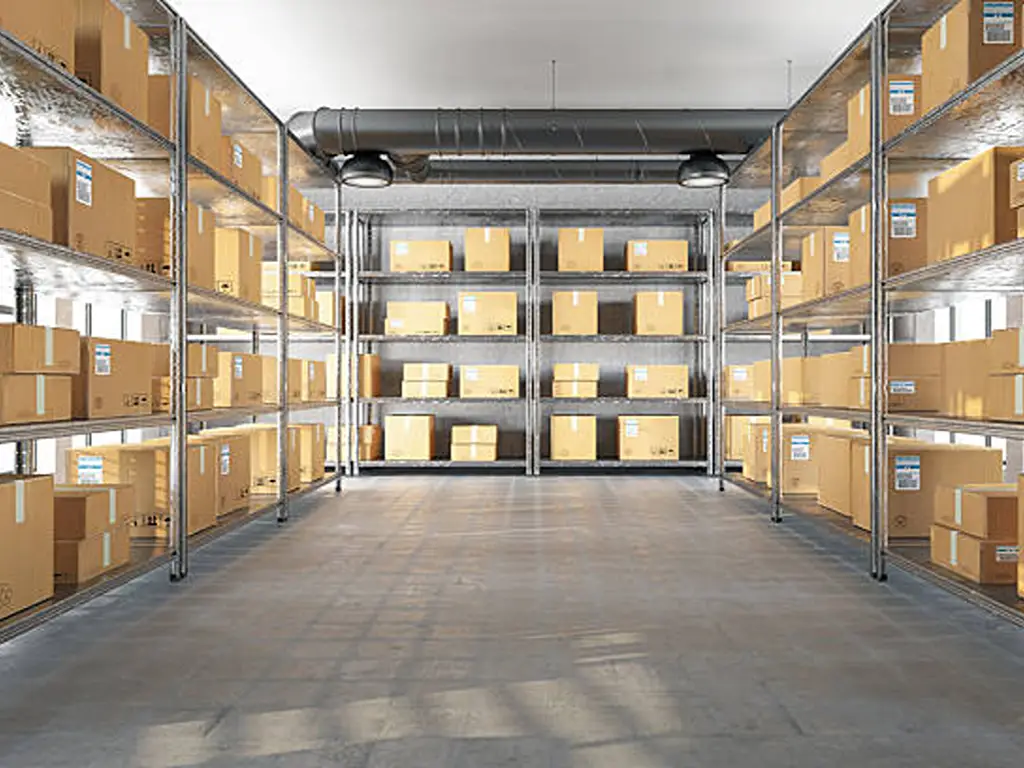
The other is exhibit storage in the warehouse sense. It is a place where your whole booth lives between shows: structure, graphics, furniture, lighting, crates, and the collateral that travels with it. This guide is about the second one.
A stored booth is an inventory with needs, not one object. Aluminum frames bend under stacked weight. Fabric graphics must be rolled, never folded across a printed surface, and kept from humidity and UV. Wooden crates warp when damp. An arrangement that ignores these distinctions is not protecting your exhibit. It is delaying the damage until move-in day.
Three kinds of players run professional trade show exhibit storage. Exhibit houses store what they built. Show general contractors, the Freeman-and-GES type, offer warehouse return as an add-on to show freight. Independent warehousing and managed-storage specialists round out the field. Their bills look nothing alike. That is the first surprise: the same booth can be quoted from $50 to over $1,200 a month. Usually nobody is overcharging. You are simply being sold three different things.
Where an Exhibit Lives Between Shows: The Real Options
Self-storage and the office corner: cheap rent, expensive labor
A self-storage unit large enough for a standard booth kit runs about $100–$350 per month in major markets (Juujbox, 2026). The visible rent is low. The hidden work is not. Your team becomes the receiving department, inventory manager, packing crew, and freight coordinator. Someone has to meet carriers, move road cases, label everything, document damage, and put it all away after every show. At four shows a year, that is an estimated 30–60 staff hours. At a loaded salary, the labor often equals or exceeds the unit rent (Juujbox, 2026).
Self-storage works for a lightweight display on a small schedule. It is the wrong home for a modular or custom booth. Most units are not climate-controlled, and nothing is inventoried at component level. The gap between “whoever packed it last” and “whoever opens it at the next show” is where cracked panels and missing parts are born. They are discovered at move-in, too late to reorder (Pure Exhibits, 2026).
Exhibit house and show-city contractor storage: the professional paths
A full program at an exhibit house includes storage, account management, handling, and some show prep. It commonly lands at $250–$600 per month for a compact 10×10, and $600–$1,500 or more for larger modular or custom exhibits (Juujbox, 2026). The premium is worth it when the same company built the exhibit and maintains it between shows. One caveat: many houses store the exhibit they fabricated and little else. Swag, literature, uniforms, and other vendors’ shipments may need separate arrangements (Juujbox, 2026).
The geography decision most exhibitors skip: where the warehouse sits matters as much as what it charges. Storage near the show city removes the cross-country freight leg and the advance-warehouse handoff from every cycle. The exhibit never travels until it is already where the show is, and a local builder can still react in the final week. Storing near headquarters means every show starts with a long freight move and ends with a long return. If your shows cluster in one city, and Las Vegas hosts some of the busiest show calendars in North America, a local warehouse quietly deletes a layer of risk and expense from each cycle.
Touring: when the booth never goes home
One more pattern confuses the decision: touring. Instead of returning home between shows, you store the exhibit venue-to-venue in the region where your shows run, often at the shipper’s facility or an advance warehouse (Exhibitor Online, “Storage Wars”). Touring pays for dense back-to-back runs in one region. It stops paying the moment shows scatter cross-country or gaps stretch past a month. Most exhibitors running two to six shows a year do not need a touring network. They need one well-chosen home.
The five options fail in different ways. Place yourself before you pick:
| Option | Meilleur pour | Rough monthly cost | When it stops working | Who carries the hidden cost |
|---|---|---|---|---|
| Self-storage unit | Single lightweight display, 1–3 shows a year | $100–350 + your labor | Multi-crate modular or custom booth; no climate control; no inventory | Your staff (30–60 hrs/yr at 4 shows) |
| Commercial warehouse | Team with internal logistics staff | $100–400 | No exhibit expertise; you inventory and prep | Your team |
| Exhibit house storage | Booth built and maintained by the same house | $250–600 (10×10); $600–1,500+ (larger) | House stores only its own exhibit; other vendors’ goods excluded | You, via usage fees and scope gaps |
| Show-city local builder | Exhibitors whose shows run in that city year after year | Varies, often bundled | Only relevant where your shows are | Shrinks each cycle: no cross-country freight |
| Touring network | Dense regional runs | Freight + per-stop storage | Scattered shows or long gaps | You, twice over |
Data source: Juujbox 2026; Pure Exhibits 2026; Exhibitor Online
Why Storage Quotes for the Same Booth Differ 20x: Reading the Bill
Three billing structures: kill the direct comparison first
That $50–$1,200 spread is a structure spread, not a quality spread. Exhibit storage is billed three ways. Until you know which one you are reading, comparing quotes is meaningless.
By space. Commercial warehouses and many exhibit houses bill by floor space or cubic volume. More crates, more dollars. Simple to audit, but the rate says nothing about service. Two facilities can charge the same, and one preps your exhibit while the other just shelves it.
By weight. Show general contractors typically bill warehouse return and storage by the pound, on top of freight. Public rate structures commonly apply a 1,000-pound minimum, so a light booth may be priced as if it weighed half a ton (Juujbox, 2026). Charges can start in the hundreds after one show. Count warehouse returns, monthly minimums, and repeated handling, and a four-show year commonly totals about $3,000–$7,000 (Juujbox, 2026). Weight-based storage moves freight through one show. It does not run an ongoing inventory program. Access between events is limited, item-level visibility is rare, and returned freight may sit for days.
By program. Exhibit houses and full-service builders often fold storage into an exhibit-management or rental contract. Storage stops being a line item. It becomes part of the price of having the exhibit built, maintained, and deployed by one accountable team.
Not sure which billing structure your last storage quote used? Send it over, and we will flag what each line really is.
Send my quote for reviewThe owning math: rows the invoice never shows
For an owned booth, the monthly bill is one row of four over a five-year life. Add purchase price spread per show. Add storage and return freight. Add your team’s hours, the 30–60 hour DIY baseline above. Then add damage, repair, and refresh: the cracked counter found at move-in becomes a rush reprint, the creased graphic is permanent, and the graphics you cannot confirm you still have get reordered anyway (Pure Exhibits, 2026).
Exhibit managers describe the tracking burden bluntly. “It’s insane trying to keep track of all of the trade show materials,” one marketing lead wrote on Reddit’s r/sales. Consultants who model own-versus-rent consistently flag storage as its most under-budgeted row (Quora, hidden costs of owning a trade show booth). Annual programs run roughly $3,000–$9,000 across the DIY-to-exhibit-house spectrum. Over the three-to-five-year life of a custom structure, the storage-and-upkeep line alone can rival the original build (Juujbox, 2026; Pure Exhibits, 2026).
Where the “$0 storage line” comes from
One structure keeps storage off your budget entirely: the rental or managed program where the exhibit house owns the exhibit. Whoever holds the asset pays for its home. When the contractor owns the pool, storage, maintenance, and refresh spread across every show’s rental price. No warehouse line reaches your invoice.
The $0 line is only honest if three conditions hold. The contractor’s warehouse must sit in or near the show city. Otherwise “rental” is just someone else’s cross-country freight with a different label. The same trained crews must handle dismantle and return. End-of-show pack-out is where most storage damage starts, and a crew that built the booth packs it differently than rushed labor at 5 p.m. on the last day. The between-show window must be real work: inspection, repair, refresh. Not a nap until three weeks before move-in.
That is the entire model: asset ownership, city location, crew continuity. Nothing exotic, which is exactly why it is checkable.
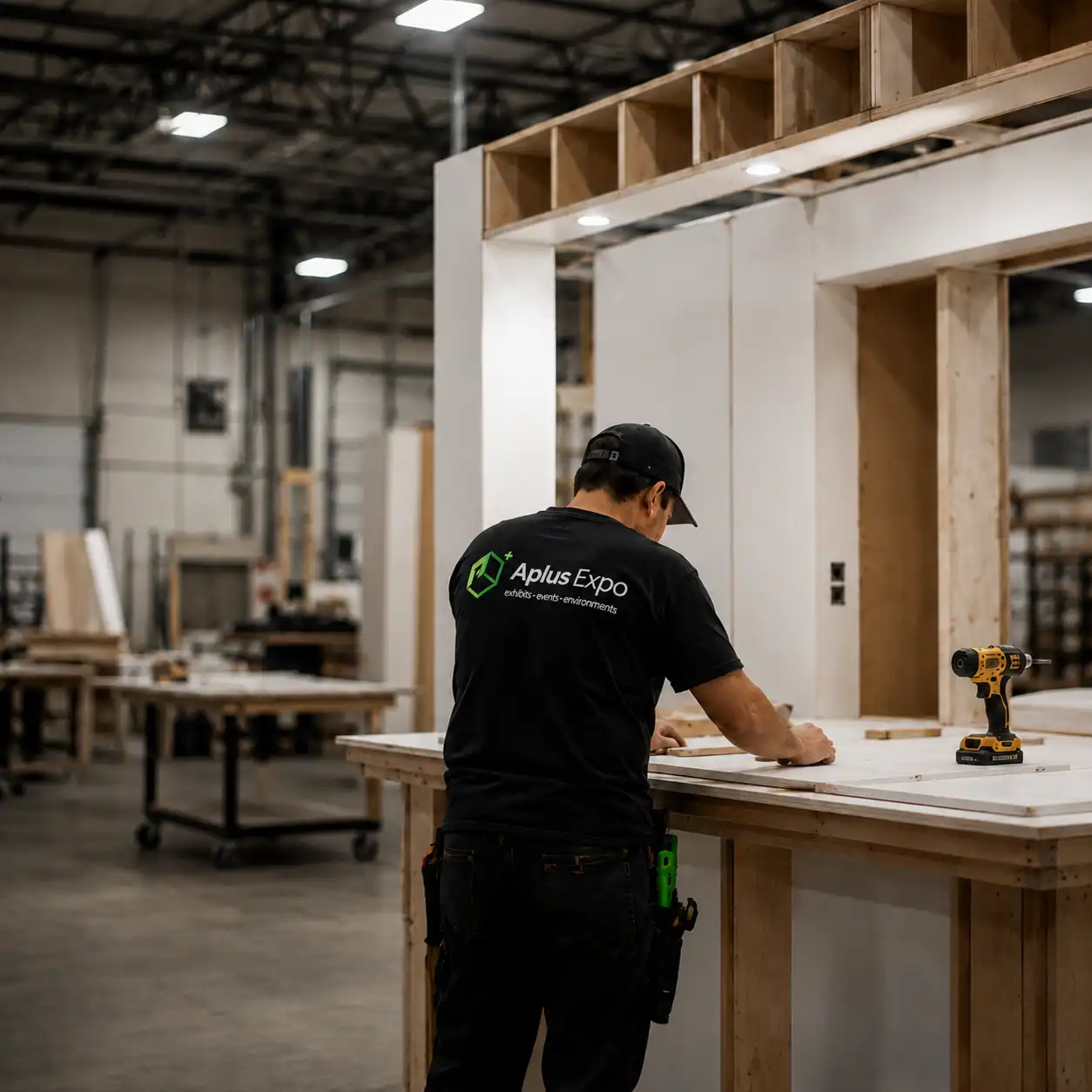
In Las Vegas, it is the model we run at Aplus Expo. The exhibits we build are dismantled by our own install and dismantle crews, then driven back to our Las Vegas warehouse and storage service, over 10,000 sq. ft in-house. They are stored there between shows. When your next show books, we trial-build the booth again. Structure and graphics go up in the factory, get photographed, and are sent to you for sign-off. Move-in day becomes a re-assembly of something that already worked once. Repairs found at pack-out get a free estimate within days, and our bill is finalized when the show closes. No invoices arrive weeks later. For a booth we built, there is no separate storage contract to negotiate. It lives in our warehouse, and the storage line on your invoice stays where it belongs, at zero.
Four shows a year
$3,000–$7,000
storage and warehouse-return on the show-contractor model
vs
$0
as a line item when the exhibit is owned, stored and maintained by the same company
Worked example: Juujbox 2026 storage pricing guide
For exhibitors running two to six shows a year, that difference is the biggest line item nobody puts in the budget. It is also the reason the “cheap storage” decision belongs at the ownership level, not the warehouse level.
Vet Any Booth Storage Partner With These Checks
Whether you store an owned booth or buy a program with storage bundled, run the same eight checks. Each is a question you can ask today:
- Intake documentation. Do they photograph and inspect the exhibit on arrival? Transit damage should be documented before storage, not argued about after.
- Component-level inventory. Do they track components against a master list, not just “crate 3 of 4”? Is the list reconciled and signed after every show return?
- Pull lead time. Standard modular exhibits should be requested at least two to three weeks before the advance-warehouse deadline. Under two weeks is where missing parts become rush orders (Pure Exhibits, 2026).
- Climate fit by contents, not dogma. Fabric graphics degrade above roughly 70% relative humidity. Electronics dislike temperature swings (Pure Exhibits, 2026). Bare frames and empty crates are far less demanding. Pay for climate control where your stored contents need it, and refuse it where they do not (Exhibitor Online, “Storage Wars”).
- Repair and refresh in the storage window. Can they fix minor damage and swap graphics between shows? Storage time is the cheapest time to update messaging.
- Insurance split. What does their liability cover, what does your policy cover, and where is the duplication? Get the claim procedure in writing.
- Scope of stored goods. Booth only, or also literature, samples, and uniforms? The classic gap is the booth stored professionally while everything around it stays scattered (Juujbox, 2026).
- Pack-out responsibility. Who packs at dismantle, and who signs off? Rushed end-of-show packing is the most common cause of damage found at the next move-in (Pure Exhibits, 2026).
If your program spans multiple cities, add a ninth: can the facility ship to each show’s advance warehouse or coordinate across hubs? Storage that cannot move with your calendar is storage you will outgrow.
Three floor-level notes. Unlabeled empty crates left on the floor are fair game for the general contractor’s boneyard, so label them or lose them. Folded fabric graphics never un-crease. And missing items are found in exactly two places: inventory, cheaply, or move-in, expensively.
8-point vetting checklist
Intake photos and inspection
Component-level inventory reconciled after every show
2–3 week pull lead time
Climate control decided by what you store
Repair and graphic refresh between shows
Insurance split in writing
Scope: booth only, or the whole event kit
Pack-out ownership at dismantle
The Storage Line in Your Budget, Recalculated
The four-line test
Before you renew a storage contract, buy an exhibit, or sign a rental program, put four lines on a page. Line one: purchase cost spread per show. Line two: storage and return freight. Line three: your team’s hours. Line four: damage-plus-refresh history. Add them per show. Then compare with the all-in price of a program where storage is internal to the builder.
For a mid-size exhibitor running two to six shows a year with a structure retiring within five, the comparison usually lands in one place. The DIY-and-warehouse route pays thousands a year for logistics your team is not trained for. The integrated route zeroes the storage line and buys crew continuity and a maintained exhibit instead.
When owning still wins
That conclusion has an honest boundary. Exhibitors running eight or more shows a year at the same footprint with consistent branding can make ownership and dedicated storage genuinely economical. The per-show spread of purchase price finally gets thin (Pure Exhibits, 2026). If your footprint changes by show, your branding refreshes seasonally, or your shows scatter, the owned structure plus warehouse loses on both ends. The asset depreciates and the logistics multiply. That is when the rental structure stops being a compromise and becomes the plan: one price per show, no storage line, no disposal bill at the end.
The practical takeaway is short. Stop picking a warehouse, and start picking an ownership structure and a home city. The cheapest monthly rate in the directory is the most expensive choice you can make when your team’s hours, your graphics’ condition, and your move-in day are all on the same line.
If you are building next year’s show budget and want the four lines run against your actual schedule, storage, freight, prep, and all, send it over for a free, itemized quote. We will come back within 48 hours.
Put the storage line back where it belongs.
Tell us your show calendar and your booth situation. You get one itemized quote for build, storage, install, and on-site support, finalized before the show closes.
Request my free itemized quoteRéférences
- Juujbox. “How Much Does Trade Show Booth Storage Cost? (2026 Pricing Guide).” 2026. https://juujbox.com/resources/trade-show-booth-storage-cost
- Pure Exhibits. “Trade Show Storage: How to Store Your Exhibit Between Shows.” 2026. https://www.purexhibits.com/trade-show-storage/
- Exhibit Studios. “Trade Show Exhibit Storage Solutions: What to Look For.” 2025. https://exhibitstudios.com/blog/trade-show-exhibit-storage-solutions/
- Exhibitor Online. “Storage Wars.” Travis Stanton. https://www.exhibitoronline.com/topics/article.asp?ID=2774
- Reddit r/sales. “Trade Show Materials/Promo Item Storage and Shipping.” https://www.reddit.com/r/sales/comments/o0op20/trade_show_materialspromo_item_storage_and/
- Quora. “What are the hidden costs of owning a trade show booth vs renting one?” https://www.quora.com/What-are-the-hidden-costs-of-owning-a-trade-show-booth-vs-renting-one
- Aplus Expo. “Trade Show Storage.” https://www.aplusexpo.com/service/trade-show-storage-1/
- Aplus Expo. “Installation and Dismantling.” https://www.aplusexpo.com/service/installation-and-dismantling/
- Aplus Expo. « Location de stands ». https://www.aplusexpo.com/service/booth-rentals/
- Aplus Expo. “Home.” https://www.aplusexpo.com/



 English
  Spanish
  German
  French
  Italian
  Korean
  Chinese