
The space contract comes back from the organizer with two words on it that were never in your plan: shell scheme. Somewhere between the deposit invoice and the exhibitor manual sits a stand you did not design. It is priced in a unit you may not use, built to rules nobody has quoted you yet.
That document gap is where shell scheme budgets go wrong. This guide walks the chain in order: what the shell includes, the sizes and rules it hands you, and the three ways to respond to it. Then it covers where upgrade money works and where it does not, what American shows charge in real numbers, and the failures that catch experienced exhibitors as often as first-timers.
What a Shell Scheme Booth Actually Is
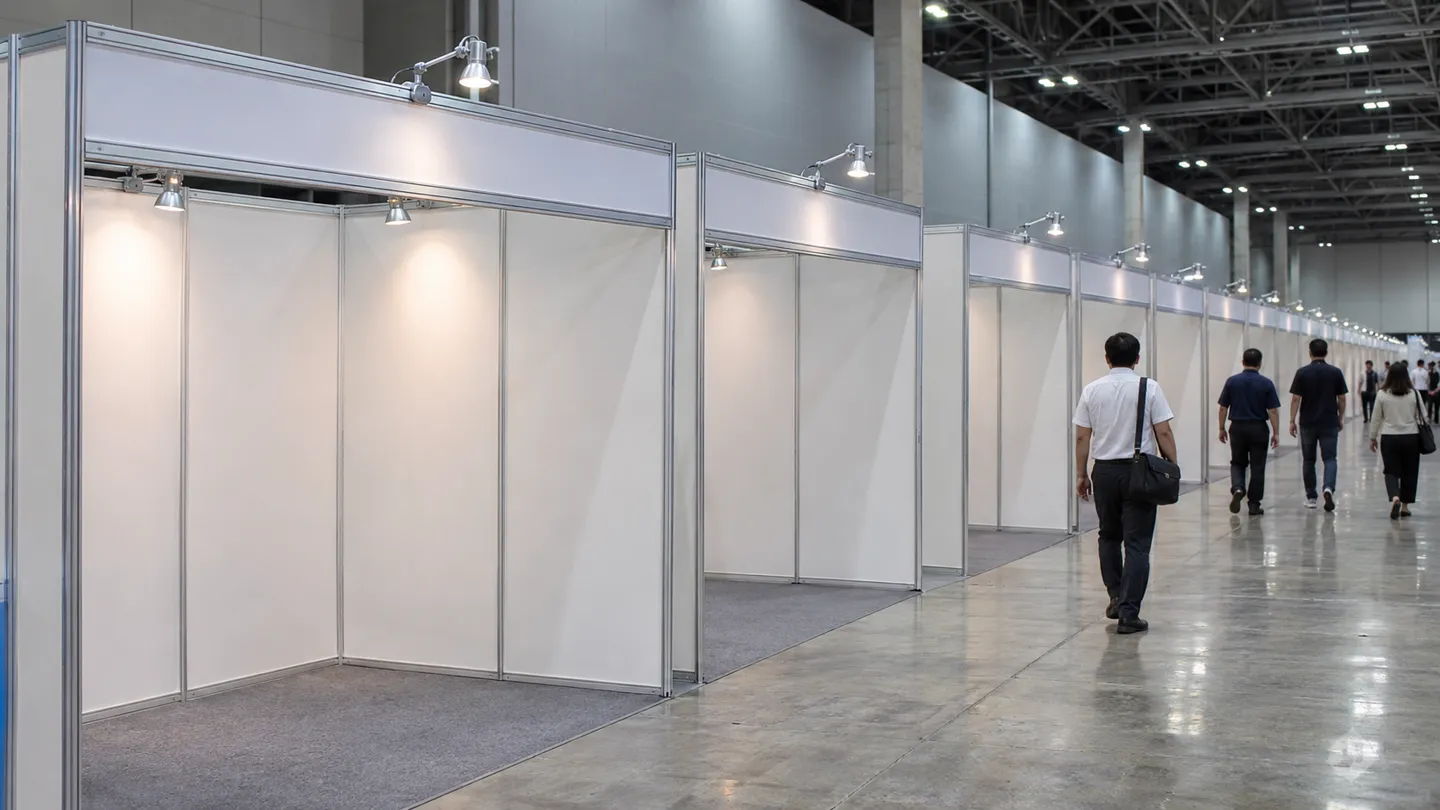
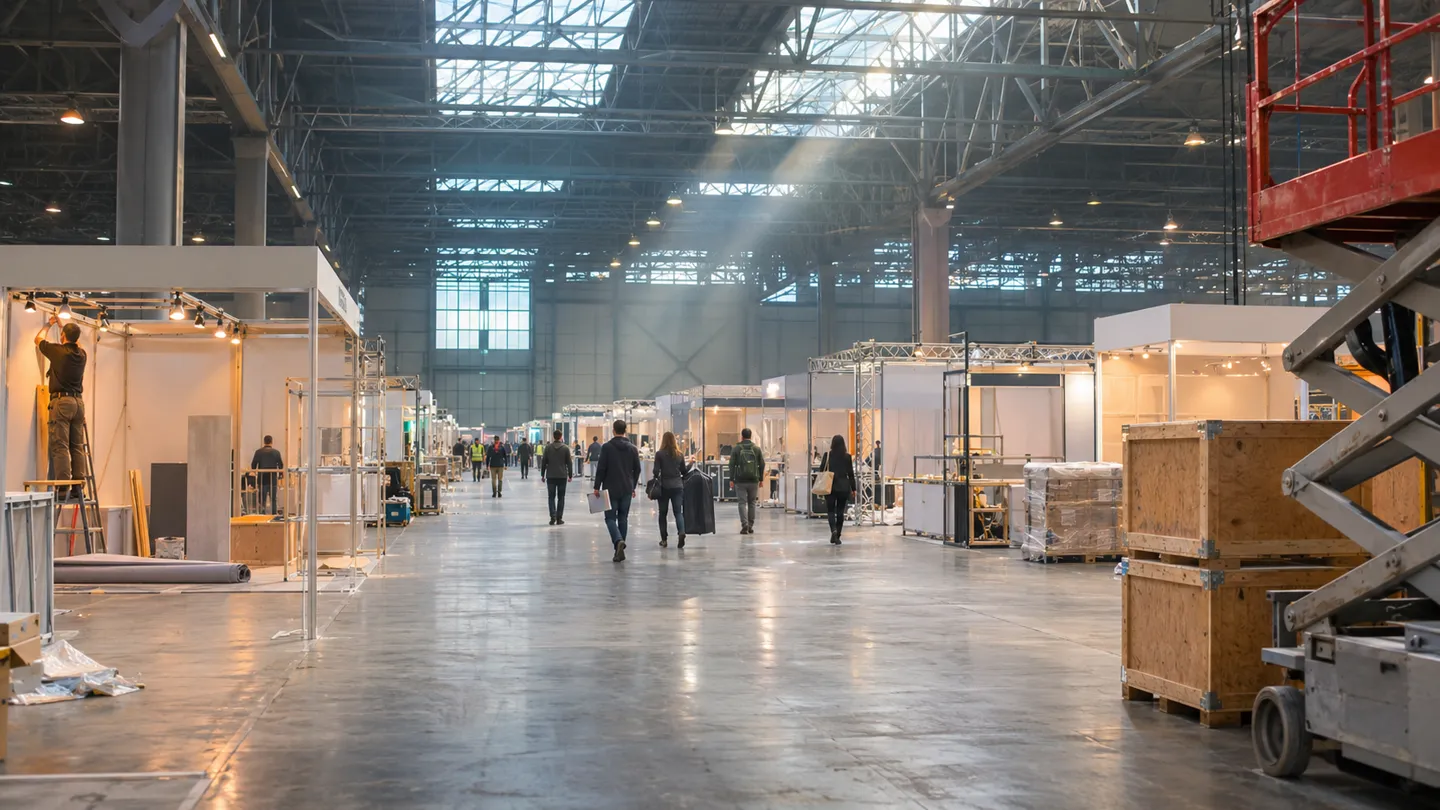
A shell scheme is the pre-built modular stand the organizer provides: an aluminum frame, wall panels, a fascia board carrying your company name and stand number, basic flooring, and usually one or two spotlights with a power socket. You do not build it and you cannot change its structure. Your entire creative job is what you put on it and around it.
What comes as standard is deliberately basic. A typical package covers the frame, plain white wall panels, the fascia, carpet or simple flooring, and minimal lighting and power. It almost never covers branded graphics, upgraded lighting, furniture, screens, extra circuits, or anything interactive. Every one of those is a separate order with its own deadline.
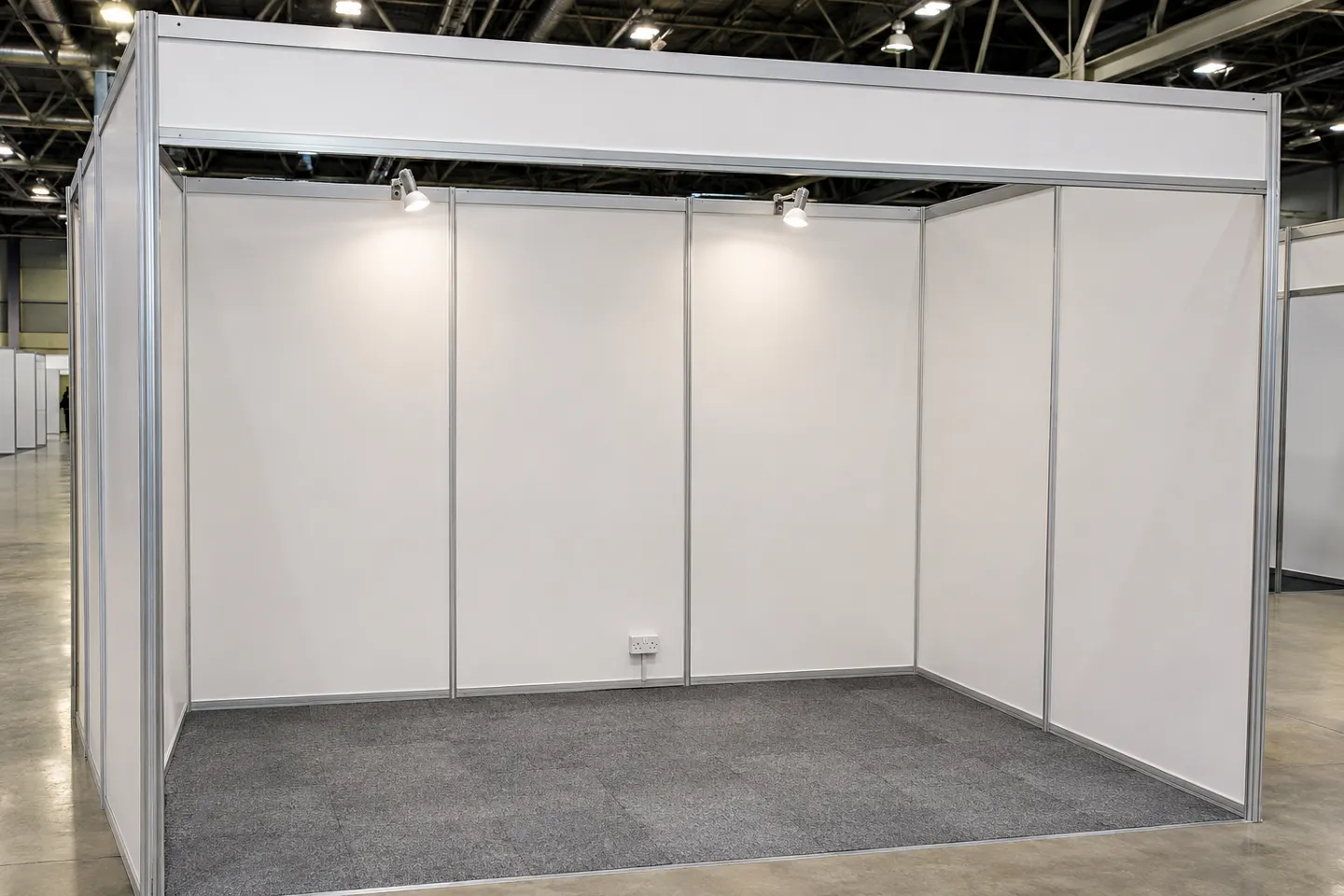
Read your contract carefully, because the same term hides two different products. In the UK and most of Europe, a shell scheme is a proper little room: rigid wall panels and a fascia on a recognized modular system. At many US shows, the word maps to something much closer to pipe and drape (Expositions pures, 2026): “Shell scheme ≈ Pipe and drape, far more basic… a US inline space typically comes with curtain dividers and little else. Anything a visitor is meant to look at, you bring.” The organizer-side vocabulary says the same thing: service kits at Las Vegas venues list “hardwall booths (shell scheme stands)” as their own category (GES, n.d.).
Same word, two deliverables
A room in Europe. A frame in the US.
UK / EU shell scheme
Rigid wall panels on a modular frame (Octanorm-type systems), fascia with your name, carpet, spotlights. A ready-made room you dress.
US show “shell scheme”
Often pipe-and-drape or a hardwall package: curtain dividers, maybe a backwall. Far more bare. Bring or rent everything a visitor should look at.
The exhibitor manual is the only source of truth. What is standard at one show is a paid extra at the next, and discovering the difference on build day is the most expensive way to find out. Before you brief anyone, ask the organizer for the full inclusions list in writing.
Sizes, Orientations and the Rules That Come With the Shell
Sizes follow two systems, and the one in your contract decides everything downstream. European organizers sell modules in metres. A 3×2 m stand suits a one or two person team, and 3×3 m (9 square metres) is the most booked size on the circuit. Take 3×4 m or 6×2 m when you need demo or meeting space. US floor plans sell in feet, and conversion is rough: “your 3×3 m is roughly a 10×10” (Expositions pures, 2026). Treat the numbers as two separate worlds: a UK price per square metre cannot be compared against a US price per square foot without redoing the whole budget.
Orientation changes outcomes as much as size. Row or inline stands open on one side, corner stands on two, peninsulas on three, islands on four. More open sides mean more passing eyes, and organizers price accordingly: corner and peninsula positions cost more than row and reliably deliver more footfall, which makes them the first thing to ask about before you settle for a row slot by default.
The shell also arrives with hard rules. Height is capped at around 2.4 to 2.5 m including the fascia on European systems (wall panels typically 2.34 to 2.4 m) (Rocket-X, 2026); American shell structures commonly sit between 94 and 98 inches (Booth Exhibits, 2025). Nothing, graphics included, may extend past your allocated footprint. Power orders, rigging approvals and other mandatory services are billed separately with their own deadlines.
Before you plan anything:
- 1) Which unit does my contract use, metres or feet?
- 2) Which orientation did I actually book, and what does it cost to move?
- 3) What is the exact height cap in my exhibitor manual?
- 4) Which mandatory services (power, rigging, cleaning) have order deadlines?
Dress It, Accept It, or Step Out of the Shell
Every exhibitor holding a shell scheme booking faces the same fork, and it has three branches.
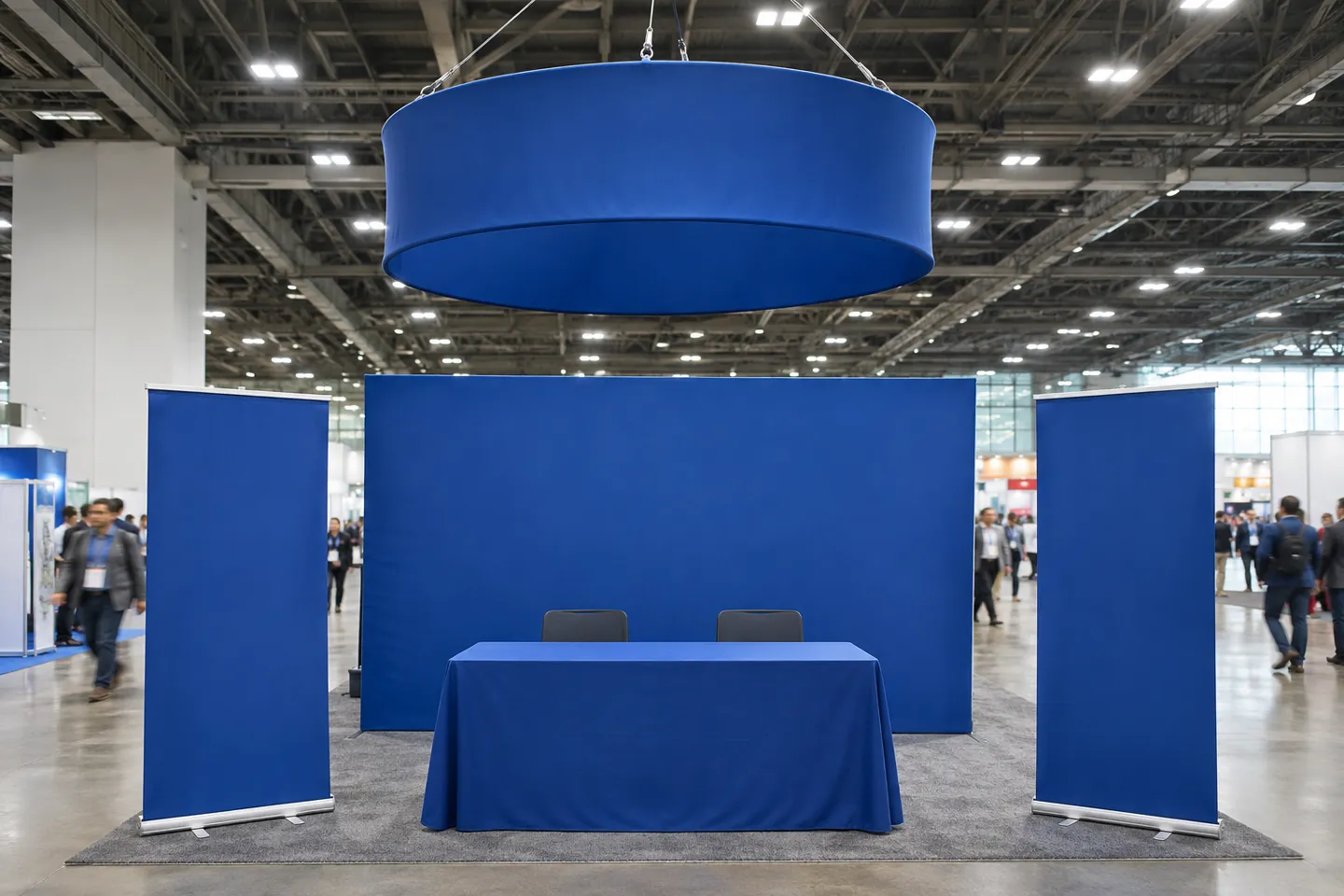
Accepting the bare shell is the zero-spend path: posters, roller banners, your own table. It exists, and for a first regional outing on a tight budget it can be the right call. Its failure mode shows up in the words of people who have watched it happen: “a shell scheme with roller banners can look very last-minute which doesn’t give a great first impression” (r/smallbusinessuk, 2026). The visitors you most want are the ones who read that signal fastest.
Dressing the shell is the mainstream choice: full graphic panels, upgraded lighting, real furniture, a floor that is not the organizer’s carpet. Costs stay predictable because the structure is fixed, and build day has fewer moving parts than any custom construction.

Stepping out means leaving the shell world entirely. One route is a space-only plot built to your own design. Another, at some US shows, is a booth rented from the general contractor that arrives closer to a finished stand (GES, n.d.). This is where budgets multiply and lead times stretch to months. It is also the only route when the plan needs ceiling rigging, structures above the height cap, or a fully enclosed environment. European organizers lean toward shell-scheme packages priced per square metre, while US shows more often sell raw space and expect the exhibitor to bring the build (Expofp, 2026). The same decision therefore weighs differently on each side of the Atlantic.
One decision sits above all three branches: position. One industry supplier with two decades of shows behind them puts it plainly: placement matters more than the stand type (r/smallbusinessuk, 2026). A weak position can eat the budget that would have bought a better build. Give any builder or designer at least eight weeks of runway (Rocket-X, 2026); the advance-order deadlines for show services cluster around that mark (Expositions pures, 2026).
Three paths from the same shell
| Path | Ce que vous obtenez | Where it fails | Suits |
|---|---|---|---|
| Accept the bare shell | Zero structure spend, total flexibility | Reads “last-minute” to professional buyers | Tightest budgets, first local outing |
| Dress the shell | Brand walls, lighting, furniture at predictable cost | Capped height, capped footprint, no rigging | Most exhibitors with lead-gen goals |
| Step out (space only / rented booth) | Full design freedom, taller structures, rigging | Cost and lead time multiply, deadlines harden | Established brands, big-product launches |
The Upgrade Stack: Where Shell Scheme Money Actually Works
Dressing a shell is a stack of purchases, and the order of the stack decides whether the money shows. The pattern that holds across show floors: walls first, light second, everything else third.
Spend order
Walls
Light
Everything else
Graphic panels: the first and biggest lever
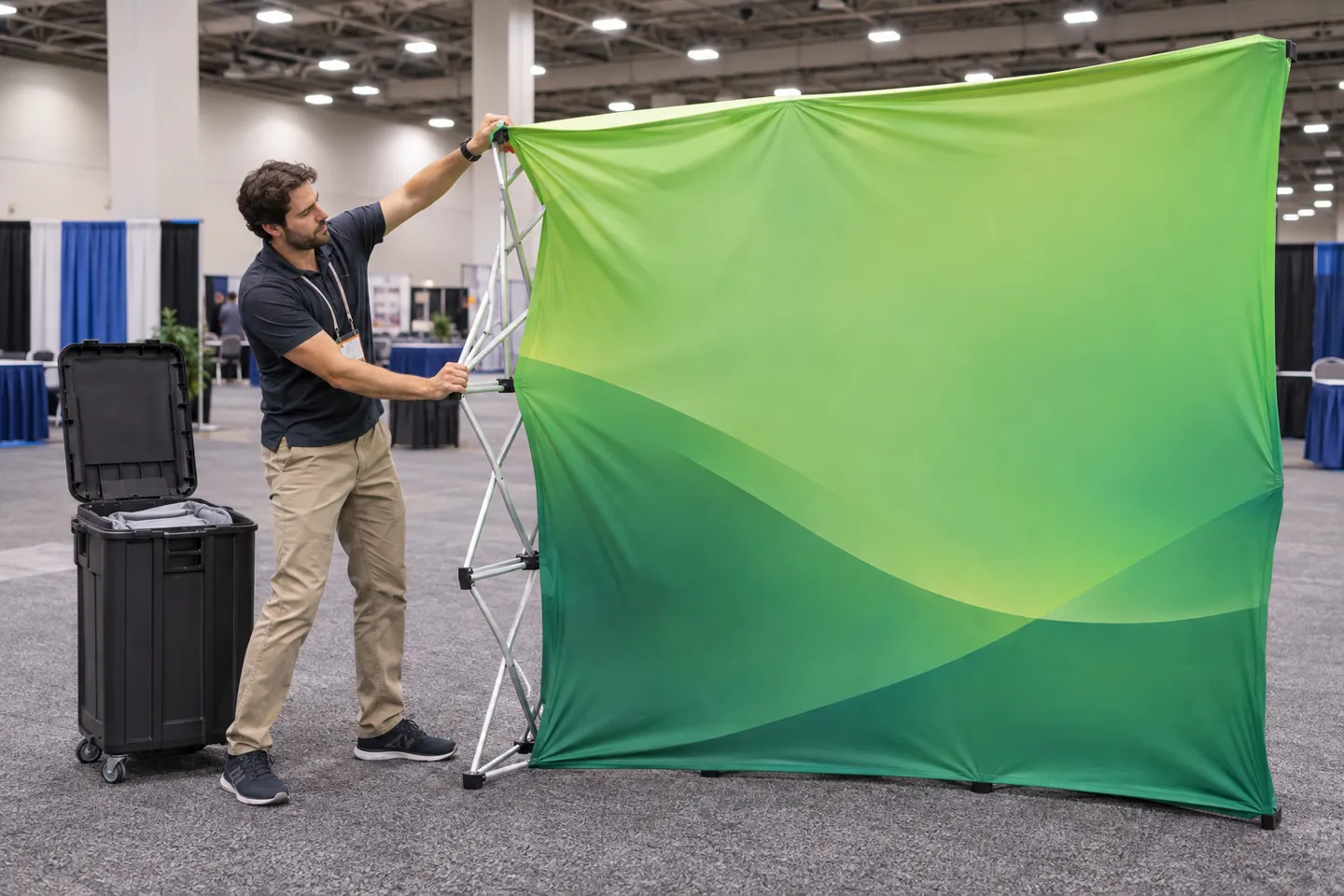
The white panel walls are the single largest visual surface you control. Covering them is the upgrade that changes how the stand reads from ten metres away. Two materials dominate, and the choice is a real trade-off with cost and finish on opposite ends. Vinyl graphics are durable, waterproof and budget-friendly, printed and mounted onto rigid panels. Fabric graphics are light, stretch tight across the wall, read as one uninterrupted picture, and hang from the shell with simple clips (Booth Exhibits, 2025). Fabric earns its premium on reuse and finish; vinyl wins on price and toughness.
The fine print lives in the module system. Shell walls are built from panels roughly 35 inches (about three feet) wide (Booth Exhibits, 2025). Graphics that ignore the module grid leave aluminum showing, or get rejected for overhang. Confirm exact panel dimensions with the organizer before any artwork is scaled. Brief against high-resolution files too: artwork that looks fine on a banner falls apart printed at wall size.
Reuse comes with a real catch. Exhibitors who reuse panels across shows report that printed panels are “prone to scratches and smudges during handling and transport. Some panels only lasted for one event, while others were reused multiple times” (r/BusinessPH, 2025). Reuse is real, it just needs protective packing and a reprint line in the annual budget, not a buy-once assumption.
Send your shell scheme package and booth dimensions, and Aplus Expo will quote the graphic panels, lighting, and furniture to fit your show’s module grid.
Get a booth quoteLighting and floor: the highest-return small money
Upgraded lighting is the most consistently under-budgeted upgrade on a shell scheme. Better spotlights or LED heads change how the stand reads across the hall, not just at the stand, which is exactly what a packed aisle demands. One honest boundary: in halls with strong ambient daylight, the gain is smaller, so check the hall before spending here. The floor is the second quiet win. Vinyl floor graphics or quality carpet tiles over the organizer’s standard carpet read as a more finished stand to visitors who never name the reason (Rocket-X, 2026).
Furniture, counters and screens
Furniture decides whether visitors stop or scroll past: a counter creates a natural conversation point, seating creates a reason to stay, shelving displays product without eating the floor. Screens and tablets add engagement without footprint, on one condition: they are tested before the doors open, because an untested screen is a black mirror. Storage matters too; visible cardboard boxes undo three thousand dollars of graphics instantly.
The matrix below turns the stack into a decision tool: what each upgrade is for, where it fails, and what to confirm before ordering it.
Shell scheme upgrade stack: boundaries and confirmations
| Upgrade | Meilleur pour | Boundary or failure point | Confirm before ordering |
|---|---|---|---|
| Full graphic panels | Brand walls, ten-metre visibility | Module overhang rejected on build day; scratch risk in transit | Panel sizes per module, artwork resolution |
| Upgraded spotlights / LED | Stand-out across a packed hall | Smaller gain in bright daylight halls | Power order deadlines; fixture specs allowed by manual |
| Furniture and counter | Conversation and dwell time | Overcrowding in small footprints | Floor plan approval, delivery windows; counts, sizes, storage |
| Screen or tablet | Engagement without floor space | Untested screens fail silently on show day | Power and internet ordering; screen size, mounts, power draw |
| Floor covering (vinyl / carpet tiles) | Perceived finish visitors notice without knowing why | Trip-edge and fitting rules | Manual rules on floor coverings; tile size, fitting method |
What a Shell Scheme Costs in the US
US shell scheme money sits in three separate wallets, and mixing them is the classic budgeting error. The first wallet is the space fee, paid to the organizer for the shell itself. The second is everything you add: graphics, furniture, lighting, floors, screens. The third is the show’s own mandatory services, power orders, material handling, and at union venues the labor rules that come with them.
Published numbers are rare, which makes the public ones worth memorizing. IMEX America, the large international meetings show in Las Vegas, lists its shell scheme option at $170 per square foot, with a 100 sqft minimum (about $17,000) (IMEX America, 2026). That price includes an essential furniture package.
Shell scheme at IMEX America: $170 per sqft, 100 sqft minimum (≈ $17,000), essential furniture package included. Published exhibitor pricing, 2026. One show, one data point: treat it as a ceiling reference, not a US average.
That $170 figure describes a flagship international event, not an American market rate. Regional shows price far lower, and there is no single national number. Two conclusions follow. First, the only reliable source for your budget is that show’s own booth pricing page and exhibitor manual. Second, at premium US shows a shell scheme is not automatically the cheap option; the $17,000 floor at IMEX says the quiet part out loud.
For orientation only, the UK reference frame: organizers there charge roughly £220 to £625 per square metre for space, with all-in dressing packages from builders around £3,000 to £5,000 (Rocket-X, 2026). Useful as a shape, useless as a conversion: never mix pounds and square metres into a US budget.
Where the three wallets go
| Layer | What it covers | Who bills it |
|---|---|---|
| Space fee | The shell, basic power, fascia, standard flooring | Show organizer |
| Personnalisation | Graphics, lighting, furniture, floor, screens | Your builder or suppliers |
| Mandatory show services | Power orders, material handling, rigging, cleaning, internet | Venue and general contractor, directly |
How Shell Scheme Booths Fail
Shell scheme failures are almost never build-day surprises. They are signing-day omissions that only surface on build day, when there is no time left to fix them.
The failures cluster into two families: things that go wrong at the venue, and things that go wrong in how the stand looks and lasts.
Failures that happen at the venue
The over-limit rejection is the most expensive one. A graphic panel, light fixture or display that crosses the height cap or the footprint line gets rejected on build day, with no time to redesign (Rocket-X, 2026). The defense is unglamorous: before anything is ordered, check every element against the manual’s height and boundary figures for your specific show.
The inclusion surprise runs a close second. Exhibitors assume the fascia carries their branded graphics, or that the socket in the photos comes with power, and discover on site that both were optional extras. The fix costs one email: get the full inclusions list in writing before planning starts, not after.
The expectation mismatch hits international exhibitors hardest. Booked on European experience, they expect wall panels and a fascia, and find curtain dividers on a US inline: the same contract word, a far more basic object (Expositions pures, 2026). Ask for photographs of the actual shell your show provides, not a diagram, before you design anything for it.
Failures of look and reuse
The roller-banner failure is quiet and expensive in a different currency. A bare shell dressed with a few roll-up banners reads, to the professional buyers walking the aisle, as a stand that was thrown together (r/smallbusinessuk, 2026). The buyers most able to sign contracts are the ones who read that signal fastest. When the budget cannot do everything, fix the walls first and buy furniture second.
The reuse failure shows up in the second and third year. Printed panels scratch and smudge in transit, and some die after a single show (r/BusinessPH, 2025). Exhibitors who budget protective packing and periodic reprinting keep their per-show cost flat; exhibitors who budgeted buy-once discover the truth at the worst moment, during setup.
The root cause under all five: the gap between what the contract said and what the exhibitor assumed. Close it in writing, before the truck loads.
The Business Lens: Reading a US Shell Scheme Before You Sign
Run the chain back through business eyes and one conclusion holds: treat the shell scheme upgrade as a line-item decision made at signing time, ranked with the space fee itself. It is not an upgrade you improvise at the venue. Every fact in this article points the same way. The American shell is more bare than the word suggests. The money sits in three wallets with separate deadlines. The failures are signing-day omissions that surface on build day, when nothing can be fixed.
For exhibitors flying in from Europe, the stakes are specific. The word “included” does not survive the ocean crossing: a European shell scheme package and an American one describe different objects, and the services wrapped around them (power, handling, build rules) differ just as much. Working remotely, mostly by email, means verification has to happen before shipping. The checks you cannot do in person become photos of the finished stand, written specifications, and approvals tied to deadlines.
That reduces to four things to lock before you sign anything.
Lock before signing:
- 1) The shell in pixels: photographs or a written spec of the exact structure your show provides.
- 2) The budget in three layers: space fee, customization, mandatory services, each with its own deadline.
- 3) The acceptance standard: the stand stood up complete before shipping, photos for your approval, fixes made in the workshop.
- 4) Delivery and response: installation finished the day before doors open, a contact on standby through the show, a defined on-site response radius.
This is the checklist our own build process was designed around. Aplus Expo builds every custom booth fabrication project inside its own Las Vegas workshops, stands the booth up complete with graphics mounted, and photographs it for your approval before anything ships (custom booth fabrication). Working from another country, you approve the build from photos instead of walking the factory floor, and changes happen in the workshop where they are still cheap.
And the boundary in the other direction: a shell scheme has a ceiling, and this plan has reached it. When the design starts needing ceiling rigging, double-height structures or a fully enclosed environment, that is the moment to step out of the shell entirely and price a proper space-only build.
If you would rather have that checklist executed than just handed over, Aplus Expo runs installation and show-floor support with standby crews through every show day (show-floor support).
From shell scheme to finished stand
Design, fabrication, installation, and show-floor support for US shows, from a Las Vegas based builder.
Get a booth quoteRéférences
- IMEX America. “Exhibiting at IMEX America: Booth Options and Costs.” 2026. https://america.imexevents.com/exhibiting-at-imex-america
- IAEE. “Guidelines for Display Rules and Regulations.” 2019. https://www.iaee.com/wp-content/uploads/2023/06/IAEE_Guidelines_for_Display_Rules_and_Regulations-1.pdf
- EXHIBITOR Magazine. “International Exhibiting.” https://www.exhibitoronline.com/topics/article.asp?ID=2469
- EXHIBITOR Magazine. “10 Small-Booth Graphic Gaffes.” https://www.exhibitoronline.com/topics/article.asp?ID=2989
- r/smallbusinessuk. “Exhibition Advice Needed: Shell Scheme or Space Only.” Reddit, 2026. https://www.reddit.com/r/smallbusinessuk/comments/1qnft82/exhibition_advice_needed_shell_scheme_or_space/
- r/BusinessPH. “Shell Booth Design sa Convention or Expo as Exhibitor.” Reddit, 2025. https://www.reddit.com/r/BusinessPH/comments/1n3sub3/shell_booth_design_sa_convention_or_expo_as/
- ExpoFP. “Trade Show Booth Pricing: How to Price Exhibit Space.” 2026. https://blog.expofp.com/trade-show-booth-pricing-how-to-price-exhibit-space/

 English
 Spanish
 German
 French
 Italian
 Korean
 Chinese