
Every exhibitor has met this line item at least once. The show is budgeted, the graphics are approved, and then the final invoice arrives with a charge you do not remember agreeing to: “material handling.” In the exhibit industry it has another name: drayage. Before you treat it as one more unavoidable cost of doing business, it is worth understanding exactly what it buys and who sets the price. It also explains why some exhibitors pay it at every single show while others barely see it on a statement.
Trade Show Material Handling: What That Line Item Actually Buys
First, a quick name check. If you searched “trade show material handling” and found results about forklift manufacturers and industrial equipment expos, you have hit an industry with the same name: material handling, the business of moving goods in warehouses and factories. This article is about the trade show meaning, where material handling is the venue-side service that moves your exhibit freight around the show.
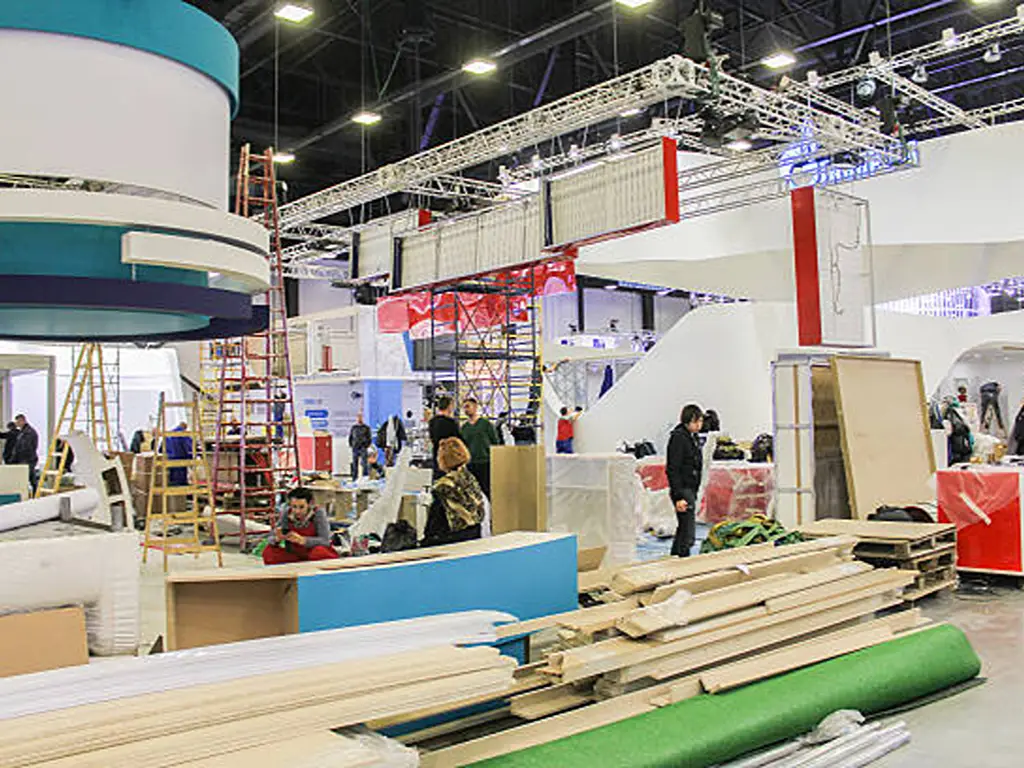
Here is the part most guides skip: this fee is not collected by your shipping carrier, and it is not negotiable. Every U.S. show appoints an official general service contractor (GSC; firms such as GES, Fern and Freeman), and that contractor is the only company authorized to move materials on the show floor (GES). When your crates arrive, the carrier’s job ends at the dock. From that moment on, everything that happens to your freight is the GSC’s work, and it is billed to you by the hundredweight.
That work is a longer chain than most exhibitors picture:
- Unloading freight from the carrier’s vehicle at the receiving dock or the off-site marshaling yard
- Transporting it to your booth space on the show floor
- Removing and storing your empty crates for the duration of the show
- Returning the empties at move-out and repacking
- Transferring everything back to the dock and loading it onto the outbound carrier
So the invoice you see is not for one forklift trip. It pays for the whole in-hall logistics operation, including the empty-container storage and the return leg (GES, TSNN).
Keep three separate bills straight, because they come from three different companies: shipping (your carrier, from your office to the show city), material handling (the GSC, inside the venue), and labor or installation (whoever builds the booth, often a separate contractor). Exhibitors who blur those lines are the ones who later discover they paid for the same movement twice.
How Material Handling Is Priced: CWT, Packing Classes, and the Minimum That Multiplies
Material handling is billed per hundredweight (CWT, or 100 lb), and weight is rounded up to the next full 100 lb, so a 212-lb crate bills as 3 CWT and a 489-lb crate as 5 CWT (TSNN). Rates are set per show and published in the exhibitor services manual. What changes the unit price is how your freight is packed:
| Packing class | Relative rate | What it covers | Your action |
|---|---|---|---|
| Crated | Lowest per CWT | Easiest to store and move | Stackable; always crate when you can |
| Palleted | Mid per CWT | Needs more care unloading and moving | Fine for heavy, stable freight |
| Special handling | Highest per CWT (often +25–45%) | Loose, pad-wrapped, oversized, or items needing special equipment | Avoid unless your product demands it |
At one foodservice expo, crated freight ran $104.50 per CWT while special-handling freight was $176.75 (TSNN, 2019 example; treat all such numbers as show-specific, not industry law). Mixing classes in one shipment matters: if your truck is mostly special-handling items, even your one or two normal crates can be billed at the inflated rate, which is why reviewing the classification on your invoice is a real money-saving step, and why the GSC will correct genuine misclassifications if you ask.
Watch the per-shipment minimum. Nearly every contractor bills a minimum weight per shipment, commonly around 200 lb (some GSCs apply more) (Steadfast Displays, GES).
And the “advance warehouse vs. direct-to-show” question has no universal answer. Shipping ahead to the contractor’s advance warehouse usually costs less because labor is calmer and storage is cheaper in show cities with abundant warehouse supply, which is why Las Vegas shows tend to reward advance shipping (TSNN). But in a small show city without cheap storage nearby, the GSC passes its own warehouse rent on to you, and direct-to-site can win (TSNN documents a Monterey, CA case where advance shipping was more expensive). Some 2026 rate tables even list direct-to-site crated freight below advance-warehouse rates, with a “riskier timing” warning attached (Steadfast Displays). The honest rule: compare both quotes in your show’s manual, then weigh the surcharge risks (late-to-warehouse, off-target delivery windows, mixed and uncrated freight) before choosing (GES).
Within any one shipment, the levers are consolidation and classification. Two crates of 114 lb and 223 lb shipped separately cost more than one combined crate, because every shipment pays its own rounding and minimum (TSNN). This is real money, but it is also the ceiling of what packing tricks can do. They shrink the rate. They cannot decide whether the bill exists at all.
Your Delivery Model Decides Whether “Material Handling” Appears on Your Invoice at All
That last sentence is the fork in the road, and almost no published guidance walks you through it. Industry sources contradict each other here: one camp tells you drayage “cannot be avoided, only shrunk” (Steadfast Displays), while experienced exhibitors report that renters “often avoid this” entirely by working with exhibit houses local to the venue (Quora, 2026). Both are right, on different layers: the fee is unavoidable for freight that ships under your name. Whether freight ships under your name at all is a delivery-model decision you make months earlier.
The four delivery models
Four delivery models cover how an exhibit reaches the floor. Each generates a different cost structure:
| Delivery model | Fee structure | Who it fits | Where it breaks down |
|---|---|---|---|
| Own + ship + self-install | Long-haul freight + full GSC drayage + labor every show, rates learned after booking | One-off shows or teams that insist on owning the asset | Cities far from your warehouse, union-city labor rules you don’t know, surprise-heavy budgeting |
| Show-city storage loop | One long-haul freight bill ever, then per-show local moves + monthly storage | Repeat exhibitors returning to the same city (e.g. annual Las Vegas shows) | Rotating cities, storage fees eat the savings, one-off trips don’t amortize |
| Local turnkey contractor | Logistics folded into one pre-signing quote, no freight under your name, no GSC drayage invoice on your side | Out-of-town and international exhibitors, anyone who wants one predictable number | Contractors without local facilities or union-city coordination push you back to model 1 |
| Hand-carry or POV | Flat-rate cart service, typically limited to two round trips, then full rates apply | 10×10-style portable exhibits, local exhibitors | Anything bigger than a carload |
The POV row’s two-trip limit, and the full-rate cliff beyond it, comes from the TSNN material-handling FAQ (TSNN).
The middle two rows are where the money hides. Steadfast, arguing for the “unavoidable” camp, still concedes the storage play: exhibitors who keep their booth in Las Vegas “skip the long-haul freight entirely for every Vegas date on their calendar” (Steadfast Displays). The turnkey row goes one step further. When the same local contractor manufactures, delivers and installs your booth, the freight never enters the show’s marshaling yard under your name. The material-handling invoice you would otherwise receive either never arises on your side or is folded into one quoted number. A heavy owned booth, by contrast, is “penalized twice”: once in cross-country freight, once in drayage billed by the hundredweight (Quora, 2026).
To see the scale of what model 1 quietly costs, run the example Steadfast publishes for a typical 10×20 booth: 2,400 lb at $140 per CWT comes to roughly $3,360 in material handling alone, before a single surcharge (Steadfast Displays, 2026 benchmark rates, which vary by show).
material handling for one 2,400-lb 10×20 booth at a $140/CWT benchmark rate, before a single surcharge (2026 rates vary by show)
What no delivery model dodges
Honesty requires the residue list, because every “avoid drayage” pitch you read conveniently omits it. Even with a local turnkey booth, freight usted generate still gets handled. Product samples and giveaways shipped to the hall are freight, and they bill like freight. Some shows carve out discounts for essential exhibit items (food samples at one 2019 expo billed at $34.75 per CWT with a 200-lb minimum), but discounts are negotiated show by show, not guaranteed (TSNN). Large product machinery is special-handling freight in any model. Unionized show cities (Chicago, New York) add labor rules that no contractor can waive; union labor is baked into the rate structure of those shows (Steadfast Displays). And if you ship at all, the GSC’s scale ticket is the arbiter of your weight. Freight brokers report exhibitors routinely try to under-declare weight, and routinely lose that argument at the yard (Reddit r/FreightBrokers, 2025). Declare honestly and photograph your shipments instead.
The pattern across all four models: packing tricks and timing shave the rate; the delivery model decides whether the line exists.
“hit with drayage, labor, electrical, internet, material handling, and a dozen other charges they didn’t know existed”
Reddit r/Entrepreneur, 2025
How to Read a Booth Contractor’s Quote: Line Items, Double-Billing, and What to Verify
If the turnkey model interests you, or if you are shipping and want a contractor who understands the freight side, the quote itself becomes your audit trail.
“You want line items for design, fabrication, graphics, shipping, drayage (that’s the material handling fee at the venue), installation labor”: a breakdown, not a total.
Reddit r/tradeshows, 2026
The line items a serious quote separates
A comparable quote splits at least these: design, fabrication, graphics, transportation, material handling (drayage), installation labor, and on-site incidentals (power orders, rigging, service-desk items). A single lump-sum number tells you nothing, because you cannot tell which of the three bills (carrier, GSC, contractor) it covers. This matters twice as much for international exhibitors, whose whole procurement process runs on itemized documentation. If a vendor cannot or will not split the quote, treat that as information.
The double-billing checkpoints
Run every quote through these five checks before signing:
The double-billing checkpoints
- Freight vs. material handling: is transport clearly separated from venue handling, with the boundary stated?
- Labor vs. drayage: installation labor and material handling are different companies’ work, and quotes that blend them hide the overcharge
- Storage in annual programs: does the monthly storage line double-count the transport leg you already paid?
- The return leg: some manuals bill inbound only, others price the full round trip; know which one you are quoted
- Union-city coordination: for Chicago or New York shows, the quote should state who handles union labor logistics
Two of those checks come straight from the industry’s own complaints. The return-leg confusion is documented on both sides of the rate debate (TSNN, Steadfast Displays), and exhibitors report union-city costs are “almost never provided beforehand”, and that finding out after you book is “too late to do anything about it” (Quora, Mark Bric Display president, 2018).
Fees are published after you book — so verify before you sign
Here is the structural problem that makes all of this necessary: full material-handling rates live in the exhibitor services manual, which most exhibitors first see after committing to the booth. Even a general contractor’s own CEO concedes “nobody wins when the exhibitor gets surprised by additional, but necessary, expenses” (Quora, Fern CEO, 2018). Because you cannot negotiate the GSC’s rate, your protection is upstream. Make the contractor put a number or a committed range on transportation, handling and installation in the quote. Confirm when the account is settled: bills closed by show end, or invoices that chase you for weeks. And photograph your freight at pickup and delivery, so a scale-ticket dispute starts with your evidence, not your word.
Out-of-Town Exhibitors: Make Logistics a Pre-Signing Number, Not a Post-Show Surprise
Pull the thread from the sections above and it leads somewhere specific. Material handling is charged by one authorized contractor, by weight, at rates you learn after you book (stations 1-2 facts). Packing and timing can shrink the rate, but only a delivery model that keeps your freight out of the marshaling yard removes the line (station 3). And the only way to verify which model you are buying is an itemized quote checked for the five double-billing points (station 4).
For an exhibitor flying in from another state or another continent, the conclusion should be uncomfortable for the vendors who hide behind lump sums: “saving on material handling” is the wrong question. The right question is whether this freight should exist under your name at all. Add these to your vendor scorecard:
- Does the contractor manufacture or warehouse in or near the show city?
- Does it operate its own transportation, or will freight still ship under your name?
- Does it install with its own crews, and can it coordinate union-city shows?
- Will it give you an itemized quote, and is the account settled by show close?
When a vendor clears those four, logistics stops being a per-show surprise and becomes a single number you agreed to before signing.
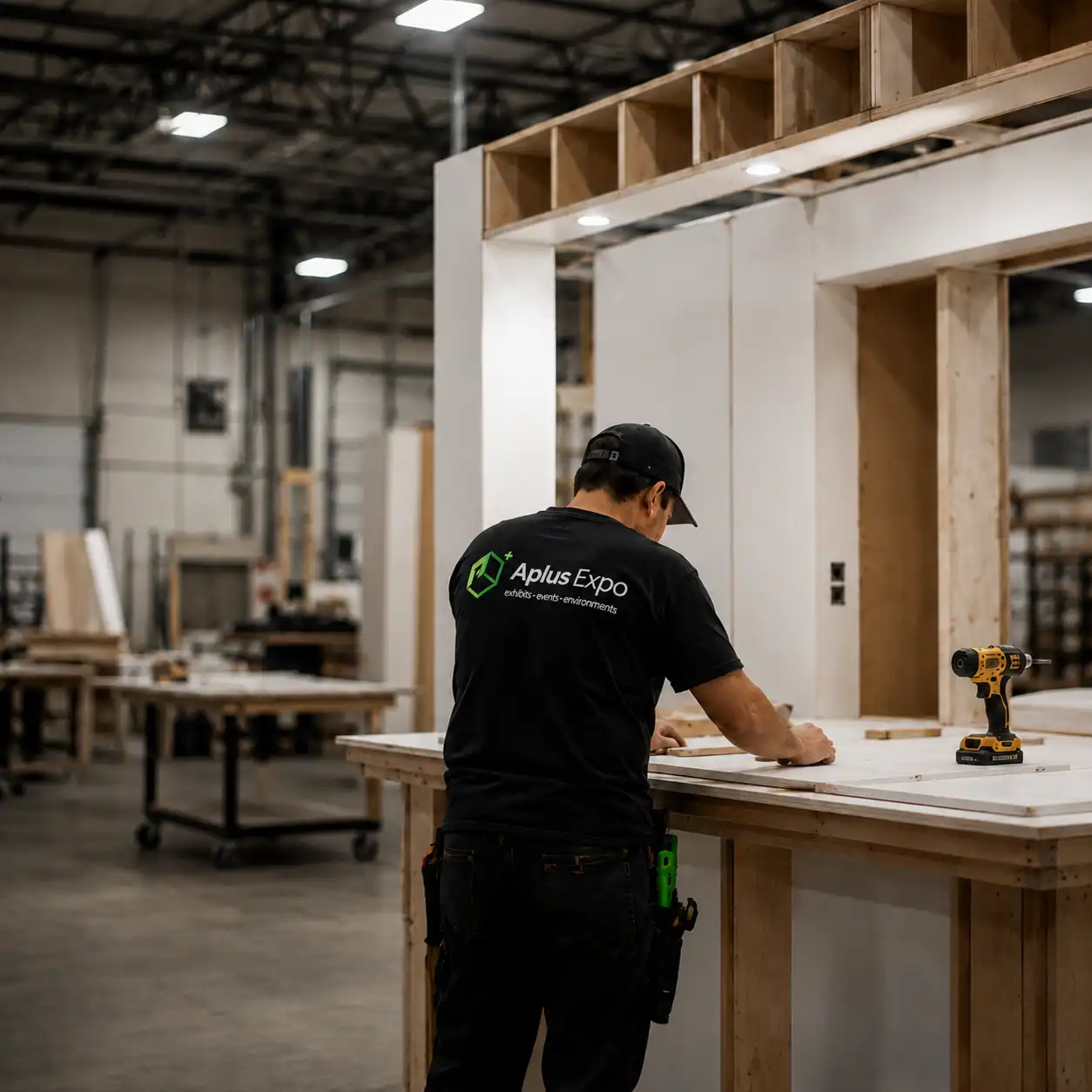
That is the structure we built our business around, and it is why we answer those four questions the same way every time. Aplus Expo’s factory is ten minutes from the Las Vegas convention centers, with more than 10,000 sq. ft of in-house warehouse behind it (Aplus Expo — About Us). We build every booth twice: roughly 80–90% pre-assembled and graphics-mounted in our factory, then photographed and signed off before it ever ships. The on-site build is then a two-to-three-hour reassembly of a proven kit, not a first-time assembly in a union hall (Aplus Expo — Custom Booth Rental). And because transportation and logistics run in-house (Aplus Expo — Transportation & Logistics), your freight never travels under your name to a marshaling yard: the handling line either disappears from your side or shows up as one quoted item, alongside a free 3D design and an itemized, line-by-line estimate before you commit. That is the pre-signing number this article keeps pointing at.
One honest boundary, though: if you exhibit once a year with a lightweight portable display and never touch a union city, the local-turnkey premium is not for you. The packing and timing levers in this article will serve you fine. The delivery-model decision is for everyone whose freight keeps crossing state lines, because that is exactly when material handling stops being a fee and starts being a design decision.
If you are planning a Las Vegas show and want a quote you can audit line by line, send us your three questions. We will answer them the same way we build: itemized, in writing, before you sign (póngase en contacto con Aplus Expo).
Make logistics a line item you sign, not a surprise you open.
Planning a Las Vegas or any U.S. show? Get an itemized quote with transportation, material handling and installation spelled out line by line — before you commit.
Request your itemized quote- TSNN. “Trade Show Booth: Material Handling FAQs.” https://www.thetradeshownetwork.com/trade-show-blog/trade-show-booth-material-handling-faqs
- Reddit r/tradeshows. “Advice Needed on Working with U.S. Trade Show Booth Builders.” https://www.reddit.com/r/tradeshows/comments/1qhxz7a/advice_needed_on_working_with_us_tradeshow_booth/
- Reddit r/Entrepreneur. “It’s Time to Talk About Trade Show Unions.” https://www.reddit.com/r/Entrepreneur/comments/1hvefsf/its_time_to_talk-about-trade-show-unions-freeman/
- Reddit r/FreightBrokers. “Trade Show Deliveries: Why Do You Need a Scale Ticket.” https://www.reddit.com/r/FreightBrokers/comments/1k729jf/trade_show_deliveries_why_do_you_need_a_scale/
- Quora. “What Are the Hidden Costs of Owning a Trade Show Booth vs. Renting One?” https://www.quora.com/What-are-the-hidden-costs-of-owning-a-trade-show-booth-vs-renting-one
- Quora. “As a New Exhibitor for a Trade Show, What Should Show Organizers Provide?” https://www.quora.com/As-a-new-exhibitor-for-a-trade-show-what-top-one-or-two-things-should-show-organizers-provide-or-do-to-help-your-experience-be-successful
- Aplus Expo. “Custom Booth Rental.” https://www.aplusexpo.com/service/booth-rentals/
- Aplus Expo. “Transportation & Logistics.” https://www.aplusexpo.com/service/transportation-logistics-1/
- Aplus Expo. “Trade Show Storage.” https://www.aplusexpo.com/service/trade-show-storage-1/
- Aplus Expo. “Installation and Dismantling.” https://www.aplusexpo.com/service/installation-and-dismantling/
- Aplus Expo. «Quiénes somos». https://www.aplusexpo.com/about-us/
- Aplus Expo. «Contacto». https://www.aplusexpo.com/contact/
- Aplus Expo. “Home.” https://www.aplusexpo.com/



 English
  Spanish
  German
  French
  Italian
  Korean
  Chinese