
Parking at the San Diego Convention Center looks simple from the outside: there is a garage under the building, you drive in, you pay, done. Then you learn that the garage pre-sells during Comic-Con, that your spot does not survive a lunch run, and that move-in day runs on a different rulebook than show day.
Those surprises are why rates and rules deserve more attention than they usually get. This guide walks through all of it in the order you’ll actually encounter it: the baseline facts, every parking option within walking distance and where each one breaks, what happens when a major event takes over, and the separate rulebook that applies when your car arrives carrying booth materials instead of beach chairs.
San Diego Convention Center Parking: The Baseline
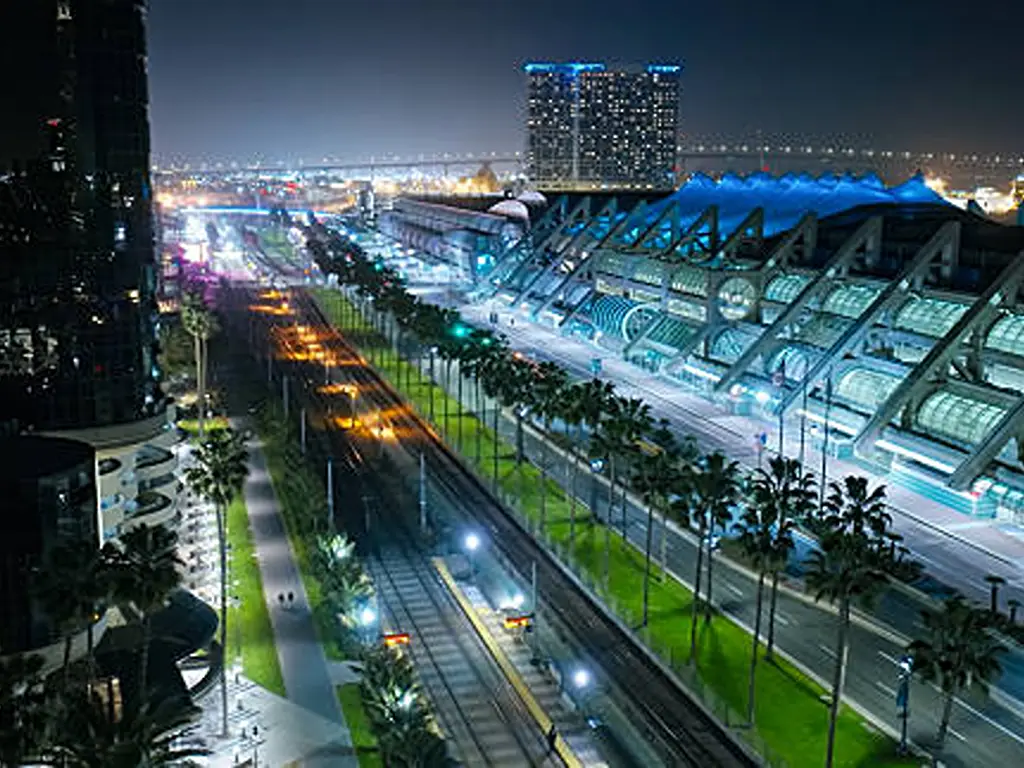
The convention center has exactly one parking facility of its own: a 1,950-space underground garage beneath the building, owned by the Port of San Diego and run by ACE Parking, with the entrance on Harbor Drive (San Diego Kongresszentrum, 2026). Thirty-one of those spaces are ADA-compliant, with elevator access straight up into the building.
Prices there are not fixed. ACE sets the rate, the number moves with event activity, you pay when you enter, and the venue publishes a projected rate schedule for the current month. On ordinary event days, expect the neighborhood of $25 to $45; one attendee report from May 2026 put the garage at $25 a day with nearby private lots at $35 (r/SDCC, 2026). ACE’s own advance-purchase page for the garage has shown rates around $39.95 on reservable days (ACE Parking, 2026).
Three rules catch people off guard every single week, so here they are up front:
The garage in one glance
- 1,950 spaces, underground, beneath the building
- Entrance on Harbor Drive; pay on entry, rates vary by event
- 31 ADA stalls with elevator access straight up into the building
- No in-and-out privileges
- No overnight parking
- No RVs or oversized vehicles
- Questions go to ACE Parking at 619.237.0399, not the venue
First, there are no in-and-out privileges. Move your car for lunch and you’re paying for a fresh ticket in the afternoon. Second, overnight parking is not permitted, so the garage cannot double as hotel parking for a multi-day trip. Third, RVs and oversized vehicles are banned outright, which matters more than it sounds once you look at what people actually try to drive to San Diego. All three come from the venue’s own parking page (San Diego Kongresszentrum, 2026).
One more baseline detail that saves a phone call: the garage is managed independently of the convention center itself. The venue’s staff cannot adjust rates or resolve disputes, so parking questions go to ACE at 619.237.0399.
That covers the official answer. The real decision, though, starts one block farther out.
Every Parking Option Within Walking Distance, and When Each One Fails
⭐ The underground garage. Best for early arrivals who want the shortest walk in the city: elevator to the lobby, no weather exposure, no street crossings. It fails in three specific ways: it fills early on big event days, the no-in-and-out rule punishes anyone who plans to move their car midday, and drive-up pricing on peak days stings. If your day starts before 9 a.m. and ends after the evening sessions, it’s still the default answer.
Hilton Bayfront’s 2,000-space structure. Directly adjacent, at the corner of Harbor Drive and Park Avenue, sits a separate 2,000-space parking structure serving the Hilton San Diego Bayfront (San Diego Kongresszentrum, 2026). It behaves like a second official garage: same neighborhood pricing, a slightly longer walk from most of the exhibit halls, and it also swells or sells out around major events. When the underground garage’s line backs up onto Harbor Drive, this is the exit people wish they’d taken.
Downtown garages in the Gaslamp and Horton Plaza area. Ten to twenty minutes on foot, east of the venue, you’ll find a dense grid of private garages and lots. This is the territory the booking apps cover, and where the cheapest day rates in walking distance live. The trade is distance and the Gaslamp’s own congestion on event nights. These garages are the right answer for budget-conscious multi-day visitors who don’t mind the walk.
Metered street parking. It exists, both City of San Diego meters and Port of San Diego meters along the Embarcadero, and both apply special event rates during big conventions (San Diego Kongresszentrum, 2026). Locals are blunt about the failure mode: street spots near the venue are scarce, and the ones you find can turn into towing operations when street cleaning or event restrictions kick in. Treat “free parking near the convention center” claims from aggregator sites as a starting hypothesis, not a plan: check the signs on the actual block, every time.
Street parking: the tow risk
One r/sandiego thread describes parking on Fifth Avenue and getting towed by day’s end. The block’s signs, read on the exact day you park, are the only reliable guide.
Park-and-ride via trolley. The San Diego Trolley’s Gaslamp Quarter and Convention Center stations drop riders at the venue’s doorstep, and parking at an outlying trolley station is often free or a few dollars. Attendees who commute this way during Comic-Con consistently report it as the least stressful option (r/SDCC, 2026). It fails for anyone hauling gear, traveling with people who can’t walk far, or leaving late, when trolley frequency drops in the evening.
Reserving ahead: ACE versus the booking apps. ACE sells advance reservations for the official garage on eligible days, and SpotHero and ParkMobile list dozens of nearby private options with fixed prices (SpotHero, 2026; ParkMobile, 2026). Booking converts an uncertain drive-up cost into a known one, which is worth more than the difference in dollars on any day when demand is high. Read the cancellation terms before you pay: some discounted spots are final, and a reservation for the wrong date is a problem you discover at the gate.
Put together, here is the decision matrix. Find the row that matches your trip:
San Diego Convention Center parking: which option fits which trip
| Option | Am besten für | Price level | Fails when | The check to make first |
|---|---|---|---|---|
| Underground garage | Early arrivals, shortest walk, bad weather | $$ (about $25-45, event-variable) | Fills early on big days; no in-and-out; no overnight | Confirm today’s rate on ACE’s projected schedule |
| Hilton Bayfront structure | Backup to the garage, hotel guests | $$ | Also swells around major events | Check event-day availability in advance |
| Downtown garages (Gaslamp/Horton) | Budget stays, multi-day, no midday car use | $-$$ (app rates vary) | 10-20 min walk; Gaslamp congestion at night | Read the cancellation terms before booking |
| Metered street parking | Short errands, off-peak hours | $ (special event rates apply) | Scarce; towing on cleaning/event restrictions | Read the block’s signs that exact day |
| Trolley park-and-ride | Big-event days, stress-averse travelers | $-free | Hauling gear; late evenings | Check station parking and evening frequency |
| App reservation (SpotHero/ParkMobile/ACE) | Anyone driving in on a known busy day | fixed booked rate | Wrong-date or non-refundable bookings | Verify date, entrance, and refund policy |
Big-Event Mode: When the Garage Is Already Sold
Now scale the problem up. During Comic-Con and a handful of other anchor events, the answer to “can I park at the convention center” changes from yes to essentially no. All parking at the venue is pre-sold during the show, and most lots within walking distance sell out alongside it (r/comiccon, 2025). Attendee reports from recent years put drive-up parking near the venue at $70 and up, with $100 days visible right next door (r/comiccon, 2025).
Peak-day reality
During Comic-Con-level events, the convention center garage and most nearby lots are pre-sold in advance. Arriving without a reservation or permit on peak days is not a pricing problem. It’s a no-parking problem.
For Comic-Con specifically, ACE runs a permit system with a lottery: you enter the lottery first, winners get the right to purchase, and what’s left afterwards goes on general sale until it’s gone (Comic-Con International, 2026). The sequence matters: show up hoping to buy on the day and the only inventory left is whatever the market produces at surge prices.
Two tactical notes from veterans who drive in anyway. Stay in the far right lane on Harbor Drive as you approach: the garage entrance queue will own the other lanes. And skip the level you enter on; drive to a farther level before hunting for spaces (r/SDCC, 2026). Both sound trivial until you’re the eighth car in a queue that isn’t moving.
There’s a pattern worth naming here, because it explains the conflicting numbers you’ll find online. Big-venue parking is being managed like an event ticket: dynamic pricing, advance sales, lotteries, sold-out days. Any article quoting one static rate is describing one day out of a whole distribution. The $25 day and the $100 day are the same facility a month apart. That’s why the planning question is replacing the driving question. It used to be “where do I park,” and for a growing share of the calendar it’s now “when do I book.”
So far this is all manageable by one person with a credit card. The next section is where that stops being true.
Move-In Days: When Your Car Becomes a Work Vehicle
If you’re reading this because you’re exhibiting, even once and even with a small booth, the rules you just read stop applying the moment your vehicle is carrying booth property. On move-in and move-out days at the San Diego Convention Center, your car is classified by what it’s there to do, and the venue has a separate, stricter rulebook for that (San Diego Kongresszentrum, 2026).
Move-in day, end to end
Which rulebook?
The car’s job decides: visitor or work vehicle
Hand-carry line
Wheels = dock = union jurisdiction
Freight routing
Warehouse or show site, never the venue address
Park and walk in
Garage rules return; no in-and-out, no overnight
Step 1: Know which rulebook your vehicle is under
Personal vehicles can park in the garage like any visitor’s car, but on-site parking permits around the docks and front drive are restricted to personal vehicles, and work vehicles are directed into the freight process (San Diego Kongresszentrum, 2026). The venue’s facility has 50 loading docks, eight of them with direct drive-on access (San Diego Convention Center Facility Guide, 2026). First-time exhibitors ask this exact question in public: “are exhibitors able to drive to the loading dock and unload?” is a real thread title (r/comiccon, 2024). The answer depends on your show’s service contractor rules, so confirm with your Event Manager before you plan around dock access.
Step 2: The hand-carry line and the union line
Here is the most expensive piece of ignorance at this venue. You may hand-carry your own items: one person, one trip, no equipment, through the front entrance. The moment you introduce wheels (a dolly, a hand truck, a rolling case), you have crossed into dock territory, and dock territory is union jurisdiction. Freight handling, material movement, installation and dismantling at this venue sit under agreements with the local unions: Teamsters for drivers and material handling, IATSE and Painters for show work, IBEW for anything above standard power (San Diego Kongresszentrum, 2026). Show after show, someone gets stopped at the door with a cart and learns that the unassisted trip through the lobby was the free option.
Step 3: Freight that ships, freight that doesn’t
If your materials ship rather than ride in your trunk, the venue itself will not accept them; this is written policy, not preference (San Diego Kongresszentrum, 2026). Freight goes either to your show’s advance warehouse or to the show site on your contracted move-in day, consigned to the right event and contact, and there is no truck marshalling on site: scheduling trucks at the dock is arranged by the show’s official service contractor, not by the venue (San Diego Kongresszentrum, 2026). Miss the warehouse deadline and your freight lands on the wrong side of the schedule, where overtime labor rates are waiting.
And the mark this guide wants you to leave with:
The mark to keep
No truck marshalling yard. Not at this venue.
How your freight gets to the dock, and when, is whatever the contractor you hired arranged.
Step 4: Where your vehicle goes after the hand-off
Once materials are handed off, your work vehicle reverts to ordinary parking rules: garage if there’s space, no in-and-out, no overnight (San Diego Kongresszentrum, 2026). Crews that stay through setup days usually plan for off-site parking plus rideshare, because move-in mornings are precisely when the garage is fullest and slowest. On the floor itself during setup, expect half lighting until closer to show opening, closed-toe shoes enforced at the halls and docks, and no one under 18 allowed during move-in or move-out (San Diego Kongresszentrum, 2026). One more recent change with teeth: the City of San Diego’s Live Event Worker Safety Ordinance took effect July 1, 2025 and applies to the convention center, tightening requirements around setup and teardown work (San Diego Kongresszentrum, 2026).
For a quick self-check before you drive in on a move-in day:
What you cannot do yourself at SDCC:
use any wheeled equipment through the front door (one person, one trip, by hand only)
unload freight at the dock yourself (union labor)
deliver freight directly to the venue address (it will be refused)
schedule your own truck’s dock slot (that’s the official service contractor)
hire your own cleaning help (in-house exclusive; outside crews get removed)
do electrical work beyond plugging into a standard 120V outlet
Nothing on that checklist is obscure; it’s all in the venue’s published regulations. But notice what it implies: almost every “can I just” question on move-in day routes through either the show’s service contractor or whoever you hired to build and manage your booth. That’s the thread worth pulling.
Almost every move-in rule above routes through your booth builder or logistics provider, and if you’d rather that team already runs this building weekly, that is a fair question to put to Aplus Expo’s transportation and logistics desk.
Talk to the logistics teamThe Questions Worth Asking Before You Book Anything
If you’re the person who owns the show budget and the show outcomes (the marketing lead whose name is on the exhibit), step back from the parking details and look at what they’re telling you. Getting a car parked is a small-money problem. Getting a booth, its freight, its crew and its vehicles through one dock system on one morning is a coordination problem. Coordination problems are where budgets actually break: union labor you didn’t plan for, overtime rates on a missed deadline, a truck with no dock slot at 8 a.m. on opening day.
None of that is a reason to panic. It’s a reason to notice that the parking rules you just read are one visible edge of a logistics chain, and the chain is only as good as whoever is managing it. Which makes the venue’s rules a surprisingly good test of a supplier: anyone who works this building regularly already has answers to the questions below, and anyone who doesn’t will improvise.
Three questions to put in front of any booth builder or logistics provider, ideally beside the quote itself:
The three-question arrival check:
What time, at which door, does my freight arrive on move-in day, and who at the show’s service contractor is assigned to my truck?
Where do my crew’s vehicles and my work vehicle park on setup and show days, and who arranges any permits?
If a window is missed (warehouse cutoff, dock slot, rigging deadline), what does that cost and who absorbs it?
Ask those three and listen to how specific the answers are. “We handle it” is a slogan; a named dock window, a named contact, and a written answer about overtime liability is a plan. If you’re comparing builders for a San Diego show, those answers are worth more than a $500 difference in quotes.
And if you’re not exhibiting at all, and came for a convention or a conference instead, everything you need was in the first three sections: book ahead on busy days, respect the no-in-and-out rule, and let the trolley save your Comic-Con.
On the exhibiting side, if you’d rather not assemble the freight windows, dock schedules and crew parking yourself, our transportation and logistics team at Aplus Expo runs its own fleet and answers those three questions for exhibitors every week. Comparing our Transport und Logistik approach with anyone’s is a fair fight.
Hand your San Diego freight windows to one accountable team
Aplus Expo designs, builds, transports and installs in-house: free booth design, clear pricing, and one crew answerable at the dock.
Get your free booth designLiteraturverzeichnis
- San Diego Convention Center. “Parking.” visitsandiego.com. Accessed September 2026. https://www.visitsandiego.com/parking
- San Diego Convention Center. “Regulations.” visitsandiego.com. Accessed September 2026. https://www.visitsandiego.com/exhibitors/regulations
- San Diego Convention Center. “Facility Guide” (PDF). visitsandiego.com. Accessed September 2026. https://www.visitsandiego.com/images/facilityguide.pdf
- Comic-Con International. “Parking.” comic-con.org. Accessed September 2026. https://www.comic-con.org/cc/plan-your-visit/getting-here/parking
- ACE Parking. “Reserve Parking – San Diego Convention Center Garage.” space.aceparking.com. Accessed September 2026. https://space.aceparking.com/events/reserve/7175
- SpotHero. “Find and reserve parking near San Diego Convention Center.” spothero.com. Accessed September 2026. https://spothero.com/destination/san-diego/san-diego-convention-center-parking
- ParkMobile. “Parking near San Diego Convention Center.” parkmobile.io. Accessed September 2026. https://parkmobile.io/parking/locations/ca/san-diego-parking/destination/san-diego-convention-center
- r/SDCC. “Parking” (attendee reports on rates and trolley strategy). Reddit, May 2026. https://www.reddit.com/r/SDCC/comments/1sy4ibl/parking
- r/SDCC. “Long time veteran, first time getting convention center parking.” Reddit, August 2026. https://www.reddit.com/r/SDCC/comments/1v2hcd9/long_time_veteran_first_time_getting_convention
- r/comiccon. “Parking for SDCC” (attendee reports on surge pricing). Reddit, September 2025. https://www.reddit.com/r/comiccon/comments/1lrr3q6/parking_for_sdcc
- r/comiccon. “How is San Diego Comic-Con parking?” (pre-sold conditions). Reddit, 2025. https://www.reddit.com/r/comiccon/comments/1m47hk4/how_is_san_diego_commicon_parking_does_the
- r/comiccon. “Are exhibitors able to drive to loading dock and unload?” Reddit, April 2024. https://www.reddit.com/r/comiccon/comments/1cwshdn/are_exhibitors_able_to_drive_to_loading_dock_and
- r/sandiego. “Parking outside Convention Center?” (towing reports). Reddit, October 2025. https://www.reddit.com/r/sandiego/comments/1o2pej0/parking_outside_convention_center
- Aplus Expo. “Trade Show Transportation and Logistics.” aplusexpo.com. https://www.aplusexpo.com/service_categories/transportation-logistics/
- Aplus Expo. “Trade Show Displays San Diego.” aplusexpo.com. https://www.aplusexpo.com/exhibit-service-san-diego/
- Aplus Expo. Homepage. https://www.aplusexpo.com/
 English
  Spanish
  German
  French
  Italian
  Korean
  Chinese